Traders brace for renewed turmoil on Strait of Hormuz stand-off
Oil is where the gap between market pricing and physical reality has been widest

[SINGAPORE/MELBOURNE] Traders are preparing for a bumpy open to the week as a continued stand-off around the Strait of Hormuz revives the uncertainty that Wall Street had been eager to look past, after a week that drove the S&P 500 Index to a record and pushed oil back towards US$90 a barrel.
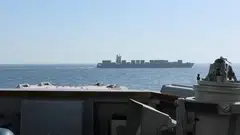
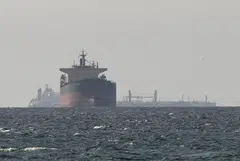
Iran warned over the weekend that ships approaching the waterway “under any pretext” would be treated as violating the ceasefire, with its Revolutionary Guard Corps firing on commercial vessels and leaving tanker operators waiting on Teheran.
The moves hardened an impasse that had appeared to ease on Friday (Apr 17), when signals of a thaw fuelled a broad rally in risk assets. Iran’s semi-official Tasnim news agency said that the Islamic Republic would skip a second round of US-Iran talks in Islamabad this week while the American naval blockade remained in place, with messages still moving through intermediaries.
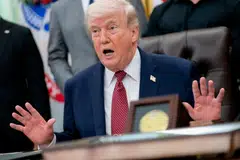
US President Donald Trump, who on Friday said that a deal was all but agreed, threatened by Sunday morning to destroy every power plant and bridge in Iran if negotiations fail. The whiplash underscores how much of last week’s rally was built on hope rather than resolution.
The S&P 500 notched a third straight week of gains above 3 per cent and is set for its biggest monthly advance since 2020. The US dollar on Friday briefly erased all of its war-era gains. Brent crude plunged, while US bonds rallied. Trading resumes in earnest for US stocks, Treasuries and oil at 6 pm New York time on Sunday.
“It appears that investors may have celebrated too early,” said Martin Hennecke, head of Asia and Middle East investment advisory at St James’s Place, adding that the weekend’s developments “could lead to some of the recent market gains to be retraced in the short term”.
In early Asian trading on Monday, the US dollar was indicated higher against major peers, while the Aussie led losses among risk-sensitive currencies.
Inflation risks remain high, and will not easily dissipate even if the shaky US-Iran ceasefire extends beyond its on Tuesday deadline. Businesses are already passing higher input costs through to customers, Hennecke noted, citing the latest S&P Global US Flash PMI, a dynamic that erodes cash and fixed-income holdings and argues for staying invested in equities through the volatility.
The Strait of Hormuz has been effectively shut for most of the seven-week conflict, crude remains materially above pre-war levels, and central banks have already been forced to rethink rate cuts, damage that will not reverse even if a deal gets signed.
SEE ALSO

“Even though the US stock market has pushed to a new record high, the risks are growing in the marketplace every time there is a setback in the negotiations to reopen the Strait of Hormuz,” said Matt Maley, chief market strategist at Miller Tabak + Co. “We are reaching the time when it’s not just higher prices that will create headwinds, it’s the shortages that are developing as well.”
Ship seized
Vice-President JD Vance, special envoy Steve Witkoff and Jared Kushner are scheduled to arrive in Islamabad on Monday night for talks the Trump administration says will continue on the terms Vance presented last week. The US naval blockade is allowing ships carrying non-Iranian cargo to depart the Persian Gulf but not any ships that left Iranian ports – a distinction Teheran has cited in hardening its stance.
On Sunday, Trump posted on Truth Social that a US Navy ship stopped an Iranian-flagged cargo ship in its tracks “by blowing a hole in the engine room” and US marines have custody of the ship.
“Our contention all along is that we need to actually see transit through the Strait of Hormuz,” said Sarah Hunt, chief market strategist at Alpine Woods Capital Investors. “Until and unless that happens, I think markets will stay volatile, although we did seem to get a bit closer to resolution of some sort last week, so if there is an expectation that talks will resume, I think last week’s market action showed some positive backdrop.”
Hunt said investors might be willing to look past the energy shock if earnings and spending hold up, especially in the US.
Long-term impact
The bond market never fully bought the peace trade. Two-year Treasury yields have climbed since the war began, as traders pared bets on US Federal Reserve rate cuts this year.
Oil is where the gap between market pricing and physical reality has been widest. The market plunge on Friday priced in normalisation, but shipping routes remain disrupted, tanker rates are elevated and inventories depleted, conditions analysts say will take weeks to work through. About a fifth of the world’s oil and liquefied natural gas moved through Hormuz before the war.
Bank of America’s cross-market risk gauge was headed for its second-fastest monthly drop on record, behind only the early-pandemic recovery. Commodity trading advisers who had been positioned short equities were forced to flip long and chase. Part of the rush, strategists said, was fear of being left behind – a reflex hardened last year, when traders who faded Trump’s tariff threats got punished by the snap-back.
With the weekend’s developments showing how the war is still in flux, the market’s “risk-on run” will be challenged, said Elias Haddad, global head of markets strategy at Brown Brothers Harriman. Still, he said his firm is sticking to the view that while the energy shock may not be over, the worst is probably over.
“The US ‘Open-for-All-or-Closed-to-All’ approach to navigation for vessels transiting the Strait of Hormuz is more likely to accelerate a reopening of that crucial waterway because shared economic pain raises the incentives for all parties to reach a workable diplomatic off-ramp,” Haddad said. “As such, end-March likely marked the bottom in risk sentiment and central bank rate expectations have room to partially revert towards pre-war levels.” BLOOMBERG
Decoding Asia newsletter: your guide to navigating Asia in a new global order. Sign up here to get Decoding Asia newsletter. Delivered to your inbox. Free.
Share with us your feedback on BT's products and services