

China’s brewing soft power in the US smells like coffee
In New York and Los Angeles, Gen Z is flocking to Mixue, Luckin and Heytea. Will the rest of America follow?
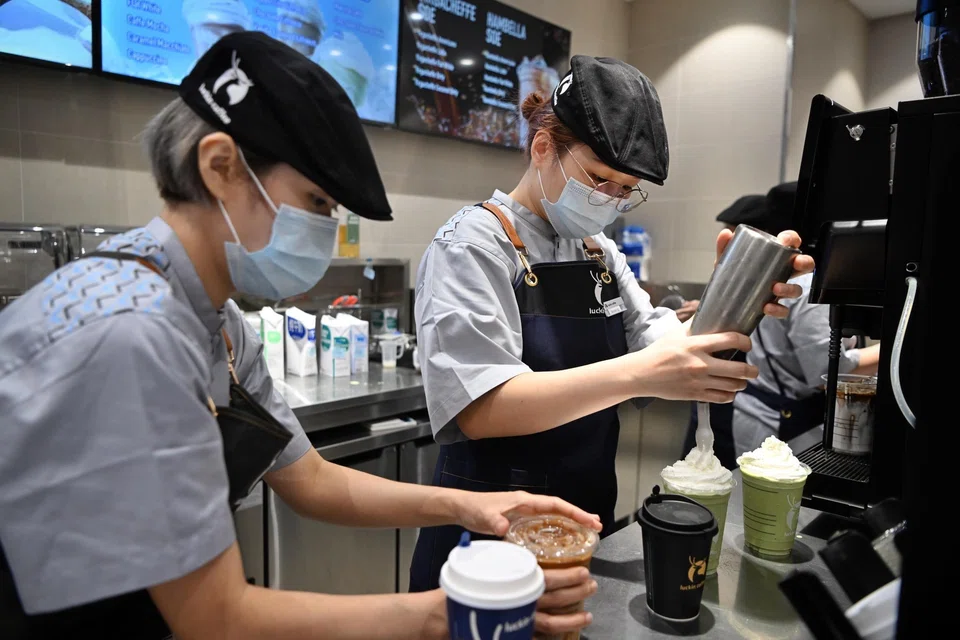
IN MAY 2025, there were exactly zero Luckin Coffee stores in the US. The Chinese chain opened its first New York City storefront the following month and now counts more than 20 locations across Manhattan.
Cotti Coffee, which first dipped its toes in the US market in 2024 with a Honolulu outpost, today has more than two dozen stateside locations, many within New York City’s five boroughs.
And it’s not just coffee: Tea-centric Chinese chains such as Chagee, Heytea and Mixue are also popping up in US cities at a frenetic pace, giving consumers the Instagram-ready drinks they crave, at prices they can live with, all ordered and quickly retrieved through app-based transactions in a way many home-grown American competitors haven’t yet mastered.
While New Yorkers might be taken aback by what feels like an overnight invasion of Chinese beverage chains, China watchers are anything but.
Over the past five years, China’s premium-drinks companies exploded in their home market. In 2021, only four out of 10 of the biggest restaurant chains in the country by location count were Chinese-owned, but today nine out of 10 are, according to market research firm Technomic.
The companies learned a lot about customer service, viral social media moments and consumer whims catering to the country’s 1.4 billion people, and when their own cities got saturated, the chains naturally turned their attention abroad.

Many have set up shop in Singapore, Thailand and other Asian countries. Globally, Mixue has surpassed McDonald’s as the biggest restaurant chain by number of locations.
Arriving in the US was a natural next step. That it happened at the same time the “Chinamaxxing” trend was taking over social media feeds seems to have been a happy coincidence for the chains and their US consumers.
Older generations might associate Chinese culture with the cheap imported goods of the 1990s or Americanised food that hardly reflects the nation’s diverse regional cuisine, but on social media, Gen Zers across the US have taken to TikTok to declare themselves to be in “a very Chinese time” in their lives.



That might mean donning house slippers, wearing Chinese-inspired fashion or trading their iced coffee for hot tea. And, if they live in a major coastal city, stopping by one of the country’s ubiquitous beverage chains that seem to have magically appeared overnight.
“These chains are riding a soft power wave they didn’t create and aren’t paying for,” said Shaoyu Yuan, an assistant professor of global affairs at New York University.
The chains have in part differentiated themselves from established brands with their tech-as-default approach, unlike Starbucks, where counter ordering via a human is the standard and phones are a “tech-based alternative”, said Aaron Jourden, senior director of international research and insights at Technomic.
At the Chinese chains, there might not even be a human taking orders at all. Instead, shoppers can order a drink in advance on the companies’ various apps, often with a coupon pushed straight to their phone, find the beverage ready and waiting when they arrive, and quickly get on with their day without even having to speak to another person. (For app-less customers, there’s a kiosk screen for ordering.)
A taste for something new
Innovative flavours are also an appeal.
By now, boba teas are old news, so these chains are introducing a seemingly endless array of options: the Pink Sunrise Refresher (a vibrant coconut-mango drink with a bubble-gum-pink strawberry cold foam) at Luckin, for instance, or Heytea’s oolong tea topped with its signature “cheese cloud” (made of cream cheese, not gorgonzola), and often at prices that appeal to cash-strapped diners who still feel okay treating themselves to permissible small indulgences.
Mixue sells a soft-serve ice cream cone, priced in New York at US$1.19 for plain, or US$0.50 more for the matcha flavour.
An orange juice Americano at Cotti may be too bitter for some American palates, but at US$3.26 with tax, thanks to a grand opening special, it’s hard to feel much regret. The layered orange and dark brown colours are perfect for Instagram either way. (Sign up for the app, and a customer can initially get it for US$0.99.)
Merch, from limited-edition stuffies to World Cup-themed magnets, lures customers in too.
Cotti’s collectable pins caught the attention of Toni Davis, a construction worker in New York and self-proclaimed “Starbucks head”. While grabbing a pin, she decided she might as well try a drink. She got the grapefruit and white jasmine tea with a little strawberry syrup added in.
“I love to try something new,” she said, adding that she plans to try another flavour next time she’s in the neighbourhood. “If they have a peach one, I’m definitely coming in here, because I’m a peach head too.”
Turning of the tides
After decades of America exporting its culture to China, the momentum seems to be going in the other direction.
While the companies’ US sales generate a small fraction of their total revenue – Technomic estimates Luckin did US$5.1 million in the US in 2025, out of global revenue of about US$7 billion – they also have plenty of room to grow.
The chains have largely focused on areas where they’ll find excited, willing customers, such as New York and Los Angeles, where local populations of Chinese expats and young, novelty-seeking Americans converge.
That leaves most of the country wide open. Only 23 per cent of Americans age 13 to 74 have visited any tea or coffee chain originally from mainland China or Taiwan, including boba spots, according to research conducted for Bloomberg Businessweek in August by consumer insights firm Langston.
Unsurprisingly, Gen Z, driven by social media, is the largest customer base – but even among them, only 38 per cent said they’ve tried any of them.
In response to questions from Bloomberg Businessweek, spokespeople from Chagee, Cotti, Heytea, Luckin and Mixue – some of the biggest-name Chinese competitors growing in the US – gave largely open-ended but optimistic responses about their US expansion plans.
“We’ll scale as the market validates our model,” a Luckin spokesperson said.
A spokesperson for Heytea, describing the US one of its “most important overseas markets”, said the company is investing in local sourcing and supply chain infrastructure. (In mid-October, it opened a location in New York’s Union Square with a “Gelato Lab”.)
Chagee’s spokesperson said it sees the US as an “important part” of its “vision” to reach 100 countries; it’s currently in nine, including China.
Cotti said it wants to go beyond New York and Los Angeles, with plans to use low prices “to break into the local market”.
And Mixue said its US presence, with 10 stores in New York and California, is “still in the early stages”.
Competing on price
Of course, nothing is guaranteed, cautioned Sandy Lim, S&P Global Ratings’ lead analyst for China retail. She noted that Mixue had to curtail its aggressive expansion plans in Japan after finding the country’s high labour and rental costs wouldn’t work with the chain’s cheap prices.
Other chains have faced similar constraints. With high labour costs and still-elevated inflation in the US, what’s to prevent the same problem from cropping up here? “At this stage, these chains have a lot to prove,” Lim said.
Still, US companies would do well to pay attention – an interesting turn, considering the Chinese chains learned in the first place by modelling Starbucks, said Stanley Rosen, a professor of political science and international relations with a speciality in Chinese society at the University of Southern California.
Starbucks sold its version of luxury to the Chinese people, including a constant stream of new products, drink customisation, mobile ordering and the idea that having multiple shops all over a single city meant consistency, dependability and convenience, not redundancy.
But now, Prof Rosen said, “the Chinese brands have gone beyond Starbucks”. Their ordering is faster, their drinks are more innovative, and, crucially for Americans on a budget, their prices are usually lower.
At a Starbucks location in New York’s Penn Station, the seasonal favourite pumpkin spice latte in a 16-ounce cup goes for US$7.45; the newly opened Luckin half a block away offers a pumpkin pie latte for the same price, but a new user on the app can snag it for US$1.99.
Asked about the pack of new rivals, a spokesperson for Starbucks emphasised the “daily ritual rooted in human connection” that its stores offer, as well as its deep relationships with customers.
Indeed, many of the Chinese chains are not designed to be a “third place” for people to hang out; some don’t even have seating. But even as Starbucks makes strides in improving its own app-ordering experience, it may be too late for some would-be customers who’ve found another option more suitable to their busy lives.
On a recent morning, Andre Brown, a banker in Midtown Manhattan, exits a Luckin holding his caramelised coffee.
He said he likes the convenience of the app, the low prices, the variety, the speed and the taste. “I used to go to Starbucks all the time.” BLOOMBERG
Decoding Asia newsletter: your guide to navigating Asia in a new global order. Sign up here to get Decoding Asia newsletter. Delivered to your inbox. Free.
Share with us your feedback on BT's products and services
TRENDING NOW

Demand, tech capabilities position Apac and AI as Skyscanner’s next growth frontiers: CEO Bryan Batista

As Indonesia picks new vice-president to succeed Gibran, investors see risks and opportunities

Higher rates, weaker spending: Is the Philippines entering stagflation?

Malaysia’s BN and ally PN declare victory in Melaka state polls in a blow to PM Anwar

