



Small nuclear reactors could boost the Asean Power Grid: GE Vernova executive
Eric Gray sees Singapore, the Philippines as promising markets for deployment of these cutting-edge reactors


[SINGAPORE] Nuclear power with small modular reactors (SMRs) could be a “huge strategic advantage” for South-east Asia – especially if it can be incorporated into the Asean Power Grid (APG), Eric Gray, CEO of GE Vernova’s power segment, said on Monday (Oct 26).
Calling nuclear power an “amazing opportunity” for the APG, he told The Business Times: “Having SMR deployments at places around that grid just adds a tremendous backbone of carbon-free power that the entire region could take advantage of.”
His comments come as General Electric spin-off GE Vernova is eyeing South-east Asia as a potential market for the SMR, dubbed the BWRX-300, that the gas turbine manufacturing giant is building in a joint venture with Japan’s Hitachi.
In March, GE Vernova and Hitachi inked an agreement to identify commercial opportunities in South-east Asia to deploy the SMR – an advanced class of nuclear reactor – that is being developed by the GE Vernova Hitachi Nuclear Energy joint venture. The partners are also looking at incorporating Japanese players into the SMR supply chain.
Asked which South-east Asian markets have the greatest opportunity to deploy the BWRX-300, Gray pointed to Singapore and the Philippines for their strong regulatory support.
Both countries agreed on Monday to explore opportunities for collaboration on nuclear energy capability building. Gray highlighted the agreement, which was made at the Singapore International Energy Week (SIEW), as an encouraging development.

“Natural way” to step into nuclear
The energy security offered by nuclear power “brings investment in – that’s where manufacturing plants will get built; that’s where jobs ultimately get created”, said Gray.
That’s as he noted strong manufacturing capabilities in Singapore, which already houses a centre of excellence for repairs on GE Vernova’s high-efficiency gas turbines in the region.
“The amount of automation that they’ve put into the factory here… is fully deployable to other technologies,” he said.
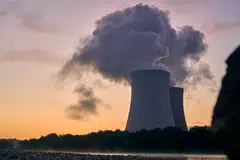

Even though South-east Asia has thus far not operated any commercial nuclear plants, Gray reckons that the modular nature of SMRs makes them a “natural way” for the region to venture into nuclear power.
SMR components can be manufactured in factories – which means “you get a lot more repeatability (and) you’re not reliant on the quality and expertise of the labour that you have in any one region”, he said.
Unlike traditional nuclear power plants that require huge spaces and technical complexity, SMRs can be as compact as a football field and require a smaller exclusion zone.
Gray’s comments come as excitement over SMRs as a clean energy solution builds up globally, even though the technology is still in its infancy.
Only Russia and China have operational SMRs for now.
Still, Gray is hopeful for a breakthrough from other quarters, since Canada’s Ontario Power Generation last year began construction on the first of four planned BWRX-300 units in the country’s eastern province.
The aim is to complete construction by the end of the decade, and to start commercial operation in the early 2030s – which would make this the first commercial SMR deployment in North America.
Gas turbine demand still strong
Separately, Gray noted that demand in GE Vernova’s gas turbine business remains strong, despite gas market volatility amid conflict in the Middle East.
Speaking to the global shortage of gas turbines – which now have delivery lead times of as long as five years, according to a Wood Mackenzie report – Gray said: “We’re ramping (up) supply, but the world is also demanding more from us.”
The shortage has cast some doubt on the fruition of gas power projects, with Wood Mackenzie projecting that South-east Asia may deliver less than one-third of its planned gas-fired power capacity by 2030, given infrastructure bottlenecks and fuel cost volatility.
Gray declined to comment directly on the Wood Mackenzie report, but he said there has been no slowdown in GE Vernova’s ongoing projects.
He noted that GE Vernova expects to reach 20 gigawatts (GW) of annual gas turbine output by the end of the year, rising to 24 GW by 2028 and 30 GW by 2030.
And even as the energy supply crisis caused by tensions between the United States and Iran prompts a global rethink of reliance on gas, Gray expects that the fossil fuel will remain a core component of countries’ energy mix and grow alongside renewables.
Still, as he noted at a SIEW panel earlier in the day: “Gas is definitely a conversation for today, but when you start thinking about a decade and beyond, that’s really where nuclear comes in.”
Decoding Asia newsletter: your guide to navigating Asia in a new global order. Sign up here to get Decoding Asia newsletter. Delivered to your inbox. Free.
Copyright SPH Media. All rights reserved.
TRENDING NOW

Government to bring forward raising of retirement age, give employers more financial support to create flexi-load jobs
Former minister Maliki Osman, Revolut chairman join Asia Gulf Holdings advisory board

Is Manila Asia’s new dining hot spot?
Simba at risk of losing operating licence over spectrum misuse

