

Ex-MAS chief Ravi Menon: Banks, wealth managers must curb AI agents’ autonomy over clients’ money as risks grow
Separately, Minister of State Alvin Tan says Singapore wants guardrails in finance, but must be risk-proportionate

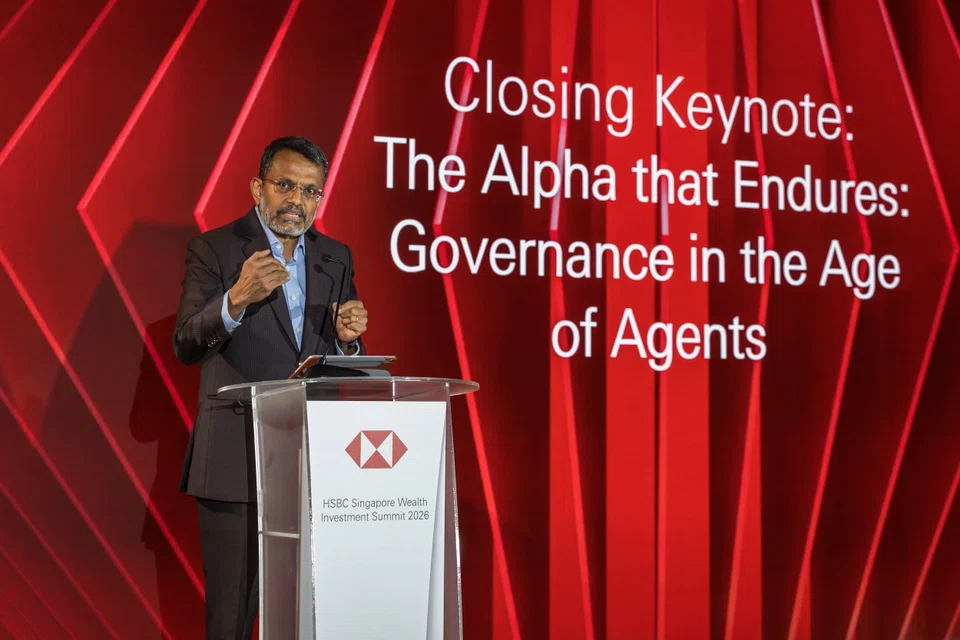
[SINGAPORE] Banks and wealth managers must set strict limits on the autonomy of artificial intelligence agents in managing clients’ money, even as the technology promises to transform wealth management, said Singapore’s former central bank chief Ravi Menon.
AI agents could bring significant gains to investors, but their ability to make decisions and execute transactions independently and quickly introduces new risks that existing financial safeguards may not be able to contain, he added.
Menon, who is chairman of the Global Finance & Technology Network (GFTN), said at HSBC’s Singapore Wealth Investment Summit 2026 on Tuesday (Nov 17): “When a family office appoints an external discretionary manager, it does not approve every trade.
“Why would we grant an AI agent looser boundaries than a seasoned portfolio manager?”
His comments came amid rising security concerns surrounding the use of third-party AI agents for personal banking needs.
Menon noted five pillars for good governance of agentic AI, which come together to spell “ALPHA”.

Alignment: The first, alignment, requires users to encode the purpose of a command, and not just the objective or target metric, to ensure that it operates within intended means.
Limits: Creating limits involves restricting an agent’s authority before it acts.
For example, Menon said, users should never give AI agents standing access to anything if it creates damage that it cannot undo.


Given that AI agents act under whosoever’s credentials they hold, they must be bound as tightly as any power of attorney, he added.
Prudence: The third pillar, prudence, calls for users to check and verify AI’s output and let agents earn their own autonomy.
“We would never hand a new hire full discretion over client money on their first day,” he said. “Prudence means treating an agent the same way: Autonomy is earned, step by step, on the evidence of its record.”
Humility: The fourth pillar, humility, means that users should design for failure and not run every big decision through a single model.
This also means keeping someone whose explicit job is to interrogate the machine’s assumptions, he said.
Accountability: This pillar means that while users can delegate execution to an agent, they cannot delegate ownership of the outcome, he said.
“Agents carry out instructions with remarkable speed and fidelity, but they do not always know when an instruction no longer makes sense,” Menon said.
Generating wealth from AI applications
Despite these risks, Menon said agentic AI holds “tremendous promise” to transform the modern economy. But it is important for investors to distinguish between the AI technology and the capital financing cycle behind it.
“Capital can surge far ahead of what the technology can yet deliver, and then retreat even as the technology keeps advancing,” he said.
Minister of State for National Development Alvin Tan said that Singapore’s role as a wealth hub is not just to grow wealth through trust, but also to generate wealth through innovation, and to give wealth by leaving a legacy.
“It’s not just about parking (funds) here,” he said in a separate dialogue at the event. “But it’s about how you then create and generate new opportunities.”
To generate wealth in the AI space, Singapore can focus on research and application uses, even if it is not in the realm of developing cutting-edge frontier models, he said.
Tan, who is also minister of state for foreign affairs a board member of the Monetary Authority of Singapore (MAS), noted several areas of AI research and applications that the Republic is focused on.
Firstly, to improve connectivity, Singapore is expanding its airport with a new terminal and building a megaport in Tuas, which will be one of the world’s almost fully automated ports.
In advanced manufacturing, Singapore is driving developments in precision engineering and semiconductors.
“We are not at the frontier models, nor at the highest end chips in the world, but Singapore accounts for one out of five of semiconductor equipment manufacturing in the world, and one out of 10 of semiconductor chips manufacturing in the world,” he said.
Singapore is focused on healthcare as well, given its ageing population. It can join the dots across different healthcare data and use AI in the application of, for example, radiology and for diagnosing of ailments, Tan noted.
Singapore is also making use of AI, robotics and automation in its built environment, which includes public housing and private housing projects.
The final AI application he cited was in financial services, where it has a strong partnership with private players. For example, he noted that the government has worked with banks in Singapore to develop a framework for agentic AI in financial services.
Regardless, Singapore’s ability to attract wealth is underpinned by trust in the jurisdiction, which now has S$7 trillion in assets under management.
Following the S$3 billion money laundering scandal in Singapore that made the news in 2023, Tan noted that it now takes longer to open a private bank account.
The government has to apply the relevant safeguards to wealth and account openings, and at the same time manage those funds flows, he said.
“We want to maintain Singapore as a very strong, trusted regulatory hub,” he added. “At the same time, we also must be risk proportionate.”
Decoding Asia newsletter: your guide to navigating Asia in a new global order. Sign up here to get Decoding Asia newsletter. Delivered to your inbox. Free.
Copyright SPH Media. All rights reserved.
TRENDING NOW
CapitaLand, Far East, Sing Holdings team up for S$1.8 billion bid at S$910 psf ppr for Jurong Lake District site
‘If there’s a price to be paid, so be it’: George Yeo says Singapore must safeguard its reputation

Demand, tech capabilities position Apac and AI as Skyscanner’s next growth frontiers: CEO Bryan Batista

US agents, Singapore officials conducted Megaspeed check in June 2025; Alice Huang interviewed: US agencies

