

Keppel to link Indonesia solar project with Jurong Island power plant, eyes data centre customers
The company is also looking into importing biomethane derived from palm oil waste or other sources

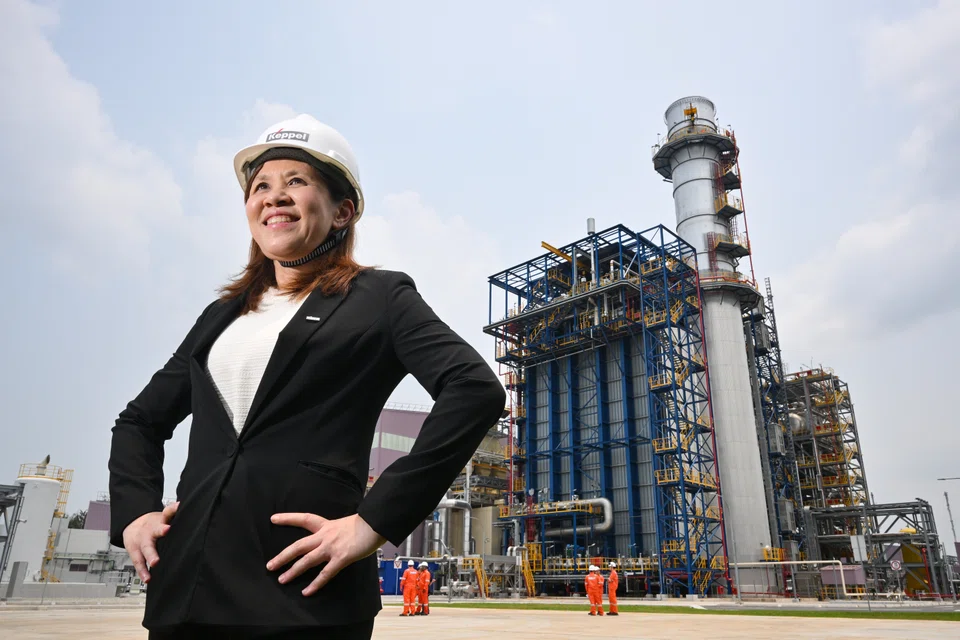
[SINGAPORE] Singapore asset manager Keppel plans to connect its Indonesian solar power project to the Keppel Merlimau Cogen (KMC) power plant – located next to the upcoming data centre park on Jurong Island.
The KMC plant will be linked to 2 gigawatts (GW) of solar power plants in the Riau Islands via a subsea transmission cable landing on Jurong Island, said Janice Bong, managing director for power and renewables at Keppel’s infrastructure division.
Keppel and one of its private funds are developing the Indonesian solar project – which integrates utility-scale battery energy storage systems – as well as the subsea cable.
The company had previously received a conditional licence from Singapore’s Energy Market Authority (EMA) to import 300 megawatts (MW) of low-carbon electricity from Indonesia.
Data centres could offtake green electricity from the project, given KMC’s proximity to the data centre park, Bong told reporters on Friday (Sep 18) during a media tour of the company’s Jurong Island facilities.
Singapore recently awarded 200 MW of new data centre capacity to four operators – including Keppel, which plans to invest over S$1 billion in an artificial intelligence-ready data centre on Jurong Island.
'%3e%3cpath%20d='M12.1475%2025.5262C13.7713%2025.4295%2014.94%2023.913%2014.94%2021.8832C14.94%2019.5359%2013.474%2018.093%2011.5917%2018.093C11.3745%2018.093%2010.9582%2018.093%2010.8393%2018.1413V25.2086L11.8891%2025.5745C11.8891%2025.5745%2012.207%2025.5262%2012.1475%2025.5262ZM11.4934%2017.6281C13.2567%2017.6281%2014.3843%2016.4292%2014.3843%2014.4501C14.3843%2012.372%2013.275%2011.2973%2011.4339%2011.2973H10.8393V17.6305H11.4934V17.6281ZM6.66078%2025.6482L7.39265%2025.5492C8.02617%2025.4502%208.26403%2025.3053%208.26403%2025.1097V11.6149C8.26403%2011.4193%208.1451%2011.3709%207.23484%2011.249L6.68137%2011.173L6.6219%2010.7588H11.9508C15.7153%2010.7588%2017.0624%2012.0797%2017.0624%2014.1578C17.0624%2015.9666%2015.7748%2017.1909%2013.4969%2017.6305V17.7041C16.111%2017.948%2017.6571%2019.5382%2017.6571%2021.7636C17.6571%2024.3318%2015.8937%2026.0417%2012.1109%2026.0417H6.60132L6.66078%2025.6482Z'%20fill='%232B2B2B'/%3e%3cpath%20d='M20.6287%2025.6505L21.5596%2025.5515C22.1725%2025.4779%2022.4104%2025.3076%2022.4104%2025.112V11.249H21.9346C20.073%2011.3479%2018.982%2013.0095%2018.408%2014.6227L18.1907%2015.5018H17.6555L18.1701%2010.7588H29.3837L29.6421%2015.4787H29.1664L28.9491%2014.6227C28.3728%2012.8645%2027.3047%2011.2743%2025.5002%2011.249H24.9856V25.1856C24.9856%2025.3812%2025.1251%2025.4548%2025.9965%2025.5515L26.7695%2025.6505L26.829%2026.0417H20.5693L20.6287%2025.6505Z'%20fill='%232B2B2B'/%3e%3c/g%3e%3cdefs%3e%3cclipPath%20id='clip0_5242_21648'%3e%3crect%20width='24'%20height='16.8'%20fill='white'%20transform='translate(6%2010)'/%3e%3c/clipPath%3e%3c/defs%3e%3c/svg%3e)
Connecting KMC to the Indonesian solar project lets Keppel tap “existing power infrastructure that we have on Jurong Island to be able to harness additional value for customers”, said Bong.
The plan is subject to “detailed development and regulatory approvals”, Keppel said in a factsheet.
Biomethane and hydrogen potential
Beyond power imports, Keppel is also focused on procuring biomethane, a renewable fuel that can be used interchangeably with natural gas in power plants. It is derived from biogas, which is in turn produced from organic matter such as agricultural waste.
Keppel has identified biomethane derived from palm oil mill effluent (POME), as well as from other sources, that could be brought into Singapore, said Bong.
POME can be sourced from Malaysia and Indonesia, given these countries’ large palm oil industries.
Singapore’s Economic Development Board last year announced a biomethane sandbox to catalyse supply chain development and facilitate adoption by key industry players. Bong said that Keppel has participated in the sandbox.
Biomethane is among the options for the new data centres on Jurong Island to meet Singapore’s requirement that they must be at least 50 per cent powered by “eligible green energy pathways”.
Separately, Keppel is also looking at the EMA’s latest call for the private sector to build new hydrogen-ready gas plant units, Bong said.
Keppel was an early entrant in this space. Its Keppel Sakra Cogen plant on Jurong Island is Singapore’s first combined-cycle power plant that is compatible with hydrogen.
The 600-MW plant, which began operations in May, can co-combust up to 30 per cent hydrogen with natural gas at the outset.
However, the Sakra facility has not started using hydrogen. The fuel remains expensive for power plant operators with an underdeveloped supply chain globally, especially for “green hydrogen” produced using renewable energy.
Asked when Singapore could tap hydrogen, Bong said that it “really depends on whether there’s economies of scale to actually bring down the cost”.
Push for Asean Power Grid
Keppel’s efforts feed into Singapore’s broader drive to diversify and decarbonise its energy sources.
On the power import front, the Republic aims to bring in about 6 GW of low-carbon electricity by 2035.
Keppel is one of six players granted a conditional licence by EMA to collectively import 3 GW of clean power from Indonesia.
However, these projects may face regulatory uncertainty, as Indonesia requires clean energy exporters to renew permits every five years. The frequent renewal time frame has been flagged as a concern for potential investors and offtakers.
Separately, EMA has granted another seven players conditional approval – the step before obtaining a conditional licence – to bring in 6.25 GW of clean power. This includes Keppel’s proposed 1 GW power import from Cambodia.
These projects could contribute to the broader development of the Asean Power Grid (APG), the decades-old vision to link up the region’s power systems for clean electricity trade.
Keppel is also involved in an earlier project transmitting green power from Laos to Singapore, via Thailand and Malaysia, that has renewed interest in the APG.
Bong noted that in the wake of the Middle East war, the APG could provide “more resilience to external shocks”.
Decoding Asia newsletter: your guide to navigating Asia in a new global order. Sign up here to get Decoding Asia newsletter. Delivered to your inbox. Free.
Copyright SPH Media. All rights reserved.
TRENDING NOW

DBS, OCBC, UOB rout lops billions off STI as inflation, rate concerns spook investors

Grab CEO’s wife Chloe Tong on life with Anthony Tan and finding her purpose

OCBC sheds S$8 billion in value as shares close nearly 6% down; analysts cautious on banks

Deal between tycoon friends sparks scrutiny of Philippine power sector

