

Seatrium more than doubles H1 net profit, sees Iran war driving demand for floating LNG solutions
The company – which sees Africa and Apac among its growth markets – will launch a new share buyback programme


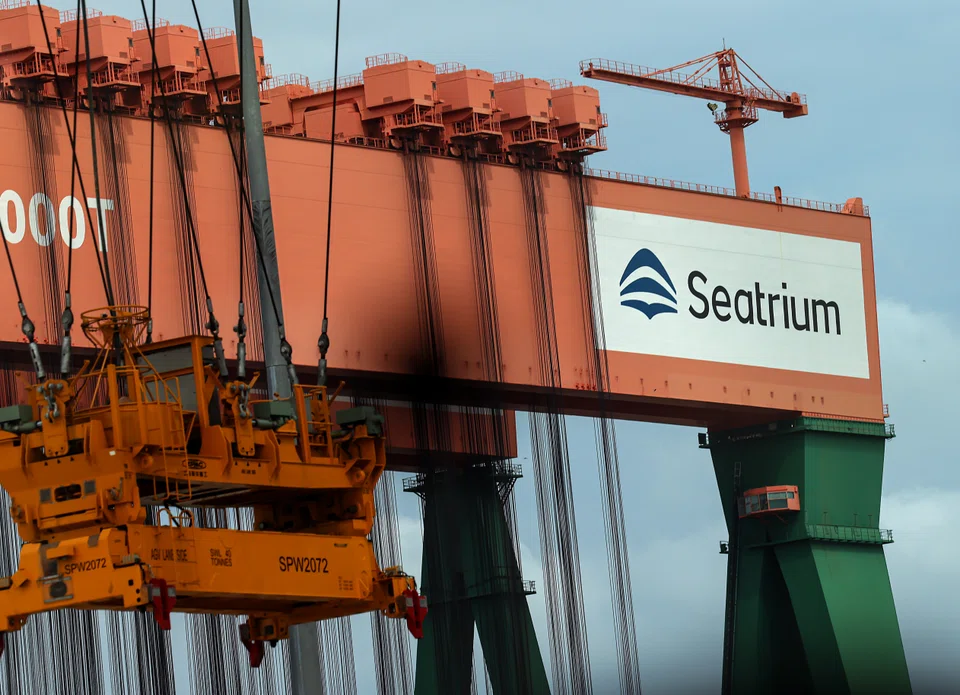
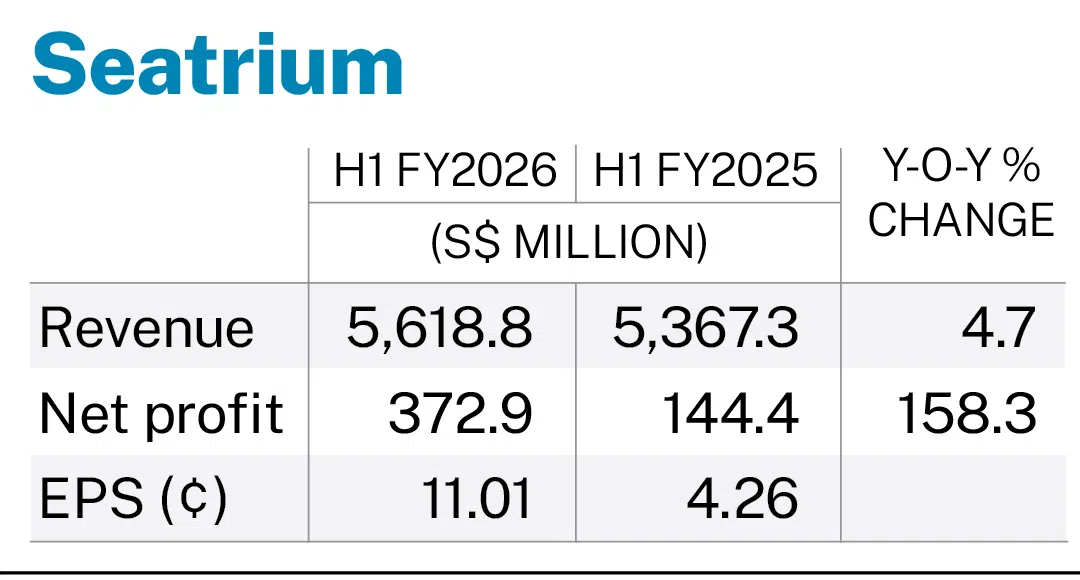
[SINGAPORE] Offshore and marine player Seatrium’s net profit surged 158.3 per cent to S$372.9 million for the first half ended Jun 30, boosted by a S$172 million gain from the sale of non-core assets.
Excluding the one-off divestment gain, its H1 net profit rose 54 per cent year on year to S$212 million, on the back of higher-margin projects and productivity improvements that lowered costs.
The company has made “strong progress” despite macroeconomic uncertainties, said CEO Chris Ong at an earnings briefing on Friday (Jul 31).
He also announced that Seatrium will launch a new share buyback programme after the completion of the ongoing S$100 million exercise.
Revenue for the half-year grew 4.7 per cent to S$5.6 billion, of which S$4.2 billion was from the oil and gas business.
The segment’s contribution rose more than 15 per cent from a year earlier, thanks to two floating production storage and offloading projects (FPSOs) for Brazil’s Petrobras, alongside two floating production units (FPUs) for oil giant BP.
“Our FPSO business is where we see the most visible near-term opportunity,” said Ong, adding that Seatrium’s yards are among the few that can deliver complex projects for contracts in the billion-dollar range.
The company is further exploring integration and module fabrication opportunities in Guyana, an up-and-coming oil producer in South America.
On the share buyback front, Ong noted that Seatrium has already repurchased S$90 million worth of shares, as a “clear signal of our confidence in the business”.
The next share buyback will “enhance shareholder value”, he said.
Floating LNG solutions
Ong also sees growing demand for offshore solutions in natural gas, namely floating liquefied natural gas platforms (FLNG) and floating storage and regasification units (FSRUs).
FLNGs are facilities that extract natural gas from undersea deposits and liquefy it. FSRUs are specialised vessels that can store liquefied natural gas (LNG) and convert it back into gaseous form for usage.
Demand comes as the Iran war has led to tighter LNG supply and strengthened the case for energy security. FLNGs allow more production, while FSRUs can deliver LNG to power systems faster and more cost-effectively than building land-based terminals.
Seatrium is pursuing S$7 billion worth of opportunities in the FLNG conversion and new-build business in Africa. It also sees S$2 billion of potential projects in the Asia-Pacific for FSRU conversions and powerships – vessels equipped with power generation facilities.
Ong highlighted that Seatrium secured an FSRU conversion contract with Turkey’s Karpowership in H1, adding that the deal is “not a one-off”.
“The pipeline for gas conversions is real; it is growing, and we intend to take the leading share of it.”
He revealed that Seatrium is looking at six to nine tenders involving FSRUs. Asked about the locations, he would only say that the opportunities are “dotted all over the world”.
Overall, the company is pursuing a global project pipeline of more than S$32 billion over the next 24 months – up from the previous estimate of S$28 billion.
The latest pipeline comprises S$21 billion from oil and gas opportunities, S$9 billion from offshore wind and S$2 billion from conversions.
“Although the market was relatively quiet in the first half, we are actively engaged across all major energy markets and expect FID momentum to accelerate in the coming quarters,” said Ong, referring to final investment decisions.
Slower offshore wind market
While oil and gas is booming, Seatrium’s offshore wind business dampened the top line, with the segment’s H1 revenue falling 21 per cent to S$0.9 billion.
Ong said that offshore wind “remains a long-cycle market”, noting that projects’ timings “have temporarily slowed”.
But he added: “The underlying demand outlook remains strong. Momentum is expected to return in 2027, supported by grid investment in Europe and an expanding project pipeline across the Asia-Pacific.”
He sees continued demand for high-voltage direct current and high-voltage alternating current systems in Europe and Taiwan.
Ong also expects that offshore wind farms will be built in deeper waters, raising demand for floating solutions. Seatrium aims to capture opportunities with its design for a floating wind semi-submersible foundation and a UK site to validate its technology.
Asked about opportunities in newer offshore wind markets – such as the Philippines – Ong said that prospects are there but the market is still “premature”.
Focus on long-term earnings resilience
Looking ahead, Seatrium expects its FY2026 net profit to be “materially higher” than FY2025, including the one-off divestment gains.
As at Jun 30, the company’s net order book stood at S$13.3 billion, comprising 24 projects with deliveries extending through to 2033.
Series-build projects accounted for more than 95 per cent of the order book, while lower-margin legacy non-FPSO projects fell to under S$140 million, or about 1 per cent of the net order book.
“We’re shifting from recovery to value creation,” Ong said. “This means growing earnings, generating cash and building resilience by scaling our series-build and adjacent services business.”
Chief financial officer Stephen Lu highlighted strong institutional demand for Seatrium’s S$400 million note issuance. This is “a clear signal of market confidence in Seatrium’s credit profile”, he said.
The company had S$1.7 billion in cash and S$2.4 billion in borrowings as at Jun 30.
Seatrium shares rose 1.4 per cent or S$0.03 to close at S$2.15 on Friday.
Decoding Asia newsletter: your guide to navigating Asia in a new global order. Sign up here to get Decoding Asia newsletter. Delivered to your inbox. Free.
Copyright SPH Media. All rights reserved.
TRENDING NOW

GCash parent Mynt rises in market debut after South-east Asia’s top 2026 IPO

In the age of AI, what is a university education for?
Singapore to use ‘every legal and regulatory lever’ against companies linked to haze: Shanmugam
‘IPOs are not the only vehicle’: KKR heads for record exits even as firms stay private for longer

