Seatrium, Petrobras eye potential natural gas collaboration to meet growing Asian demand
They are exploring new ventures just as two major oil vessels set sail for Brazil’s Buzios oil field
 Add BT as a preferred source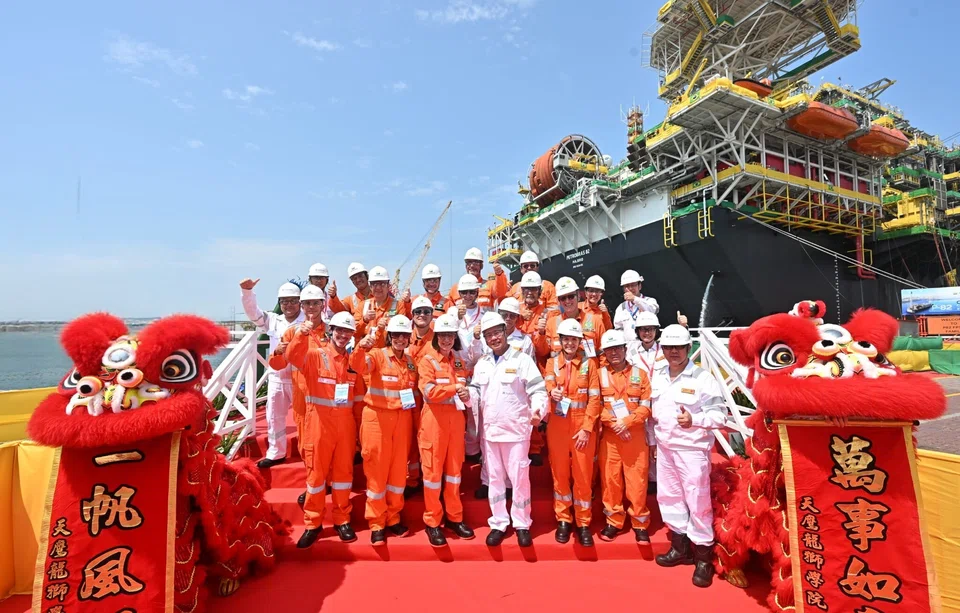
[SINGAPORE] Brazilian oil giant Petrobras and offshore and marine player Seatrium are discussing a potential tie-up to explore offshore solutions in natural gas, said Magda Chambriard and Chris Ong, the respective CEOs of Petrobras and Seatrium, on Thursday (Aug 27).
They were speaking at a media briefing following the christening ceremony for two floating production storage and offloading project (FPSO) vessels, that will soon set sail for Brazil’s deepwater Buzios oil field.
Chambriard noted that she is in discussions with Ong about how Seatrium can support Petrobras in “the challenge to liquefy gas offshore” and be part of the exportation of gas to Asia and other markets.
“We export a lot of crude oil (to the) Asia-Pacific – it is our first destination, and when we look forward, we see that maybe it will be the first destination for gas as well,” she said, noting the region’s gas demand is the fastest growing globally.
Ong added that the liquefied natural gas (LNG) market is something that Seatrium is “very focused upon”.
“We will not only (have) FPSOs… we hope to see many other assets that we are able to put our people (and) the mix of our capabilities together to enable the economics of that part of the supply chain,” he said.
During the company’s earnings briefing for the first half ended Jun 30, Ong noted growing demand for offshore solutions in natural gas. This came as the Middle East conflict led to tighter LNG supply and underscored the need for energy security.
Ong previously highlighted growing demand for floating liquefied natural gas platforms (FLNG) and floating storage and regasification units (FSRUs) in particular. FLNG units extract natural gas from undersea deposits and liquefy it, while FSRU vessels store LNG and convert it back into gaseous form for use.
During its first-half results briefing in July, Seatrium said it was pursuing S$7 billion worth of opportunities in Africa’s FLNG conversion and new-build segment.

It also identified S$2 billion of potential projects in the Asia-Pacific for FSRU conversions and powerships – vessels equipped with onboard power generation facilities.
Continued collaboration
Both companies announced on Thursday that two FPSOs, Petrobras 80 and Petrobras 82, are expected to set sail for Brazil’s Buzios oil field in September and October, respectively.
After a journey of around 70 days, they are expected to begin production in the first half of 2027. The vessels have a production scale capable of lifting Brazil’s national oil production by 10 per cent.
The FPSOs each have an oil storage capacity of around 2.5 million barrels and are each designed to produce 225,000 barrels of oil and process 12 million cubic metres of gas per day.
When operational, they are expected to add 450,000 barrels of oil per day, or an approximately 34 per cent increase to the installed production capacity to the Buzios field.
These vessels are among a broader programme of six FPSO units that Seatrium is concurrently managing for Petrobras. These will provide approximately 1.3 million barrels of oil per day in total when they come onstream. This is equivalent to roughly 30 per cent of Brazil’s average daily oil production of 4.5 million barrels of oil per day as at June 2026.
Since establishing its presence in Brazil in 1999, Seatrium has invested nearly S$2 billion in building local capabilities and supporting the country’s offshore energy industry. Meanwhile, the company recently resolved a long-standing legal issue tied to Brazil’s 2014 Operation Car Wash corruption scandal.
Following investigations by Singapore’s Corrupt Practices Investigation Bureau that began in 2023, the Singapore High Court approved a deferred prosecution agreement earlier this year. Under the settlement, Seatrium will pay US$57 million to local authorities and will not face criminal prosecution in Singapore.
Decoding Asia newsletter: your guide to navigating Asia in a new global order. Sign up here to get Decoding Asia newsletter. Delivered to your inbox. Free.
Copyright SPH Media. All rights reserved.