

Simba admits exceeding spectrum limits amid failed M1 deal; parent company Tuas’ full-year profit surges 277%
Management attributes the unauthorised usage to hardware and software issues


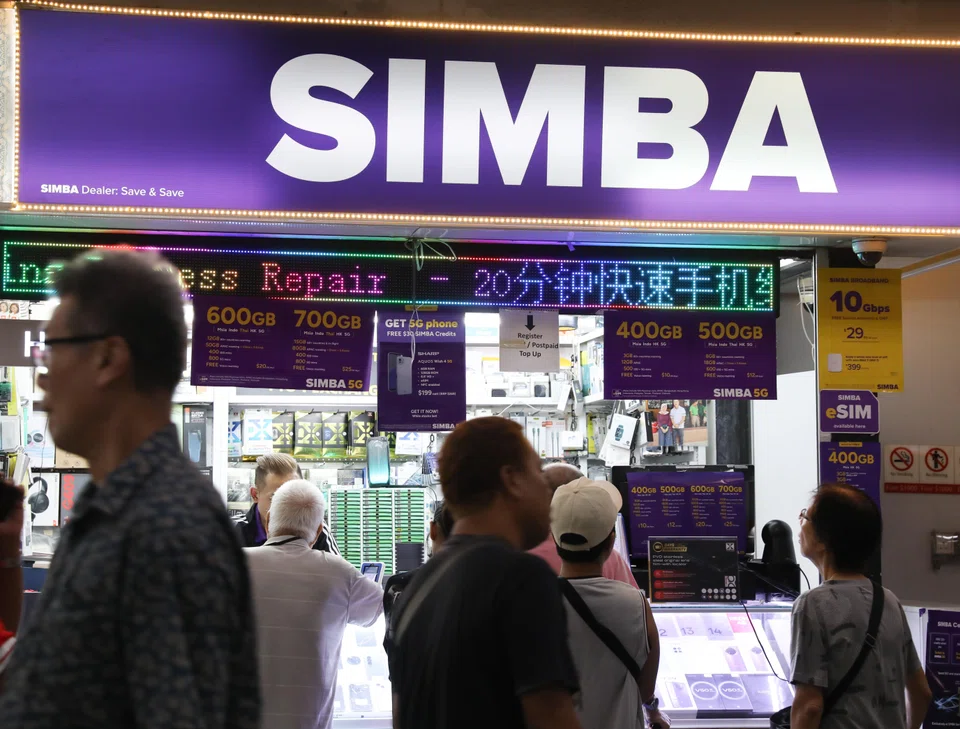
[SINGAPORE] Simba has shed more light on the unauthorised spectrum usage that contributed to the collapse of its proposed acquisition of M1, saying on Wednesday (Sep 23) that it used spectrum beyond the limits permitted by the regulator.
“There was some use of spectrum that was permitted by the IMDA (Infocomm Media Development Authority), and we then used it outside the limitations that were in that purpose,” said Tony Moffatt, company secretary of Tuas Ltd, the Australian-listed parent of Simba, in an earnings call.
Management attributed the unauthorised usage of the 2,300 megahertz spectrum – used for 4G networks – to a combination of both hardware and software issues, without giving further details.
In May, the S$1.4 billion deal between Simba and M1 fell through after IMDA said that Simba could have used radio frequency bands it was not assigned to provide mobile services, which would constitute a breach of Singapore’s Telecommunications Act.
Tuas said in its annual report that IMDA has yet to advise Simba on what consequences should follow should it find that spectrum has been misused.
Such consequences may include financial penalties, modifications to, or termination of Simba’s licences to operate in Singapore, and personal consequences for individuals found to have been involved, it added.
Moffatt noted that the company does not have further information about when IMDA will be making its decision.
“We remain fully cooperative with the IMDA regarding the unauthorised spectrum usage matter and are currently awaiting their formal decision,” wrote David Teoh, executive chairman of Tuas, in the annual report.
In a statement to The Business Times on Wednesday, an IMDA spokesperson said that the regulatory body is still investigating the matter.



The spokesperson added that the authority will take the “appropriate enforcement actions” should any issues be established.
Profit more than trebles
Despite ongoing regulatory uncertainty, Tuas saw its full-year net profit more than treble on the back of subscriber growth and a broader mix of plans catering to different customer segments.
Net profit stood at about S$26 million for the full year ended Jul 31, up 277 per cent from about S$6.9 million in the year before.
Revenue increased 24 per cent year on year to S$187.6 million, from S$151.3 million.
Earnings per share rose to S$0.0478 from S$0.0148, while underlying earnings before interest, taxes, depreciation and amortisation (Ebitda) was up 22 per cent at S$83.8 million.
Underlying Ebitda excluded “significant items of S$3.7 million” related to due diligence and professional engagements around the failed M1 acquisition from Keppel.
Tuas raised S$322 million from institutional investors through a placement and S$42.5 million through a share-purchase plan from existing shareholders to support the M1 acquisition. With the deal now off, the board said it has yet to make a decision on the use of the raised capital.
Simba’s active mobile services increased from about 1.3 million at the end of the 2025 financial year to nearly 1.5 million as at Jul 31 this year, despite an “increasingly competitive market”.
Its fibre broadband business also ended the year with 62,000 subscribers.
Gross mobile average revenue per user stood at S$9.42 and did not include interconnect revenue, which is growing with Simba’s larger subscriber base, said the company.
More growth avenues
Tuas does not believe that Simba would necessarily be excluded from future consolidation in Singapore’s telco market following the failed M1 acquisition.
“I don’t think we will be blocked from participating in consolidation should an opportunity arise,” noted Moffatt.
“But there is nothing that is happening at this stage that would lead us to a view that it is likely to happen in the near term.”
For the new financial year, Tuas said that it expects Simba to incur an additional S$15 million to S$30 million in capital and operating expenditure. This will help it meet cybersecurity requirements imposed by Singapore regulators, said management.
Teoh added that Simba is also developing “new innovative products for the Singapore market”, set to be launched in the new financial year.
Richard Tan, CEO of Simba, noted that the telco is eyeing more growth in the business and enterprise space, specifically within the enterprise broadband space.
Shares of Tuas on the Australian Securities Exchange closed 23.4 per cent or A$0.544 lower at A$1.785 on Wednesday, after the announcement.
In the year to date, shares of Tuas have fallen A$5.30 or 74.8 per cent from A$7.08.
Decoding Asia newsletter: your guide to navigating Asia in a new global order. Sign up here to get Decoding Asia newsletter. Delivered to your inbox. Free.
Copyright SPH Media. All rights reserved.
TRENDING NOW

Once staunchly pro-China, Malaysian Chinese businesses are now distancing themselves from Beijing

Looking beyond looming CEO succession, should UOB potentially pursue a transformative merger?

Could stablecoins be the future of money?

Grab CEO’s wife Chloe Tong on life with Anthony Tan and finding her purpose

