

Beyond data centre Reits: The AI potential that Singapore investors are still missing
Such trusts represent only one layer of a much larger digital infrastructure ecosystem


[SINGAPORE] When Masayuki Ozaki left buy-side investing last year to become chief financial officer of the manager of pure-play data centre real estate investment trust (Reit) NTT DC Reit, he might reasonably have expected to spend his time explaining occupancy and rental reversions.
Its six data centres in Northern California, Northern Virginia, Vienna and Singapore run at mid-to-high-90 per cent occupancy, and the latest quarterly update showed a 13.4 per cent rental reversion.
Yet units trade at a yield now closer to 8 per cent, above the 7.5 per cent pitched at its July 2025 listing – a gap some investors read as an asset-quality warning.
But Ozaki puts the gap down to unfamiliarity rather than fundamentals. Two-thirds of the portfolio sits in markets such as Sacramento and Vienna that Singapore investors do not know well.
“Our experience suggests that there is still a learning curve for investors when it comes to data centres, which work differently from traditional real estate: How would they be able to tell what makes a good data centre or a good data centre market?” Ozaki told The Business Times.
NTT DC Reit is about as legible as an artificial intelligence-adjacent investment gets here. If that’s still misunderstood, what chance does the rest of the ecosystem behind it have?
The AI play
It would be unsurprising, then, that Singapore investors looking for AI exposure may be overlooking some of the biggest beneficiaries of the AI boom.
While data centre Reits have become the default way to invest in the theme, they represent only one layer of a much larger digital infrastructure ecosystem.
For example, ask Keppel CEO Loh Chin Hua whether the market has fully appreciated the group as an AI play, and he reaches for an anecdote.
SEE ALSO



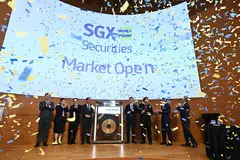

At a Keppel Next event last year – a showcase of the technologies the group works with, themed on how it both enables and embeds AI – Keppel invited some of the analysts covering the stock. One of them came up to him afterwards with a verdict: “You are the only AI player in Singapore.”
The claim sounds broad. But what the analyst was pointing to was that Singapore has no shortage of companies with AI exposure: landlords leasing space to hyperscalers, contractors building the shells, utilities selling the power. What it lacks is a company present at every layer at once.
Keppel can provide the data centre, the power that runs it, the subsea cable that connects it, and the third-party capital that funds all three through its asset management arm.
Loh’s own term for this is “an ecosystem player”: the ability, as he describes it, to bring data centres, power, connectivity and asset management into the same solution.
The economics explain why that matters. The infrastructure AI rides on is capital intensive enough that, in Loh’s words, “no company can actually put it all on its balance sheet” – which is precisely the argument for Keppel’s asset-light model.
As Loh puts it, the difference is between building one power plant off the balance sheet and building five with investors alongside.
JPMorgan’s head of Singapore property research Mervin Song makes the same case in valuation terms.
In an October 2025 initiation note, he argued that Keppel “should command a scarcity premium as Singapore’s only listed play on this theme”, spanning data centres, power and subsea cables.
Loh’s own postscript to the analyst’s remark at the Keppel Next event is the more interesting part. It is still, he said, something the market needs to appreciate. And therein lies the opportunity.
Indeed, the AI boom is not merely driving demand for chips and software. Beyond that, every large language model such as Claude and ChatGPT requires data centres, electricity, cooling systems, fibre connectivity and capital to fund.
The ecosystem nobody sees
If one company being able to span the full stack is unusual enough to earn a scarcity premium, the flip side is that everyone else holds a piece of it.
Exposure to the AI build-out is scattered across connectivity, power, cooling, real estate and engineering names – most of them never labelled AI at all.
Start with connectivity, which is perhaps the easiest to overlook because most of it sits underwater.
Singapore is already one of the world’s largest submarine cable hubs, a factor Eastspring Investments identifies as central to its appeal as a data centre location, alongside an open telecommunications market and regulatory framework that have drawn hyperscalers including Google, Meta and Amazon.
Every data centre needs somewhere to send its data, and Keppel’s clearest AI-related win this year has come from cable rather than compute.
In July, it confirmed rights agreements for all five fibre pairs on the Bifrost Cable System, the first subsea cable linking Singapore directly to the US West Coast via Indonesia.
Contract value across the five pairs, including 25 years of operations and maintenance income, comes to roughly US$1.3 billion, at an expected internal rate of return (IRR) of about 30 per cent.
Keppel has since secured an Infocomm Media Development Authority licence for a second system, Kruger, running west from Singapore to Oman, with a final investment decision targeted for end-2026.
Singtel is pursuing a similar build-out through Nxera. NetLink NBN Trust owns the last mile: The nationwide fibre network moving data between homes, offices and the data centres storing it.
All three are part of the infrastructure the AI trade depends on, but none of the three trade as AI stocks.
One level up is the business of building and operating the physical infrastructure. At its August investor day, Keppel cited over 1 gigawatt (GW) of data centre development pipeline and S$12 billion of dry powder for infrastructure and connectivity strategies.
JPMorgan’s investor day note flagged how far the earnings mix has shifted, citing guidance that “more than 70 per cent of earnings are expected to come from infrastructure solutions supporting AI”.
CapitaLand Investment runs a similar model with broader geographic reach, including a China-focused data centre fund.
Below the developer-operator layer sit names less-often associated with AI:
- Boustead, a specialist developer;
- ST Engineering, whose engineering capabilities increasingly support critical digital infrastructure;
- CSE Global, active in electrification and data centre solutions; and
- Venture Corp, whose networking equipment sits inside the computing supply chain.
The power and cooling bottleneck
If land was the constraint of the last data centre cycle, power is the constraint of this one. Loh has noted that data centre projects globally have stalled on grid or power limits rather than land.
Here, Sembcorp Industries is a fairly direct beneficiary, as rising data centre power demand feeds through to Singapore’s utility market. Delta Electronics, accessible via depositary receipt, supplies power, cooling and thermal management hardware inside the buildings.
Keppel’s own power arm plays into the same theme: Its Sakra Cogen Plant, Singapore’s first hydrogen-ready combined-cycle gas turbine, lifted group generation capacity by 45 per cent to 1.9 GW this year at an expected IRR of around 15 per cent, giving Keppel behind-the-meter capability it can plug directly into its data centre platform.
This brings the story back to where it started.
Data centre Reits remain the most visible, most liquid way into the theme.
Keppel DC Reit, Digital Core Reit and NTT DC Reit stand as the pure-plays, alongside diversified exposure through CapitaLand Ascendas Reit, Mapletree Industrial Trust and CapitaLand India Trust.
Keppel Infrastructure Trust sits adjacent, holding telco and utilities-linked infrastructure rather than data centres directly, but fits the same theme.
Local investors may rue the lack of obvious AI plays such as Anthropic and OpenAI. But Singapore’s listed ecosystem provides the infrastructure required to support these companies.
We may not operate the gold mine, but we own the picks and shovels.
What the public markets don’t show
Move beyond the listed universe, and Singapore’s role as a regional data centre hub becomes clearer – though even less visible to public market investors.
A cluster of private operators, headquartered in or heavily invested around Singapore, is being built out at a scale that dwarfs most of what trades on the Singapore Exchange.
Bridge Data Centres, backed by Bain Capital, is targeting 3 GW of capacity across Asia by 2030. Empyrion Digital, backed by Seraya Partners, raised US$828 million in equity co-investment for a footprint spanning six Asian markets, including a 200 megawatt campus in Johor.
Evolution Data Centres has taken the opposite geographic bet – the Philippines, Thailand and Vietnam – backed by a Warburg Pincus joint venture and Abu Dhabi’s Zero Two.
Together with others such as Digital Edge DC, Vantage Data Centers and Princeton Digital Group, they make up a private market larger in aggregate than the listed one.
Beneath that sits a niche few investors know: Singapore-grown data centre cooling and water specialists.
KoolLogix builds rack-level rear-door heat exchangers; Red Dot AI builds the software layer that optimises cooling, power and risk across a facility; and Hydroleap treats the massive volumes of wastewater these thirsty buildings generate.
None of the three are likely to list soon, but they all sit inside nearly every hyperscale build these platforms are putting up.
Put together, the Reit mispricing Ozaki describes looks like the smallest, most visible symptom of a larger blind spot.
The country’s AI credentials are not in question; Boston Consulting Group ranks Singapore among just five global “AI pioneers”, singling it out alongside the US for the depth of its talent pool.
Nor is the broader framing absent from the market: Eastspring points investors beyond data centre and industrial Reits to the technology champions feeding the AI value chain, while cautioning that discipline is needed to see past the hype.
But even that wider lens stops short of power, cooling, subsea cable and the private platforms building at scale around Singapore.
Add to that its strategic location between the East and West, a stable regulatory environment, a concentration of hyperscalers and its deep capital markets, and one finds that Singapore is uniquely positioned.
Yet, the AI investing narrative has largely been flattened into a single instruction: buy a data centre Reit.
The more accurate picture is a full-stack platform – cables under the sea, power behind the meter, cooling inside the racks, engineering behind the build, capital recycling behind the ownership – spread across public and private markets, most of it never labelled “AI” at all.
As Ozaki said: “The AI sector is evolving rapidly and is expected to remain a key driver of demand for digital infrastructure. As investors deepen their understanding of the data centre sector, they will be in a better position to appreciate the broader opportunities arising from AI.”
Decoding Asia newsletter: your guide to navigating Asia in a new global order. Sign up here to get Decoding Asia newsletter. Delivered to your inbox. Free.
Copyright SPH Media. All rights reserved.
TRENDING NOW

DBS, OCBC, UOB rout lops billions off STI as inflation, rate concerns spook investors

Grab CEO’s wife Chloe Tong on life with Anthony Tan and finding her purpose

OCBC sheds S$8 billion in value as shares close nearly 6% down; analysts cautious on banks

Deal between tycoon friends sparks scrutiny of Philippine power sector

