

UOB cuts 2026 margin guidance as funding costs rise; Q3 profit rebounds to S$1.25 billion
Its earnings growth is supported by record fee income driven by its wealth, cards and loan-related businesses
[SINGAPORE] UOB expects its net interest margin (NIM) to fall below guidance for 2026, as rising funding costs continue to squeeze lending profitability despite a sharp rebound in its net profit for the third quarter ended Sep 30, 2026.
Full-year NIM is now likely to come in below its earlier guidance of 1.75 to 1.8 per cent, even as net interest income in 2027 is projected to surpass this year’s levels, said Leong Yung Chee, UOB’s group chief financial officer, in the bank’s results briefing on Wednesday (Nov 4).
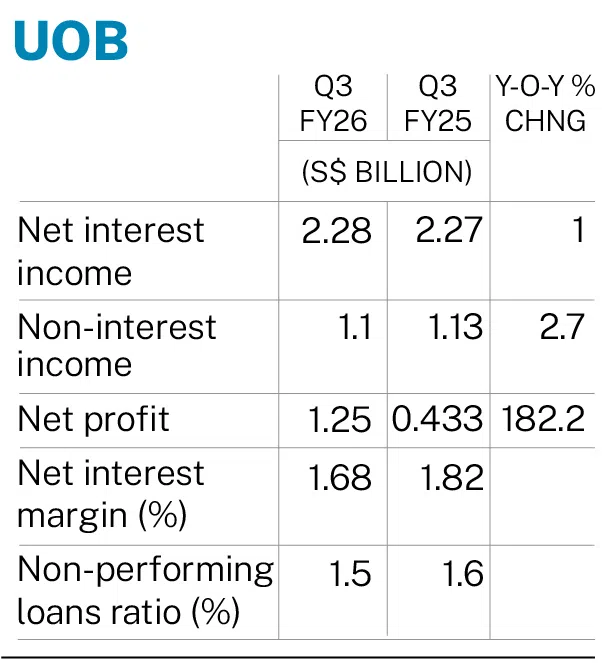
The revised outlook came as UOB posted a 182.2 per cent rise in Q3 net profit to S$1.25 billion, from S$443 million in the year-ago period.
Its results missed the S$1.38 billion consensus forecast among six analysts polled by Bloomberg.
Shares of UOB fell as much as 7 per cent during trading on Wednesday and closed 5 per cent or S$2.02 lower at S$38.44.
The increase in net profit came off a low base, after diving 72 per cent in Q3 2025, weighed down by S$1.36 billion in allowances for credit and other losses amid macroeconomic uncertainties and sector-specific headwinds.
Allowances for credit and other losses were 81 per cent lower at S$258 million in Q3 2026.
Earnings in the latest quarter were supported by record net fee income on the back of growth in the lender’s wealth, cards and loan-related businesses.
Net fee income for Q3 2026 climbed 19 per cent on the year to S$733 million, as wealth-management fees hit a record S$258 million.
Meanwhile, net interest income for the quarter grew one per cent to S$2.28 billion, from S$2.27 billion in the same period last year. This came as NIM, a key measure of lending profitability, narrowed to 1.68 per cent, from 1.82 per cent previously.
Leong said that intense competition for quality lending assets has limited banks’ ability to raise pricing, even as benchmark interest rates have started to increase.
Despite firming rates, loan yields remained under pressure while deposit costs increased, essentially “acting in different directions”, he noted.
“We’ve still got one more quarter to go, but with the pressures that we are seeing projected forward, we think (NIM) is going to be below 1.75 per cent for the full year,” he added.
Meanwhile, other non-interest income shed 29 per cent to S$370 million, due to lower trading and investment income.
Leong said that the impact of mark-to-market losses arising from a spike in bond yields was “not insignificant”, as market volatility weighed on non-customer-related income.
2027 outlook and return on equity
Looking ahead, UOB projects 2027 loan growth to come in at a mid-single-digit range, while fee income is expected to reach mid to high-single-digit growth.
Operating costs are projected to be “elevated” in 2027, Leong pointed out.
This comes as the bank continues to invest in wealth and technology, even as it works towards a return on equity of 12 to 13 per cent over the medium term.
Wee Ee Cheong, UOB’s deputy chairman and CEO, declined to specify a timeline for that target, noting that it should be achieved sustainably.
Artificial intelligence-related financing currently accounts for less than 5 per cent of UOB’s loan portfolio and consists of a mix of short and long-term facilities, Leong added.
While the sector is a “growth area”, the bank’s approach to underwriting for AI-related financing focuses on ensuring “reliable cash flow, reliable off-takers (and) a strong credit profile of the borrowers”, he explained.
On the asset-quality front, the lender’s non-performing loan (NPL) ratio stood at 1.5 per cent, compared with 1.6 per cent in the year-ago period.
Leong cited a “better-than-expected” recovery in the US market, where the NPL ratio fell from around 4 per cent in 2025 to 2 per cent currently.
However, he noted that the recovery in the bank’s portfolio for mainland China, Hong Kong and Taiwan has been slower, with the bulk of the newly classified non-performing assets in the quarter coming from the region, largely involving real estate-related exposures.
He added that the bank has “reshaped and reduced” its real-estate exposure, although the affected loans were largely existing ones on the bank’s books.
Beyond mainland China, Hong Kong and Taiwan, he noted that Asean continues to be a key growth market for the bank.
Despite MSCI’s recent proposal to reclassify Indonesia from emerging to standalone-market status, Wee said UOB holds a long-term view on the country, which accounts for less than 3 per cent of the bank’s loan and profit contributions.
“We are long-term… So it’s a question of having the commitment, and we just move. If you don’t have a long-term commitment, every day you (will) worry about volatility,” he noted.
UOB kicked off the Q3 earnings season for Singapore banks, with DBS and OCBC set to release their results on Thursday and Friday, respectively.
TRENDING NOW

US midterms: What investors can expect after Democrats shatter Republican strongholds

Dip buyers emerge for tech stocks as traders look past midterms, focus on fundamentals

Former CEO of SGX-listed GS Holdings charged over false trading

Waymo founder predicts ‘landslide’ robotaxi adoption in Singapore, driven by high car costs

