

US chip restrictions could slow AI financing, cloud Singapore banks’ loan growth outlook
Near-term impact likely ‘contained’ due to city-state lenders’ conservative approach to data centre financing

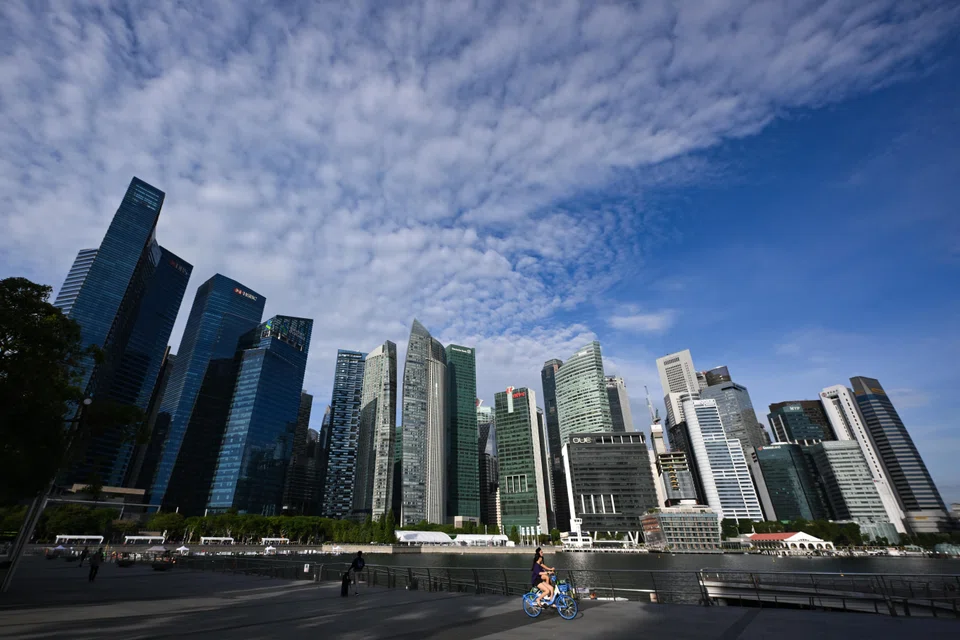
[SINGAPORE] Singapore banks’ loan growth outlook could be clouded by US export controls on advanced artificial intelligence chips, as lenders are likely to scale back the financing of data centres amid heightened uncertainty, analysts said.
While near-term impact is likely “contained” given the Singapore lenders’ conservative approach to data centre financing, greater scrutiny of China-linked exposures could result in a loss of a key growth driver going forward, the analysts noted.
“The banks are assessing how this impacts their lending pipelines, and it’s fair to expect some slowdown in underwriting as there is more scrutiny,” said Jayden Vantarakis, head of Asean equity research at Macquarie Capital. “Any slowdown in loan underwriting would drive lower loan fee income.”
This comes as investors have long been bullish on South-east Asia for powering the supply of physical AI infrastructure for frontier model training.
There will likely be some near-term moderation in financing activity as operators reassess their expansion plans and seek greater clarity on licensing requirements, said Joanna Cheah, Asean research analyst at Jefferies.
Alicia Garcia Herrero, chief economist for Asia-Pacific at Natixis Corporate & Investment Banking, noted that banks are already tightening due diligence on end users and compliance amid higher credit scrutiny on China-linked exposures.
Future underwriting will prioritise clear non-China end users, strong sponsors and documented compliance over pure capacity growth, she said.
“The controls extend beyond supply chains into financing, and will slow the boom more than derail it for well-positioned banks,” she said.
This would challenge the banks’ constructive loan-growth outlook for next year, as the lenders cited demand for data centre-related financing as a key driver prior to the latest developments, noted a CreditSights report.
It noted that a shift away from data centre financing towards trade loans and domestic mortgages could also lower margins given that these loans typically carry lower yields.
Small portion of loan book
Nevertheless, impact on the banks is likely contained and should not extend to asset quality or credit shocks, given their diversified loan books, analysts said.
The data centre exposure of Singapore banks is small, at around 3 to 5 per cent of the total loan book for DBS, OCBC and UOB, although CreditSights noted that the figure is higher than global peers’ 1 to 2 per cent.
For Maybank, data centre exposure is also “relatively small”, making up 0.6 per cent of the bank’s total gross loans outstanding as at Sep 30.
But its spokesperson said that it was too early to determine the full impact as the situation continues to evolve, and further clarity was needed on the implementation and scope of the measures.
“It does remove a possible loan growth avenue but we don’t anticipate a significant change to asset quality,” said Lorraine Tan, director of equity research (Asia) at Morningstar.
Jefferies’ Cheah added that data centre financing is not central to her earnings or returns assumptions, given the banks’ diversified loan portfolios, strong capital buffers and rising fee income.
OCBC group CEO Tan Teck Long told The Business Times in an interview on Nov 19 that the bank does not finance companies that are involved in the re-export of high-end chips, and reviews its customers to ensure that they are in line with regulations.
Its data centre financing is mainly related to hyperscaler use, with less than half a per cent of financing in AI-related training, he added.
Elaine Lam, OCBC head of global corporate banking, added that the bank will continue to focus on projects backed by strong sponsors, proven operating capabilities and clear cash flow visibility.
UOB also does not foresee material concerns for now, as the majority of its exposure is to US hyperscalers that are compliant with the new rules, said a spokesperson.
As for DBS, a spokesperson said that the bank has continued to work on data centre financing transactions and remains committed to supporting existing data centre customers, subject to applicable regulatory requirements across jurisdictions.
Citi, HSBC and Standard Chartered declined to comment.
Long-term demand intact
Analysts do not expect the restrictions to fundamentally alter the longer-term structural demand for digital infrastructure across Asean, although the composition of demand and pace of capacity additions could change.
Banks will likely increasingly differentiate financing opportunities based on the ultimate end user and intended use of computing capacity, rather than simply the domicile of the data centre operator, Jefferies’ Cheah said.
This would mean more stringent due diligence, tighter loan covenants, greater scrutiny of underlying off-take agreements and licensing requirements, and potentially higher risk premiums or lower leverage for projects with greater regulatory uncertainty, she added.
OCBC’s Tan also expects the data centre space to continue growing due to supply constraints.
“Because of the severe shortage, if someone vacates one data centre, my personal view is that someone else will take it,” he said. “If one of the hyperscaler wants a data centre somewhere in South-east Asia, and then something becomes available, it’s not a bad (deal for the hyperscaler to take over the space).”
But the CreditSights analysts warned that the US hyperscalers will unlikely relocate a substantial proportion of their Al computing infrastructure from the US to South-east Asia, due to US industrial and national-security policies and operational challenges.
However, US hyperscalers will likely continue to invest in regional cloud and Al infrastructure to serve local customers and meet data-residency requirements, the report said.
On Nov 19, the US tightened export controls on advanced AI chips to Singapore, Malaysia, Thailand and Indonesia to prevent Chinese companies from circumventing licensing requirements through data centres in these markets.
The Financial Times subsequently reported that Nvidia stopped the shipment of its servers to the four Asean nations, although Singapore Deputy Prime Minister Gan Kim Yong later commented that the government has not confirmed a shipment halt and is working with local companies to assess operational impacts.
TRENDING NOW

JPMorgan, BlackRock among those making bid to manage CPF savings

GIC in talks to lease bulk of 88,000 sq ft CapitaSky space to be vacated by Allianz

BN-PN’s Melaka election landslide puts spotlight on jobs, investments and political divides
Why Singapore, Johor and Riau Islands should build a cross-border ecosystem for AI

