



Will he or won’t he? Fed chief Warsh could spring big surprise by raising rates this week
If he chooses to stay put, he is likely to warn markets of a hike at next meeting in September
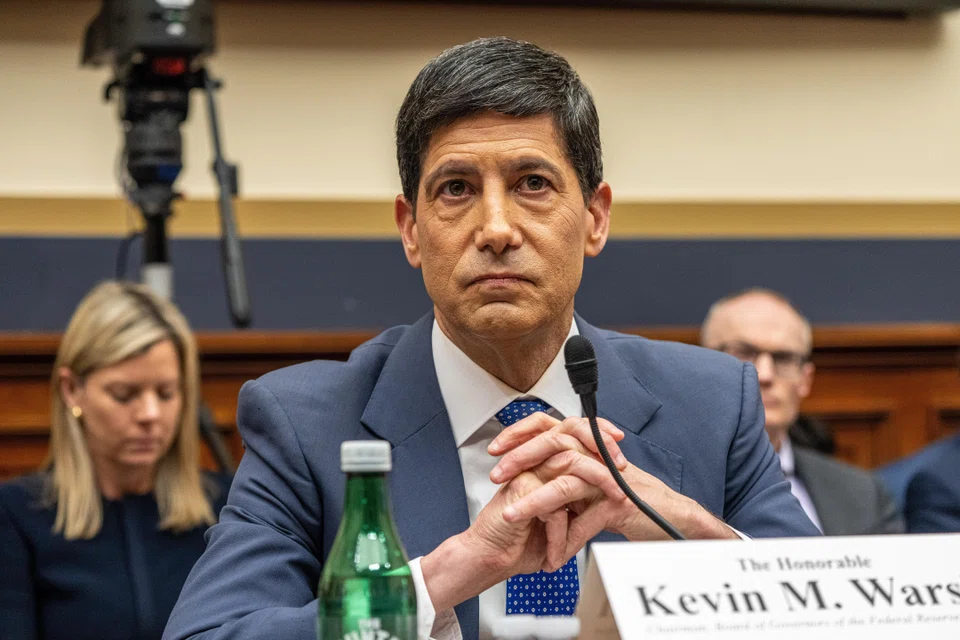
MANY analysts and economists do not expect it to happen this week, but there are some signs that the US Federal Reserve could spring one of the biggest surprises in recent years by raising interest rates at the end of its two-day policy meeting on Wednesday (Jul 29).
In his second meeting since taking over the top job in May, Fed chairman Kevin Warsh could boost rates to a range of between 3.75 and 4 per cent – from the current level of between 3.5 and 3.75 per cent.
That is largely because oil futures have shot up to test the US$100-per-barrel mark as the US-Iran war escalates, said analysts.
Iran is frustrating the US’ efforts to reopen the Strait of Hormuz and Houthi allies are trying to shut down an alternative route through the Red Sea.
The price of oil, of course, soon feeds into prices of most consumer goods because of their links with freight and raw material costs.
On the Fed funds futures markets, the odds of a rate hike in July are now roughly 30 per cent, after being close to zero before the latest flare-up.
Economists at Bank of America (BOA) Global Research, however, think that the US central bank “will stay on hold”, though they added that the spike in oil prices “has made it a close call”.
They noted that Warsh has the potential to go either way. Not raising rates this week could cause bond markets to question the Fed’s credibility.
A hike could also confuse the markets because of Warsh’s previous arguments that central banks must “look through” supply shocks such as the oil crisis.
SEE ALSO

“We think July is Warsh’s call as he has enough votes either way,” said the BOA economists, who anticipate the first hike to take place in September this year.
With US President Donald Trump reimposing tariffs on many of the country’s key trading partners, this move by the White House could also influence the Fed’s members and put greater pressure on Warsh to increase interest rates.
While the stock market has been more or less flat in the two months since Warsh took over from Jerome Powell, there has been extreme volatility underneath the surface, and much of it is related to fluctuating interest rate expectations.
The recent wild swings in stocks – particularly in semiconductor stocks – have stoked concerns that the stock market is on unstable footing.
As in the dotcom boom, small investors are making leveraged bets on high-tech firms such as Samsung Electronics and Micron, with little understanding of the nature of their business.
This could be another reason for Warsh to take a more hawkish stance, seeking to discourage investors from further inflating an artificial intelligence bubble.
In South Korea, the epicentre of AI speculation, the central bank raised rates earlier this month. The Kospi Composite Index has fallen by more than one-quarter since its June peak.
Even if Warsh does not raise interest rates this week, the vigilantes on the US Treasury market are already doing so. The yield on the 30-year bond has been above 5 per cent for the longest stretch since 2007 as investors demand higher yields to offset inflation and financial risk.
If Warsh postpones raising rates, however, he is likely to warn markets of a hike at the Fed’s next meeting in September. It would certainly be a major surprise if he actually signals that no rate hikes are imminent.
The only thing worse than a central bank bringing on a bear market – a la South Korea – is a central bank allowing inflation to run wild, as happened in the stagflationary era back in the 1970s.
There is little certainty about what Warsh will do on Wednesday or how the markets will react. It is almost certainly going to be a lively week, with many in the US and around the world tuning in to see what the Fed chief will say at his customary post-meeting press conference.
Decoding Asia newsletter: your guide to navigating Asia in a new global order. Sign up here to get Decoding Asia newsletter. Delivered to your inbox. Free.
Share with us your feedback on BT's products and services
TRENDING NOW

He built the Vingroup empire. Now South-east Asia’s richest man is handing some key roles to his sons

Grab CEO’s wife Chloe Tong on life with Anthony Tan and finding her purpose

DBS wants to be ‘Asian bank for Asians’ rather than global bank: CEO Tan Su Shan
PropNex plots its next act beyond Singapore residential property

