



Asean Summit: PM Wong urges swift conclusion of substantive South China Sea code
He also backs closer AI cooperation with Beijing and further regional trade integration

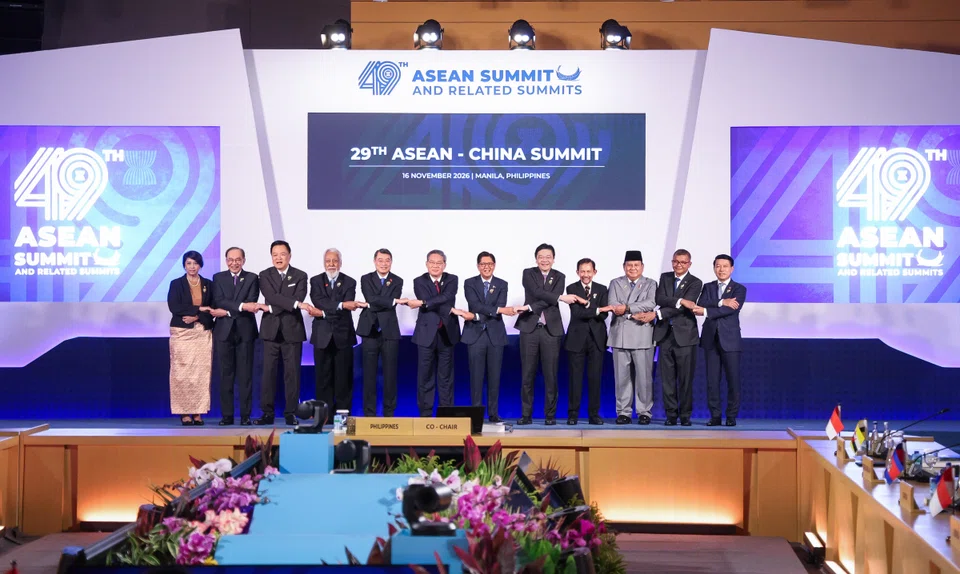
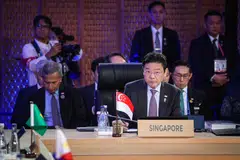
[MANILA] Singapore Prime Minister Lawrence Wong has urged the “expeditious conclusion” of a substantive South China Sea Code of Conduct that is consistent with international law, amid ongoing negotiations between Asean and China over the disputed waterway.
Speaking at the 29th Asean-China Summit in Manila on Monday (Nov 16), he said the code should comply with the 1982 United Nations Convention on the Law of the Sea and safeguard the rights and interests of all parties using the waterway.
The meeting took place on the second day of the 49th Asean Summit. Chinese Premier Li Qiang arrived in Manila on Sunday evening after visiting Thailand.
A day earlier, Philippine Foreign Secretary Maria Theresa Lazaro said Asean and China had provisionally agreed on about 80 per cent of the draft code’s paragraphs, but contentious issues remained.
Only one of four major negotiating issues has been resolved, with whether the code should be legally binding among those outstanding.
Negotiations have lasted more than two decades. The Philippines had sought to conclude the code this year, but talks could continue under Singapore’s Asean chairmanship in 2027. The code aims to manage disputes arising from overlapping territorial claims in the South China Sea.

PM Wong said China had been a valued partner through its support for Asean-led mechanisms, including the East Asia Summit, Asean Regional Forum and Asean Defence Ministers’ Meeting-Plus.
He identified regional peace and stability as one of three areas for closer Asean-China cooperation, with economic integration and digital cooperation making up the other two.
On the digital front, PM Wong welcomed China’s proposal to designate 2027 as the Year of Asean-China AI Cooperation.
SEE ALSO
He said China was a leader in artificial intelligence applications, while Asean economies could use the technology to raise productivity and transform their economies.
“We look forward to working with China to achieve meaningful outcomes,” he said.
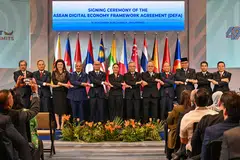
The proposal, previously raised in July, comes as Asean seeks to deepen digital integration following Saturday’s signing of the Digital Economy Framework Agreement (Defa).
The agreement aims to reduce digital trade barriers through common rules in areas including electronic payments, digital identities and data flows.
PM Wong said Defa could also deepen digital connectivity between Asean and China.
On trade, he noted that the Asean-China Free Trade Area 3.0 Upgrade would enter into force in December. Signed in October 2025, the upgrade covers the digital and green economies, supply chain connectivity, customs procedures and transparency.
Officials were also working to streamline customs procedures and simplify certification requirements, PM Wong said.
“These developments will give greater confidence to our businesses to invest and grow in our respective markets,” he said.
He added that further liberalisation of the Asean-China Air Transport Agreement would improve connectivity and facilitate greater flows of goods and people. Signed in 2010, the agreement allows unlimited passenger and cargo services between Asean countries and China, with later protocols expanding airlines’ operating rights.
PM Wong said such cooperation was particularly important amid sharpening geopolitical tensions and rising barriers to trade and investment.
Singapore would seek to build on these ties as the incoming Asean chair, he added. “I look forward to working with Premier Li and my Asean colleagues on this shared endeavour,” he said.
Decoding Asia newsletter: your guide to navigating Asia in a new global order. Sign up here to get Decoding Asia newsletter. Delivered to your inbox. Free.
Copyright SPH Media. All rights reserved.
TRENDING NOW
Ex-Nvidia CEO Jensen Huang carried a secret for more than a year. It led to his downfall
South-east Asia has lost Nvidia’s best salesman

Demand, tech capabilities position Apac and AI as Skyscanner’s next growth frontiers: CEO Bryan Batista
Jensen Huang discusses comeback as Nvidia CEO with allies: report

