Asean’s success tied more to neutrality play, not extent of economic integration: George Yeo
He also emphasises how peace and neutrality is always a consistent goal and strategic play for the bloc

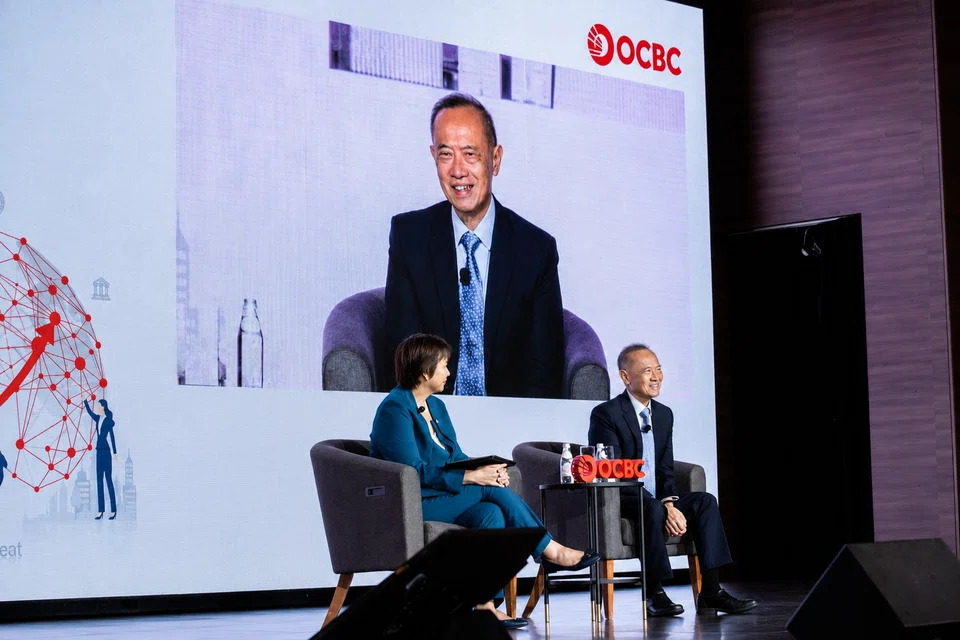
[SINGAPORE] The success of Asean as a region is tied more to its ability to stay neutral rather than its extent of economic integration, said Singapore’s former foreign minister, George Yeo.
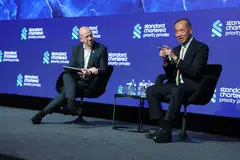
This is crucial in a world where large powers conflict regularly, he noted on a panel at OCBC’s Global Markets Economic Forum on Thursday (Jul 23) that was moderated by the bank’s chief economist, Selena Ling.
A neutral play has also “always been (the region’s) strategy”, according to Yeo. He added that during his time in Cabinet as minister of trade and industry and minister of foreign affairs, Asean was always within his “first circle” of political and economic interests. Yeo retired from politics after the 2011 General Election.
He shared that it was common for instabilities to arise in the region, citing domestic conflict in Myanmar and border skirmishes between Thailand and Cambodia as notable examples.
However, the former minister also emphasised how peace and neutrality was what Asean would aim for invariably as a collective.
“Even major superpowers such as the US and China would much prefer if (Asean was not) a problem for them, too – and instead open a new front for them (on trade and partnerships),” added Yeo.
“The key is that within Asean, we must not be divided. Because if we are and start taking sides, for example, then major powers will be forced to intervene to safeguard their own interests,” he warned.
Singapore – which will assume the Asean chairmanship in 2027 – will also have a “buffer” to rely on, for as long as Asean stays whole, said Yeo.
“Without Asean, countries like Singapore may be forced to take sides when dealing with the major superpowers, which can put us in a difficult – and sometimes impossible – situation,” he said.
“With Asean, our life chances are much better.”
A key “pole” in a multi-polar world?
The way Yeo sees it, the region can afford more “modest” views and goals, when asked about its potential to become a central “pole” in a multi-polar world.
“There is no profit in being a power,” he said. “We can continue to make ourselves useful to the major powers... (and) build a (solid) gravitational field (around them) – but not too much.”
In particular, China would much prefer South-east Asia to not become “an underbelly to itself” – or turn inward and become vulnerable or weak. This comes as China values its influence in the region across the areas of trade, diplomacy and people flows.
Yeo said the region will be fine as it is, as long as it manages to stay balanced with the US and China, and other regional powers such as Japan.
Such a position is no mean feat for all countries within Asean, where country leaders and ministers will have to “work hard” to resolve problems and achieve this equilibrium, he added.
Vietnam’s role in Asean
Vietnam’s role in the Asean bloc came up as a topic in the dialogue on Thursday, with Yeo citing it as a country “obsessed with innovation”.
He made the point that Vietnam was the most technologically advanced country in South-east Asia now, as they can “catch up very quickly” with the latest developments in the sector.
“They are intense people – they work hard,” he said. “If they keep good political management and prevent social (challenges) from holding them back, they will be the masters of artificial intelligence,” he said.
This could see the Asean nation helming the AI race in the next 10 to 20 years, and place them on the map as a new global leader in the field.
Vietnam’s latest foreign direct investment strategy as at June 2026 named priority sectors to include that of semiconductors, AI and biotechnology, as local companies attract bigger and more sophisticated projects in these areas.
But Yeo also said Vietnam would never be a regional hegemon – which is good for other Asean states like Singapore – simply because China is their direct neighbour.
“Vietnam needs Asean in order to have a normal relationship with China,” the former minister said.
“And therefore, Vietnam will work with the rest of us to keep Asean whole and unmolested.”
Decoding Asia newsletter: your guide to navigating Asia in a new global order. Sign up here to get Decoding Asia newsletter. Delivered to your inbox. Free.
Copyright SPH Media. All rights reserved.