



Indonesia eyes 70% share of mining benefits through equity or revenue
Investors want clarity on how the 70% would be calculated and how it will be applied. No decision has been made

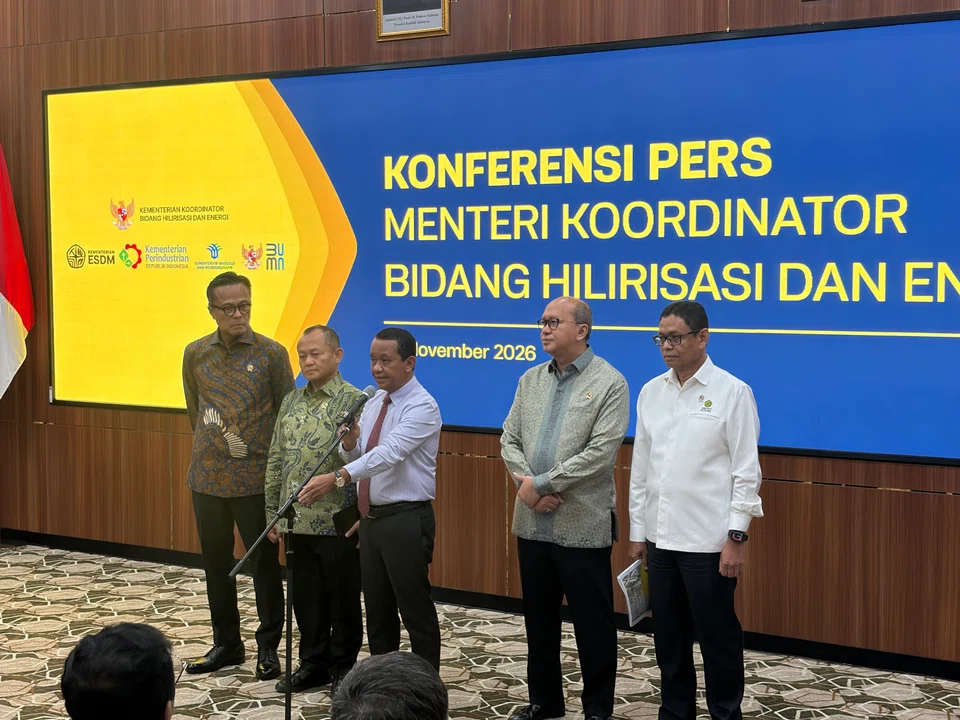
[JAKARTA] Indonesia, in seeking a bigger share of the country’s mineral wealth, is mulling over how to secure 70 per cent of the economic benefits from mining for the state; the options include taking majority stakes in mining companies or raising more government revenue from the sector.
Energy and Mineral Resources Minister Bahlil Lahadalia said at a media briefing in Jakarta on Monday (Nov 23) that the government was weighing a 70 per cent equity stake against a revenue-based option. The government is still working out how it would calculate its share under the revenue option.
“The formula options are still under exercise, and no decision has been made,” Bahlil said, adding that the government would honour existing contracts and apply changes to equity ownership only to future agreements.
Indonesia is the world’s largest exporter of thermal coal and the largest producer of mined nickel, accounting for about 59 per cent of global nickel output last year. Its mining industry includes major coal producers such as Bayan Resources and Dian Swastatika Sentosa, as well as nickel players including state-owned Vale Indonesia and Chinese-backed operators such as Tsingshan and Huayou.
Analysts at Jakarta-based brokerage Stockbit said the proposal adds to uncertainty for miners. Investors were looking for clarity on whether the 70 per cent would be calculated under existing rules, or would require new measures, and how these would be applied.
“Investors would be watching for further clarification from the government, particularly on the scope and implementation of the directive,” wrote Stockbit.

Bisman Bakhtiar, executive director of the Indonesia-based think tank Center for Energy and Mining Law Studies, said the proposal could pave the way for a greater role by sovereign wealth fund Danantara in managing Indonesia’s mining assets.
Bahlil said the proposal was rooted in Indonesia’s Constitution, which stipulates that natural resources must be controlled by the state and managed for the benefit of the people.
The government said the proposals would enable Indonesia to maximise returns from its natural wealth and channel more revenue into public spending, including schools, infrastructure, regional development and access to clean water.



The proposal is part of President Prabowo Subianto’s push for the state to have a greater role in mining and for Indonesians to benefit more from the country’s mineral wealth.
Prabowo had on Nov 14 called for at least 70 per cent of mining proceeds to go to the state, including through equity stakes in mining companies. Investors could still provide capital to mining ventures, he said, but the bulk of the returns should ultimately flow to Indonesians once their investments had been recouped.
“All mining permits, all mining business licences, from now on, at least 70 per cent must be enjoyed by the state. If necessary, the shares must be controlled,” he said.
Indonesia’s mining sector is largely operated by private companies; investors hold licences to extract and develop the country’s mineral resources, while the state collects revenue through royalties, corporate income tax and export duties.
Companies are also subject to domestic market obligations, which require them to allocate a portion of certain commodities for local consumption.
The directive revives concerns over a gross-split scheme for mining, under which revenue is divided between the state and companies before costs are deducted, rather than based on profits after expenses. A similar proposal was floated earlier this year but scrapped in June.
Bill Sullivan, a senior foreign counsel at Christian Teo & Partners in Indonesia and a specialist in mining and energy, said taking 70 per cent of mining companies’ profits would be far more detrimental to investor confidence than giving the state a 70 per cent equity stake. This is because in the latter situation, that stake could be structured to limit the government’s share of dividends.
Indonesia’s Company Law allows dual-class share structures, under which the classes of shares carry varied dividend and voting rights. “This could enable the state or state-owned enterprises to hold 70 per cent of a company’s equity while receiving only a small share of its dividends,” he said.
Indonesia had previously invoked its constitutional mandate over natural resources to push for greater state ownership of mining assets.
In 2018, it secured a 51.2 per cent stake in Freeport Indonesia through a deal involving state-owned mining holding company MIND ID. Freeport Indonesia operates Grasberg in Central Papua, one of the world’s largest copper and gold mines. US miner Freeport-McMoRan retained the remaining 48.8 per cent.
The proposal comes as Indonesia’s natural-resource producers face a growing regulatory burden from new mining, export and foreign-exchange rules that could constrain cash flow and raise operating costs.
In a Nov 20 note, Fitch Ratings said mining companies could face greater cash-flow pressure if the government materially increases its share of the economic benefits, with the impact depending on the mechanism ultimately adopted.
“Higher-cost miners and projects with large investment requirements would be most exposed,” Fitch wrote.
Mining companies are also subject to a new export-monitoring regime run by Danantara Sumber Daya Indonesia (DSI), a unit of state investment agency Danantara, which oversees export transactions and uses market benchmarks to monitor pricing and compliance.
Indonesia has also tightened rules requiring certain exporters to retain their foreign-exchange proceeds domestically, while the government is considering additional export duties on coal.
Decoding Asia newsletter: your guide to navigating Asia in a new global order. Sign up here to get Decoding Asia newsletter. Delivered to your inbox. Free.
Copyright SPH Media. All rights reserved.






