



Indonesia stocks suffer worst plunge in nearly 30 years as MSCI proposes standalone status
The country’s stock exchange will seek further clarification from the index provider on its concerns

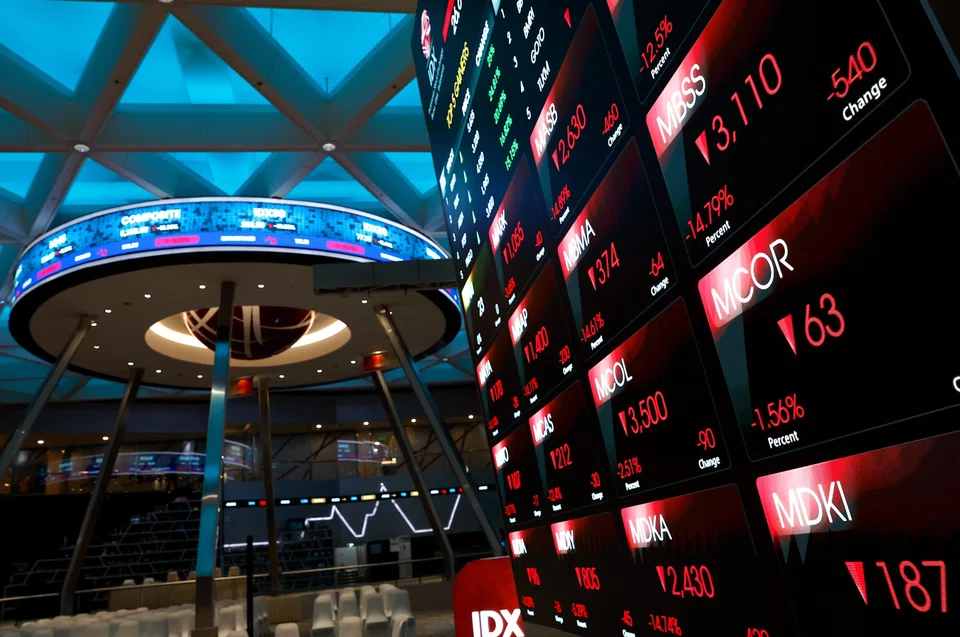
[JAKARTA] Indonesia’s benchmark stock index plunged nearly 12 per cent on Friday (Oct 16), triggering a trading halt as investors fled equities after MSCI proposed downgrading the country from emerging-market to standalone status.
The decline marked its steepest one-day fall since January 1998 – or nearly three decades ago.
The latest move has renewed concerns over market transparency and the risk of further foreign capital outflows. Friday’s sell-off took the Jakarta Composite Index’s year-to-date losses to more than 40 per cent, making it one of the world’s worst-performing equity markets.
The rupiah weakened 0.5 per cent to 18,027 per US dollar.
The trading halt was the first since a two-day sell-off in late January, when MSCI first raised concerns over Indonesia’s market investability, triggering sharp losses.
The global index provider on Friday morning launched a consultation on a potential reclassification of Indonesia from an emerging market to a standalone market.
A move to standalone status would remove Indonesian equities from MSCI’s emerging and frontier-market indices, potentially prompting investment funds tracking those benchmarks to reassess or unwind their exposure to the country.
Harry Su, managing director of research at Samuel Sekuritas Indonesia, said that a direct downgrade from emerging-market to standalone-market status would be rare and severe, as MSCI would typically take a more gradual approach by first moving a market to frontier-market status.
If the proposed downgrade goes ahead, Indonesia would be the first market in the Asia-Pacific to be classified as a standalone market. Markets currently classified by the index provider as standalone include Argentina, Nigeria, Ukraine, Zimbabwe and Lebanon.


MSCI cited persistent concerns over shareholding transparency, suspected coordinated trading and a lack of evidence that regulatory reforms have meaningfully improved the country’s equity market.
It added that market participants have not observed sufficient progress in addressing concerns about market investability, despite reforms announced by the Indonesian authorities.
MSCI said that it expects to proceed with the reclassification unless feedback from the consultation provides clear evidence of material improvements in market governance and functioning.
The proposal comes as Indonesia faces sustained foreign-investor selling and concerns over the transparency of its stock market, including the availability of reliable information on share ownership and free float.
The Indonesia Stock Exchange (IDX) said it has taken concrete steps with the Financial Services Authority – known locally as OJK – to improve market transparency, integrity and quality.
In a statement on Friday, IDX president director Jeffrey Hendrik said that the reforms have received positive responses from global investors and international index providers, reflecting continued efforts to strengthen the credibility and competitiveness of Indonesia’s capital market.
“The exchange respects MSCI’s independence in assessing markets under its own methodology, but would seek further clarification from the index provider on the considerations behind its announcement,” Hendrik added.
The final decision will be announced by Jun 30, 2027, with feedback accepted until Apr 30, 2027. MSCI may also provide an interim update on market participants’ responses during the consultation period.
Ari Jahja, head of Indonesia research at Macquarie Capital, said the next six to eight months are critical for Indonesia. He noted that the market impact will be negative in the near term, with the outcome hinging on how the proposed changes are implemented.
“The consultation is likely to raise Indonesia’s equity risk premium and keep foreign investors cautious until there is greater regulatory clarity,” he added.
Addressing concerns
The move follows warnings in June that MSCI would consider a reclassification consultation if Indonesia failed to demonstrate sufficient progress by its November 2026 index review.
As part of its June market classification review, MSCI said that investors had raised significant concerns about persistent opacity in shareholding structures and suspected coordinated trading behaviour.
Hasan Fawzi, head of capital markets, financial derivatives and carbon exchange supervision at OJK, said the issues raised by MSCI were addressed in Indonesia’s capital market integrity reform plan, including through consistent and sustained law enforcement.
“We remain committed to strengthening law enforcement in the capital market to uphold market integrity, through effective coordination and cooperation with all relevant stakeholders,” he noted.
Indonesian authorities have announced measures including greater disclosure of shareholders with ownership stakes above 1 per cent, more detailed investor classification data, reporting on high shareholding concentration and a road map towards a minimum free-float requirement of 15 per cent.
However, institutional investors have stressed that the reforms must be implemented consistently and demonstrate a sustained, material impact on market conditions.
MSCI said that significant concerns remain over market dysfunction. Market participants also indicated that moving Indonesia to frontier-market status would not adequately reflect the severity of the problems identified, it added.
A setback
The proposed reclassification would mark a significant setback for Indonesia’s efforts to attract foreign investment into its equity market.
Henry Wibowo, co-founder of Alphagate Capital and former chief Indonesia strategist at JPMorgan Chase, estimated that a downgrade to standalone-market status could trigger up to another US$5 billion in foreign outflows.
“Indonesian regulators need to take bold action in the near term, including imposing monetary penalties, pursuing criminal charges and establishing proper enforcement mechanisms against market manipulators,” he said.
Such measures would increase the chances of MSCI reversing its position, Wibowo added.
Ricky Ho, chief investment officer at Four Capital, expects Indonesian equities to come under immediate selling pressure, particularly stocks with significant foreign institutional ownership, as investors begin pricing in the more severe possibility of a downgrade to standalone-market status, rather than the previously discussed move to frontier-market status.
“The question now is how long Indonesia will remain a standalone market,” he said.
MSCI will maintain its existing freeze on certain index-related changes involving Indonesian securities until further notice. The restrictions cover changes arising from index reviews and corporate events.
Under the freeze, MSCI will not increase foreign inclusion factors or the number of shares used in index calculations, add securities to the MSCI Indonesia Investable Market Index, or promote securities to higher market-capitalisation segments.
The provider will continue removing securities identified by Indonesian authorities under the high shareholding concentration framework and use shareholder disclosure data for stakes above 1 per cent to adjust free-float estimates.
Decoding Asia newsletter: your guide to navigating Asia in a new global order. Sign up here to get Decoding Asia newsletter. Delivered to your inbox. Free.
Copyright SPH Media. All rights reserved.
TRENDING NOW

Singapore identifies 7 firms responsible for haze fires, notices issued urging action: Grace Fu

DBS remains analysts’ pick ahead of Q3 earnings after Singapore banks’ share slump

High Court rules against Julius Baer’s Singapore trust arm in US$50 million family trust dispute

Could stablecoins be the future of money?

