



Indonesia’s new finance minister touts policy continuity, keeps deficit outlook
Suahasil Nazara is the third finance minister in less than two years
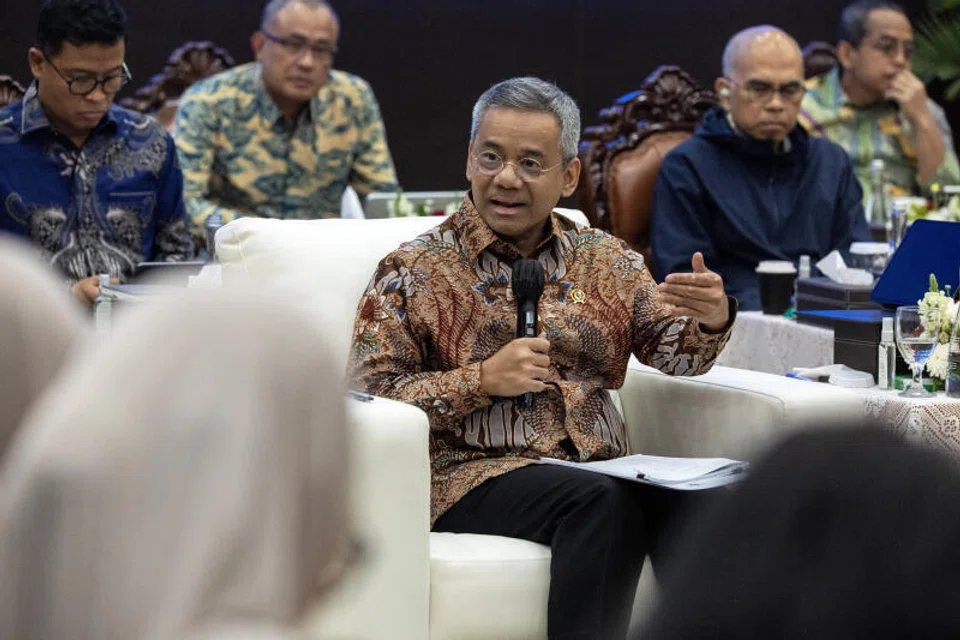
[JAKARTA] Indonesia’s newly appointed finance minister, in his first press conference on Friday (Sep 18), emphasised fiscal policy continuity by keeping the 2026 budget deficit outlook unchanged in a bid to restore investor confidence as worries about fiscal profligacy rattled markets.
Indonesian President Prabowo Subianto sacked Finance Minister Purbaya Yudhi Sadewa earlier this week and appointed his deputy, Suahasil Nazara, to the post, making him the third finance minister in less than two years.
Investors and analysts have been closely watching Indonesia’s fiscal policy under Prabowo, who won the 2024 election with costly campaign promises amid a limited fiscal space.
So far in 2026, capital outflows have intensified after ratings agencies Fitch and Moody’s downgraded Indonesia’s credit rating outlook due to policy unpredictability.
At the press conference, Suahasil reiterated his commitment to abide by the legislated fiscal deficit ceiling of 3 per cent of gross domestic product and called for discussion about any potential changes to fiscal rules to be done in a constructive manner, referring to parliament’s discussion on Thursday about potential changes.
“The state budget must remain credible,” the new minister said.
“We must strengthen revenue, ensure that spending is increasingly effective and productive while remaining efficient, and manage our deficit in a sound and controlled manner,” he said.
Suahasil also said Indonesia’s economy remained resilient amid higher global interest rates.
Budget deficit outlook unchanged
In the January to August period, South-east Asia’s biggest economy ran a budget deficit of 240.1 trillion rupiah (US$13.55 billion), equivalent to 0.93 per cent of GDP, Suahasil said.


His ministry said the baseline scenario remained for a deficit of 2.85 per cent of GDP for the whole of 2026.
The government collected 2,055.6 trillion rupiah of revenues as at the end of August, up 25.4 per cent from the same period last year. It spent 2,295.7 trillion rupiah, up 17.1 per cent year on year, the minister said.
Its subsidy payments reached 331.4 trillion rupiah, up 52.1 per cent from the same period last year, reflecting the rising costs of subsidising imported fuel.
Spending for Prabowo’s programme to feed students and pregnant women reached 134.2 trillion rupiah as at August compared with the 229 trillion rupiah budget expected for all of 2026.
Suahasil pledged to refund taxpayers who had overpaid in accordance with regulations. Purbaya had previously requested more audits of tax refunds, causing delays. As at end-August, the refunds reached 191.82 trillion rupiah, down 37 per cent annually, the tax office data showed.
Cash placement at state banks to continue
One of Purbaya’s unconventional policies was placing government funds at state-owned commercial banks, instead of at the central bank, a decision intended to bolster banking liquidity and raise economic growth prospects, but which had irked monetary policymakers, according to analysts.
Suahasil said the policy to keep a minimum of 200 trillion rupiah in the banks until July 2027 would continue. He said any withdrawal would be well communicated to maintain stability of the financial sector.
Purbaya’s exit also came amid plans to transfer the majority stake in a China-funded bullet train project from state firms to the government amid financial woes faced by the current owners. Purbaya had set a target for the transfer on Tuesday.
A ministry official told the press conference due diligence on the plan was still underway, including to calculate the valuation for the stake. REUTERS
Decoding Asia newsletter: your guide to navigating Asia in a new global order. Sign up here to get Decoding Asia newsletter. Delivered to your inbox. Free.
Share with us your feedback on BT's products and services
TRENDING NOW

Malaysian king buys stake in Singapore-listed mining firm expanding into rare earths

Family offices ‘kept captive’ by relationship managers turn to independent advisers, direct deals

Once staunchly pro-China, Malaysian Chinese businesses are now distancing themselves from Beijing

Could stablecoins be the future of money?

