



Malaysia’s coalition strains grow, but investors hold their nerve
The ruling group should survive, but concerns over slow reforms and policy continuity are growing


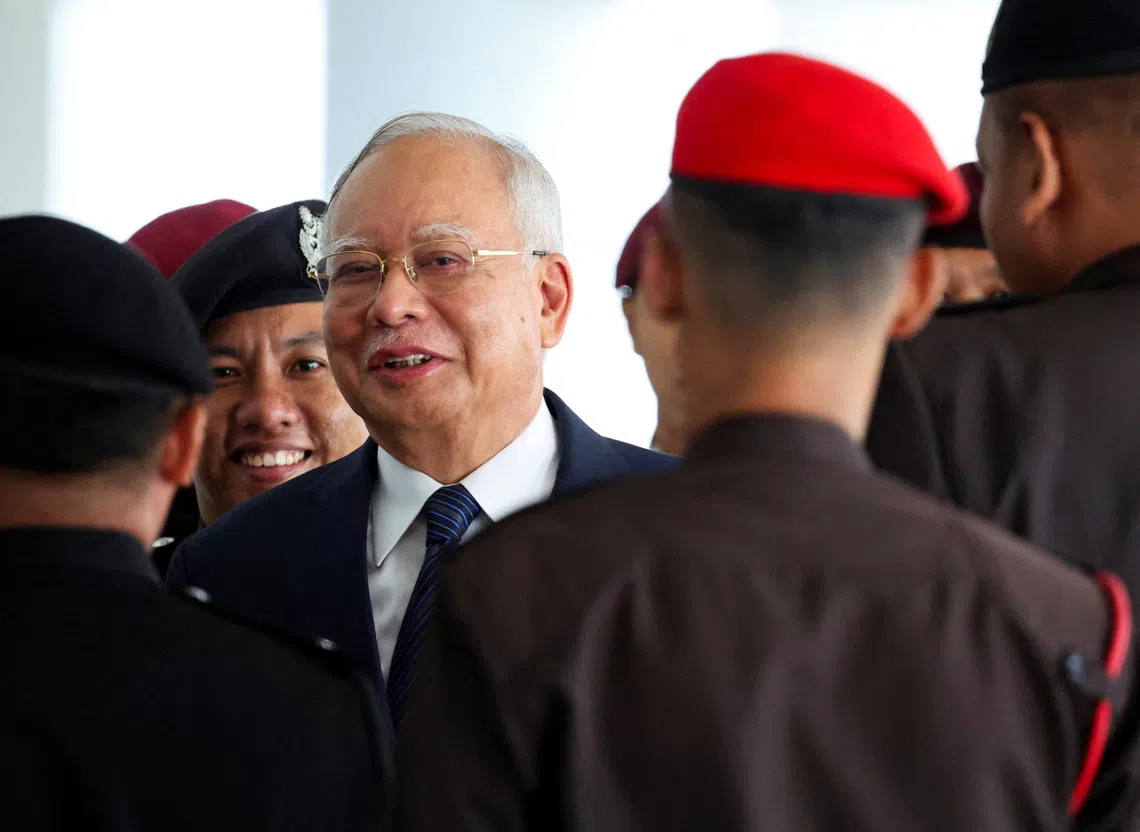
[KUALA LUMPUR] A deepening rift in Malaysia’s ruling coalition, over the decision to allow jailed former premier Najib Razak to serve the remainder of his corruption sentence under house arrest, is unlikely to topple Prime Minister Anwar Ibrahim’s government.
But pundits say it could complicate difficult economic reforms and cloud long-term policy certainty needed to draw investments, even as Malaysia continues to enjoy strong investor interest.
Shawn Balakrishnan, Asia-Pacific partner at Penta Group, said that companies making commitments over 10 or 20 years need confidence that policies and commercial relationships can survive not only a change of minister, but also a wider reordering of Malaysia’s coalition system.
At stake is the momentum behind measures such as subsidy rationalisation, fiscal-deficit reduction and foreign investment approvals, as well as the delivery of major developments such as the Johor-Singapore Special Economic Zone (JS-SEZ).
He pointed out that political fragmentation could affect businesses well before an election is called.
Ministers under greater electoral pressure become more attentive to constituency concerns, while coalition partners become more willing to differentiate themselves publicly, he noted.
“Issues involving prices, jobs, foreign ownership, subsidies or large infrastructure projects can acquire an electoral dimension that did not previously exist.”
Bank Muamalat Malaysia chief economist Dr Mohd Afzanizam Abdul Rashid said that foreign institutional investors were familiar with the country’s political landscape after navigating several administrations since the landmark 2018 election.
The 2018 election ended Barisan Nasional’s (BN) six-decade rule after it was rocked by the scandal involving state investment fund 1Malaysia Development Bhd (1MDB), with Pakatan Harapan’s (PH) victory sparking euphoria among reform-minded voters.
But that quickly turned to disenchantment amid unprecedented political instability, with Malaysia changing prime ministers three times before Anwar took office in 2022.
“My sense is that the foreign institutional investors are savvy about the political landscape in Malaysia,” said Dr Afzanizam, who has not revised Malaysia’s economic forecasts or investment outlook, which he deemed resilient.
Malaysia’s economy expanded by a faster-than-expected 6 per cent year on year in the second quarter of 2026, accelerating from the 5.4 per cent growth recorded in Q1.
Coalition fault lines
Najib is serving a sentence for misappropriating RM42 million (US$10.3 million) from SRC International, a former unit of 1MDB.
The conditional pardon allows Najib to remain under house arrest until Aug 23, 2028, subject to conditions including the payment of a RM50 million fine. He remains in prison while working to fulfil those conditions, his lawyers said.
Umno, which anchors the BN coalition, welcomed the decision and launched a fund to help Najib pay the fine.
But it angered supporters of the Democratic Action Party (DAP), the largest party in PH, who regard accountability for the 1MDB era as central to the party’s reformist identity.
DAP secretary-general Anthony Loke subsequently offered to resign as transport minister. Other DAP ministers, however, will remain in the Cabinet, allowing the party to register its disagreement without destabilising the government.
Sunway University political scientist Professor Wong Chin Huat described Loke’s move as an “elegant expression of dissent”: forceful enough to be noticed, but not so disruptive as to bring down the government.
“He gives a voice to many PH supporters who cannot find the right expression,” Prof Wong told The Business Times.
Insiders said that Loke effectively took one for the team, as a broader exodus of DAP ministers could have unsettled the government.
The dispute follows a challenge by Umno president Ahmad Zahid Hamidi, who said those demanding that BN leave the government should either seek a fresh electoral mandate or formally remove the coalition and face a confidence vote in parliament.
Status quo, for now
Nevertheless, neither DAP nor Umno has withdrawn parliamentary support for Anwar.
Prof Wong said that Umno has little incentive to bring down the government, as Anwar would retain the support of about 120 lawmakers without BN’s 30 MPs – still more than the 112 needed for a majority in the 222-seat parliament.
Leaving the government would therefore put Umno in opposition without necessarily removing Anwar from office. The party is instead seeking to buy time and strengthen its position against both PH and the opposition Perikatan Nasional (PN), Prof Wong added.
Polls: Later than sooner
An immediate election appears unlikely. The professor described the prospect of a fresh poll in 2026 as “very slim”, noting that parties from Sabah and Sarawak have a strong incentive to keep Anwar in office.
These parties play a key role in the unity government and wield considerable influence in federal policymaking. A future government formed by BN and the opposition PN using mainly Peninsular Malaysian seats could reduce their bargaining power.
Prof Wong said the likelihood of parliament being dissolved could increase after Hari Raya next year, opening a possible election window in May or June 2027.
He put the probability of parliament serving its full term, which ends in December 2027, at about 30 per cent.
Challenging position
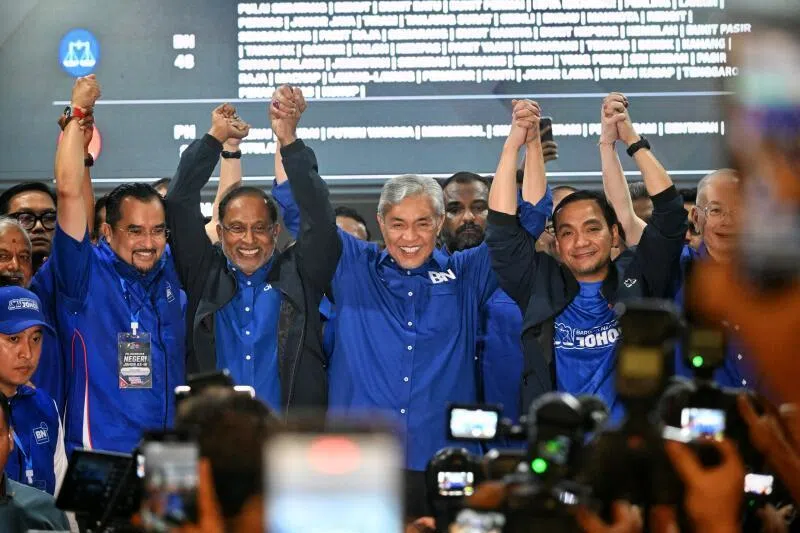
Recent state elections have shifted the balance within the ruling coalition, emboldening BN and piling pressure on PH to strengthen voter support.
BN won 48 of Johor’s 56 seats in July, leaving PH with eight. In Negeri Sembilan, BN and PN secured a combined 25-seat supermajority, displacing PH from the state government.
The next test will be the coming state elections in Melaka, where the state assembly was dissolved on Wednesday (Sep 23), and Sarawak, where an election is constitutionally due by April 2027.
While reforms matter to PH’s traditional base, bread-and-butter concerns dominate nationally, with the Middle East conflict adding to inflation and fuel price risks.
A Merdeka Center poll found that 73 per cent of voters viewed the economy as Malaysia’s biggest issue, while a Negeri Sembilan survey ranked living costs as the leading concern across all groups.
Impact on Malaysian assets
For now, financial markets have taken the latest political developments in stride, with no significant sell-off in the ringgit or equities following the house-arrest decision.
On Wednesday, the ringgit was trading at 4.0797 against the US dollar, strengthening by about 0.1 per cent from 4.0833 on Sep 18 when the decision was announced.
The benchmark FTSE Bursa Malaysia KLCI gained about 0.7 per cent over the same period.
“The encouraging signal is that foreign investors have so far distinguished between political noise and economic fundamentals,” said Penta Group’s Balakrishnan.
TRENDING NOW

Once staunchly pro-China, Malaysian Chinese businesses are now distancing themselves from Beijing

Looking beyond looming CEO succession, should UOB potentially pursue a transformative merger?

Could stablecoins be the future of money?

Grab CEO’s wife Chloe Tong on life with Anthony Tan and finding her purpose

