As more Asean states turn to Russia for fuel, will Moscow boost its influence in the region?
Moscow has much to gain as fuel exports to the region will result in hard currency and alternative markets
[SINGAPORE/JAKARTA/HANOI] As the stand-off in the Strait of Hormuz continues, more South-east Asian countries have turned to Russia for fuel supply, possibly increasing its influence in the region.
The Philippines has started receiving oil supplies from Russia, while Malaysian Prime Minister Anwar Ibrahim said on Apr 18 that the country’s state-owned oil giant Petronas would negotiate oil purchases from Russia to ensure sufficient domestic supply.
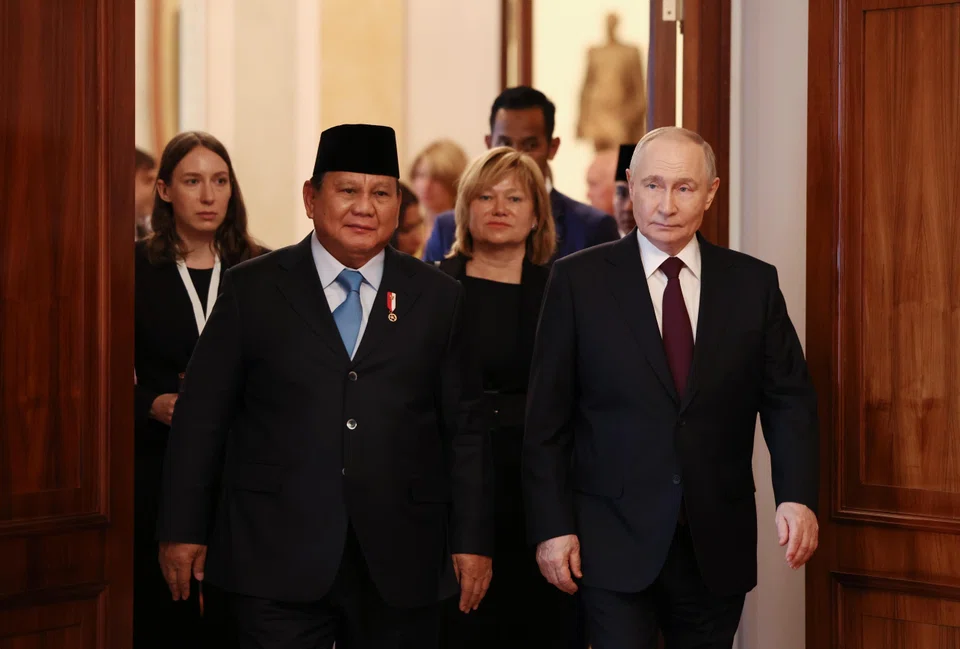
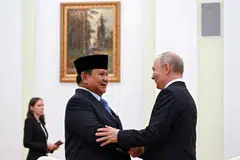
On Apr 13, Indonesian President Prabowo Subianto met his Russian counterpart Vladimir Putin in Moscow to secure Russian supply of crude oil and liquefied petroleum gas (LPG).
The Middle East war has led to a virtual halt in traffic through the Strait of Hormuz, which carries about a fifth of the world’s oil exports. Asian countries have been especially affected, as 80 per cent of these exports would be bound for Asia, according to the International Energy Agency.
“Our crude oil import needs a year is around 300 million barrels. We will take (what we need) from anywhere,” Indonesia’s Energy and Mineral Resources Minister Bahlil Lahadalia told reporters on Apr 16 in a briefing on Prabowo’s Russia visit.
“We have achieved quite positive results where we can secure additional crude oil reserves. In addition, we will also be able to obtain LPG,” said Bahlil of the talks in Russia.
'%3e%3cpath%20d='M12.1475%2025.5262C13.7713%2025.4295%2014.94%2023.913%2014.94%2021.8832C14.94%2019.5359%2013.474%2018.093%2011.5917%2018.093C11.3745%2018.093%2010.9582%2018.093%2010.8393%2018.1413V25.2086L11.8891%2025.5745C11.8891%2025.5745%2012.207%2025.5262%2012.1475%2025.5262ZM11.4934%2017.6281C13.2567%2017.6281%2014.3843%2016.4292%2014.3843%2014.4501C14.3843%2012.372%2013.275%2011.2973%2011.4339%2011.2973H10.8393V17.6305H11.4934V17.6281ZM6.66078%2025.6482L7.39265%2025.5492C8.02617%2025.4502%208.26403%2025.3053%208.26403%2025.1097V11.6149C8.26403%2011.4193%208.1451%2011.3709%207.23484%2011.249L6.68137%2011.173L6.6219%2010.7588H11.9508C15.7153%2010.7588%2017.0624%2012.0797%2017.0624%2014.1578C17.0624%2015.9666%2015.7748%2017.1909%2013.4969%2017.6305V17.7041C16.111%2017.948%2017.6571%2019.5382%2017.6571%2021.7636C17.6571%2024.3318%2015.8937%2026.0417%2012.1109%2026.0417H6.60132L6.66078%2025.6482Z'%20fill='%232B2B2B'/%3e%3cpath%20d='M20.6287%2025.6505L21.5596%2025.5515C22.1725%2025.4779%2022.4104%2025.3076%2022.4104%2025.112V11.249H21.9346C20.073%2011.3479%2018.982%2013.0095%2018.408%2014.6227L18.1907%2015.5018H17.6555L18.1701%2010.7588H29.3837L29.6421%2015.4787H29.1664L28.9491%2014.6227C28.3728%2012.8645%2027.3047%2011.2743%2025.5002%2011.249H24.9856V25.1856C24.9856%2025.3812%2025.1251%2025.4548%2025.9965%2025.5515L26.7695%2025.6505L26.829%2026.0417H20.5693L20.6287%2025.6505Z'%20fill='%232B2B2B'/%3e%3c/g%3e%3cdefs%3e%3cclipPath%20id='clip0_5242_21648'%3e%3crect%20width='24'%20height='16.8'%20fill='white'%20transform='translate(6%2010)'/%3e%3c/clipPath%3e%3c/defs%3e%3c/svg%3e)
Indonesia’s agreement with Russia can help it reduce its reliance on the US for LPG, commonly used for cooking in Indonesia. So far in 2026, about 70 per cent of Indonesia’s LPG supply has come from the US, according to the Observatory of Economic Complexity, an online data platform.
On Apr 15, a senior Indonesian government official told The Straits Times that Washington has recently attempted to leverage this dependency in non-trade negotiations.
“The US is seeking broader military cooperation, warning through back-channel negotiations that LPG shipments could be disrupted if an agreement is not reached,” said the senior government official, who spoke on condition of anonymity.
SEE ALSO
On Apr 13, amid Prabowo’s Russia visit, Indonesia and the US signed a Major Defence Cooperation Partnership in Washington to boost efforts in military modernisation, training and joint exercises, and operational cooperation.
Amid reports that the US had sought broader military use of Indonesia’s airspace, the country’s Defence Ministry clarified that any proposal on US military overflight access was not part of the agreement and remains under separate consideration.
Myanmar, Russia growing closer
Similarly, on Apr 15, officials from Myanmar were in Moscow to discuss energy cooperation.
Both countries have deepened their relationship since the 2021 coup in Myanmar.
Moscow was one of the few countries that did not criticise the Myanmar military over the coup; Russia stayed engaged with the junta and continued to supply arms and fighter jets.
Then Myanmar military chief Min Aung Hlaing, who is now the country’s president, visited Russia and met President Putin three times in 2025 alone.
According to the Kremlin, by the end of 2024, bilateral trade had increased by approximately 40 per cent from the year before, reaching nearly US$2 billion (S$2.5 billion).
Dr Kristina Kironska, head of the Myanmar Studies Center at Palacky University Olomouc in the Czech Republic, told The Straits Times that over the last five years, Russia has also been deepening military-to-military ties.
“Officer training and defence cooperation were conducted quite openly and without much scrutiny,” she said.
Energy constitutes a strategic area of cooperation between the two countries.
In 2024, Moscow said it had supplied more than 90 per cent of the oil on the Myanmar market. Indeed, between March and June 2023, Russian oil exports to Myanmar jumped from almost nothing to 8.36 million barrels of oil.
In February 2025, the two countries inked a memorandum to carry out projects such as a coal-fired thermal power plant and an oil refinery development in Dawei, south-eastern Myanmar.
And in March that year, Moscow and Naypyitaw signed an intergovernmental agreement on the construction of a low-capacity nuclear power plant in Myanmar.
James Shwe, an independent Myanmar political analyst, said Russia’s engagement with Myanmar is not about philanthropy or ideological solidarity.
“It is a calculated pursuit of strategic interests by a declining arms exporter seeking to preserve market share, project power in the Indian Ocean, build an anti-Western coalition, and maintain a reliable vote at the United Nations,” he said.
S-E Asian country that’s closest to Russia
No country in South-east Asia has a closer or more comprehensive relationship with Russia than Vietnam. It was no surprise when then Vietnamese Prime Minister Pham Minh Chinh paid an official visit to Moscow from Mar 22 to 25, with energy high on the agenda.
Some agreements achieved during the trip concerned long-term projects in the energy sector, such as the construction of Vietnam’s first nuclear power plant and the development of renewable energy.
Russian media reported that Russia’s second-largest natural gas producer, Novatek, had agreed to sell around one million tonnes of liquefied national gas (LNG) to Vietnamese firms in 2026.
Novatek will also invest in an LNG power plant in Ca Na in central Vietnam together with Russian oil giant Zarubezhneft, which has long been exploring oil in the South China Sea with Vietnam’s state oil corporation Petrovietnam.
Zarubezhneft and Petrovietnam are to develop a massive oil storage facility in Nghi Son, where a major oil refinery is located. The Nghi Son refinery accounts for about 40 per cent of the domestic fuel supply market and relies primarily on crude oil imported from Kuwait.
Dr Artyom Lukin, professor of international relations at Russia’s Far Eastern Federal University in Vladivostok, said: “Not only Vietnam, but other South-east Asian countries are now likely to show more interest in Russian oil and gas.
“However, they will need to compete for Russian oil and gas with other countries – China, in particular. Russia’s capacities are large but not unlimited.”
China’s imports of Russian crude oil grew year on year by 31 per cent in the first quarter of 2026 to nearly 32 million tonnes, reported Russia’s news agency Tass.
As the US temporarily eased sanctions on Russia’s energy exports, Russian oil prices have risen, partly because of demand and partly because the costs of Russian oil and gas production are generally higher than in the Middle East, according to the Russian analyst.
“Russian hydrocarbons are mostly sourced from inhospitable northern regions with difficult natural conditions,” said Dr Lukin. “Oil-importing countries should be prepared either to pay much more for supplies or invest in oil and gas production in Russia.”
Increased Russian footprint?
As the likes of Jakarta, Hanoi and Naypyitaw make a beeline for Moscow to seek fuel, will this pave the way for Moscow to have greater clout in the region?
Dr Kironska said: “Moscow is buying political loyalty, access and visibility in a region where it has historically been a secondary player.”
She added that Moscow has much to gain as fuel exports to the region will result in hard currency and alternative markets for its energy sector, as well as access to strategic infrastructure like ports.
Moscow also stands to gain diplomatic leverage, which means “cultivating partners in Asean who may dilute consensus against Russia in multilateral settings”.
Fabby Tumiwa, chief executive officer of Jakarta-based think-tank Institute for Essential Services Reform, told ST: “Amidst ongoing tensions with G7 nations, Russia is using energy exports to strategically strengthen its relations with the Global South, where Indonesia is a key player.”
The Group of Seven countries are the US, UK, France, Germany, Italy, Japan and Canada.
“If this energy trade creates a reliance or sense of indebtedness, it provides Moscow with significant leverage to extract political favours from Indonesia in the future,” Fabby added.
Shwe warned of Russia’s growing influence in Myanmar.
He said: “Asean should view Russia’s deepening footprint in Myanmar not as a distant bilateral matter but as a serious strategic challenge that introduces authoritarian governance models, military hardware, nuclear technology and great power competition into a region that has long prided itself on non-alignment and consensus-based decision-making.”
Dr Kironska also highlighted how increased Russian fuel exports to Asean members may create “dependencies, giving Russia influence without needing deep economic integration”.
Concurring with Shwe, she fears this may lead to “a more fragmented Asean”, even if Russia’s role is primarily transactional.
But it is not all negative.
Independent Myanmar-Russia analyst Wai Yan Phyo Naing believes that Asean’s growing engagement with Russia may bring benefits.
“It offers some states an opportunity to pursue balancing or hedging strategies, not only in relation to China at the regional level, but also within the broader global political system involving China, the West and the United States.”
Dr Wai Yan Phyo Naing said the relationship can “be seen as mutually beneficial, as long as Russia remains focused on supplying weapons and technology rather than pursuing direct political influence”.
In the case of Indonesia, turning to Russia for fuel looks to have helped it stave off pressure from the US in defence talks over issues like military overflight access.
As Fabby said: “Giving in to such a demand would only create new problems for the government, sparking both parliamentary backlash and public outrage.” THE STRAITS TIMES
Decoding Asia newsletter: your guide to navigating Asia in a new global order. Sign up here to get Decoding Asia newsletter. Delivered to your inbox. Free.
Share with us your feedback on BT's products and services