



Three bets behind Vietnam’s three-hub free-trade-zone network
Each FTZ is anchored by a key deep-water port and a hinterland serving a distinct engine of economic growth
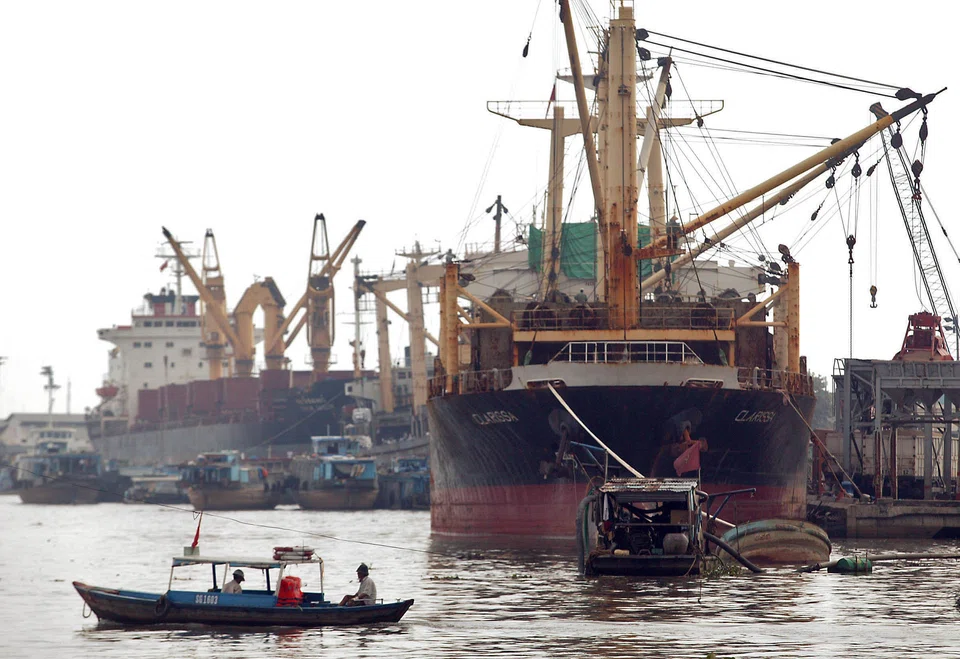
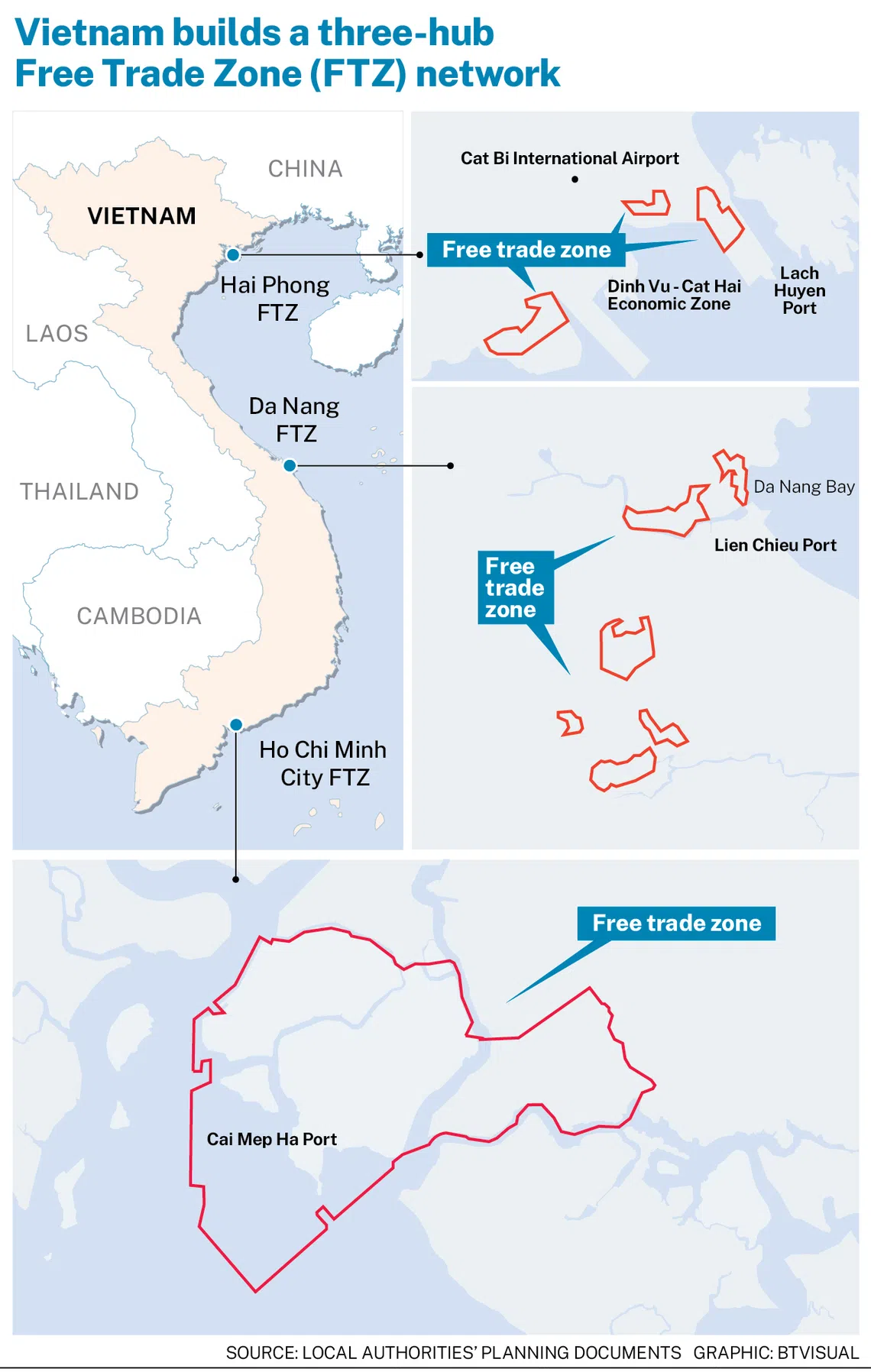
WHEN Ho Chi Minh City established a free-trade zone (FTZ) of 4,174 hectares (ha) beside the Cai Mep port complex in the south of Vietnam in late July, Vietnam gained a third FTZ spanning the length of its coastline.
This followed the establishment of a roughly 1,881 ha zone in the central city of Da Nang in June 2025 and a 6,292 ha zone in the northern city of Hai Phong four months later.
At first glance, the projects look like variations of the same industrial-policy formula: defined territories linked to deep-water ports, manufacturing hubs, logistics facilities and preferential investment mechanisms.
In practice, they are three different bets on how Vietnam can deepen its position in Asian supply chains.
Truong Bui, partner at Roland Berger South-east Asia and head of transportation practice in the region, pointed out that FTZs in northern, central and southern Vietnam would reflect the comparative advantages of each region rather than competing with one another for the same cargo and investors.
“These distinct hinterlands are integrated into different global value chains and trade with different markets,” he said.
Hai Phong is positioned to capture more value from the electronics and high-technology manufacturing clusters concentrated across northern Vietnam.
Da Nang is developing its role as a commercial gateway for central Vietnam and the region’s East-West Economic Corridor.
Ho Chi Minh City’s zone at Cai Mep Ha builds on the south’s vast cargo base and strategic location to support the development of an international transhipment hub.
SEE ALSO

The strategy is intended to solve problems created partly by Vietnam’s own export success.
The country’s merchandise trade reached a record US$930 billion in 2025, making it Asean’s second-largest trading economy by goods turnover, behind only Singapore and well ahead of Malaysia, Thailand and Indonesia.
Yet, the maritime economy continues to depend heavily on basic port handling and inland transport.
“FTZs would diversify maritime revenue streams and strengthen Vietnam’s position as a regional maritime and logistics hub,” Bui said, referring to transhipment, bunkering, ship services and other value-added logistics and manufacturing activities within the port area.
Yap Kwong Weng, CEO of Vietnam SuperPort – a strategic multimodal logistics asset in the global facility network operated by Singapore logistics giant YCH Group – said small manufacturers in Vietnam sometimes face cash-flow pressures alongside high logistics costs.
Logistics costs remained at around 16 per cent of gross domestic product in 2025, according to Vietnam’s Ministry of Industry and Trade.
That is still above the levels recorded by several South-east Asian peers and the global average of around 11 to 12 per cent.
The opportunity, Yap said, is for Vietnam to develop FTZs as “value-creation clusters”, and “not just as an assembly place”.
That requires more than favourable tax treatment; it also means providing premium allocations for zero-duty transit zones, cold-chain and bonded storage facilities, as well as the financial and professional services multinational companies need.
“This will be the best time (for Vietnam) to place a bet,” Yap added, referring to the country’s “transformational phase” with its 10 per cent annual GDP growth target. “This will significantly increase the country’s GDP if done correctly.”
Hai Phong: The high-tech supply chain bet
Hai Phong’s 6,292 ha FTZ spans three non-contiguous sites linked to economic zones, including two sites around Lach Huyen – northern Vietnam’s international deep-water gateway.
The wager is straightforward: Foreign-invested high-technology companies already manufacturing across northern Vietnam – including South Korea’s mobile-phone giant Samsung and Apple supplier Foxconn of Taiwan – could be encouraged to expand their higher-value activities within the region.
Its proximity to China-linked supply chains, combined with more streamlined inventory management, regional distribution, logistics and customs clearance under the FTZ regime could strengthen Hai Phong’s appeal as a high-tech manufacturing and export hub.
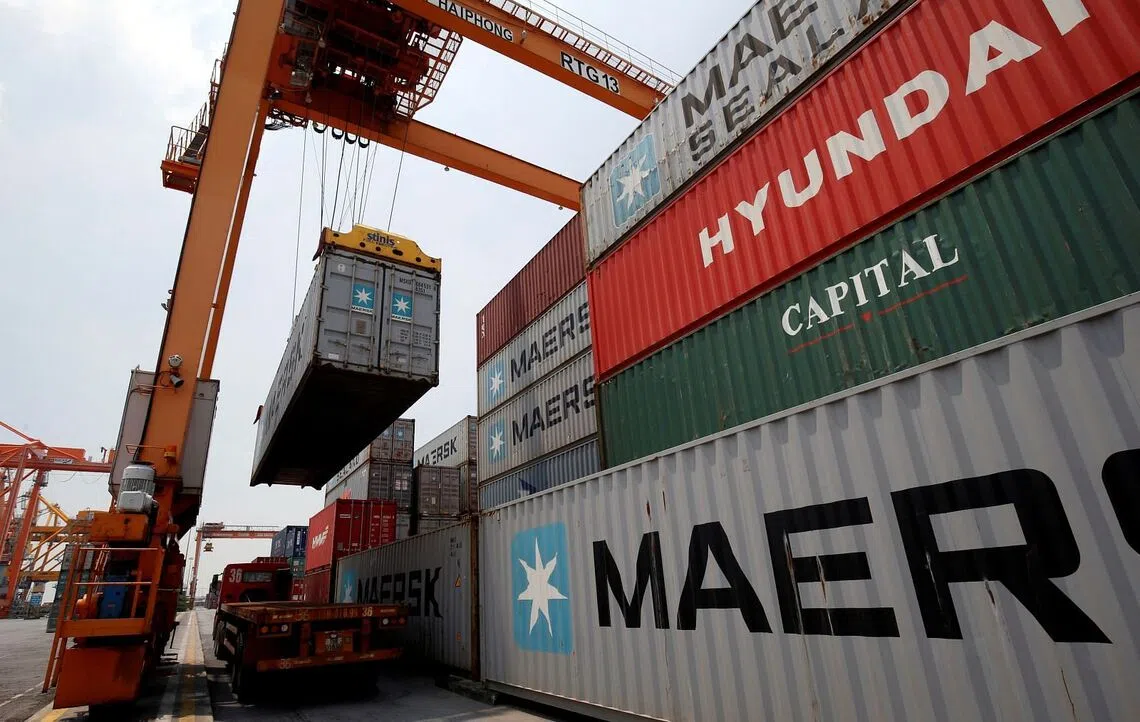
At Bloomberg Businessweek Vietnam’s Infrastructure Symposium in July, Nguyen Xuan Ky, CEO of Hateco Hai Phong International Container Terminal, pointed to LG Innotek’s under-development semiconductor-substrate and packaging factory as an example of investment whose competitiveness depended on connecting infrastructure keeping pace.
The facility is about 10 km from the Lach Huyen port. “The port system is strong,” Ky said.
“But if the bridges and connecting infrastructure are not built in time (in the coming period), logistics costs will rise, congestion will return and the area’s ability to attract investment will be constrained.”
Da Nang: The economic corridor bet
Da Nang begins with a different weakness: It lacks the cargo volume and manufacturing density of northern and southern Vietnam. The opportunity, however, comes from location and policy flexibility.
The roughly 1,881 ha FTZ is spread across seven non-contiguous sites and designed to draw on connections to Lien Chieu Port and Da Nang International Airport, while developing alongside the city’s component of the Vietnam International Financial Centre.
YCH has decided to invest in a a sandbox there despite the central region’s smaller cargo base, Yap said.
He believes the city’s Lien Chieu Port and its FTZ could be the gateway to the region’s East-West Economic Corridor through its connections to Laos and neighbouring markets.
“While cargo flows are not as optimal in Da Nang as compared to its north and south counterparts, the city presents a very strategic geographical location and potentially a logistics hub where it can optimise regional distribution,” he added.
“I would say (Da Nang) mirrors what Singapore has done, considering that it is a city-state that began by improving its port services over the years.”
Rather than developing a large site at once, the Singapore group is considering what Yap called a “park-in-a-park” approach for the sandbox in Da Nang, beginning with a small core and expanding as demand becomes visible.
YCH has also been developing several multimodal logistics hubs across Vietnam and Cambodia, as well as a smart logistics and distribution hub in the border-gate economic zone between the two countries.
Ho Chi Minh City: The transhipment bet
The southern project is the boldest maritime wager.
Its 4,174 ha FTZ – about 25 km from Ho Chi Minh City’s upcoming Long Thanh International Airport – is a contiguous site divided into eight subzones.
It incorporates existing container-terminal area, two Cai Mep Ha container terminals, a planned railway station, an inland-waterway port, the southern part of Cai Mep Industrial Park, a 906 ha logistics centre, and an industrial-urban-service area.
Unlike Da Nang, Cai Mep does not need to prove that it has local cargo. Southern Vietnam already has one of the country’s largest and most diverse manufacturing hinterlands and remains a dominant centre of export-oriented production.
The harder question is whether it can persuade global shipping lines to shift regional transhipment flows from established hubs such as Singapore and Malaysia.
An FTZ is a “very critical condition for opening an international transhipment port”, said Roland Berger’s Bui at the Infrastructure Symposium, noting southern Vietnam’s favourable position along major shipping routes to the US and Europe.
He pointed to Malaysia’s Port of Tanjung Pelepas as a precedent.
Maersk, one of the world’s largest container logistics companies, acquired a stake in the port and shifted its South-east Asian transhipment centre there from Singapore in 2000.
Bui said Vietnam had every right to pursue a similar ambition, although doing so would require policies and incentives strong enough to attract one or more anchor shipping lines.
YCH’s Yap noted that the first step for Vietnam’s FTZs “would obviously be to create and build the critical infrastructure".
But the greater challenge is creating “a three-hub digital footprint” that combines the north, centre and south into a single system.
“If done well, it could become a very powerful asset for Vietnam,” he added. THE BUSINESS TIMES
Decoding Asia newsletter: your guide to navigating Asia in a new global order. Sign up here to get Decoding Asia newsletter. Delivered to your inbox. Free.
Share with us your feedback on BT's products and services






