



TRX and Labuan IBFC join forces to boost Malaysia’s regional financial ambitions
The aim is to streamline operations for businesses expanding into the country and Asean

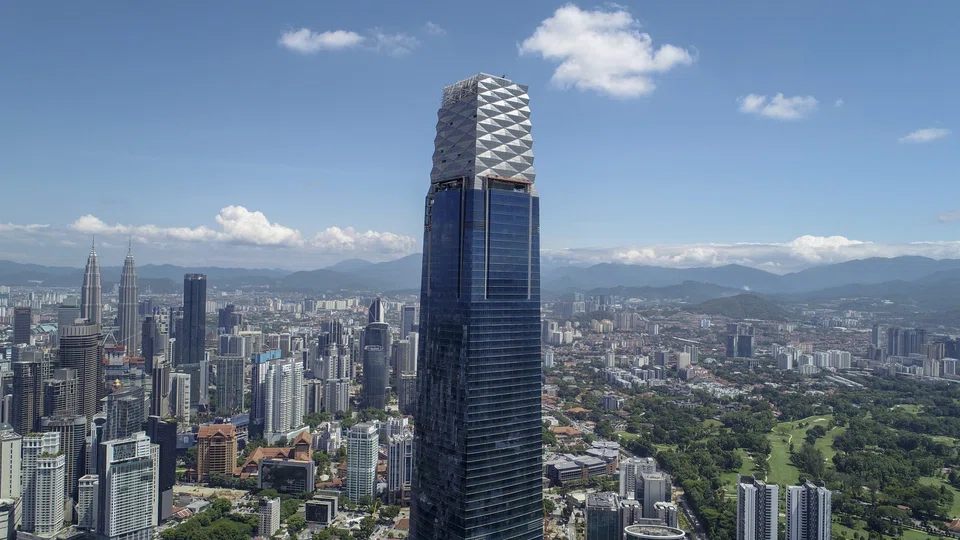
[KUALA LUMPUR] Malaysia’s two international financial centres (IFCs) are joining forces to sharpen the country’s regional pitch – one that combines Kuala Lumpur’s Tun Razak Exchange (TRX) business district with Labuan’s cross-border financial structures and licences.
Through a memorandum of understanding (MOU) signed on Friday (Sep 18), TRX City and Labuan International Business and Financial Centre (IBFC) aim to streamline operations for businesses expanding into Malaysia and Asean under a “one ecosystem, two IFCs” strategy.
The partnership focuses on joint promotional initiatives, market research, business networking and cross-border financial opportunities.
However, leadership from both entities clarified at the signing of the MOU that operating in TRX does not automatically grant access to Labuan’s tax incentives or regulatory privileges.
Instead, the tie-up connects two complementary propositions: TRX’s physical infrastructure and concentration of financial talent with Labuan’s international financial framework.
Combining strengths
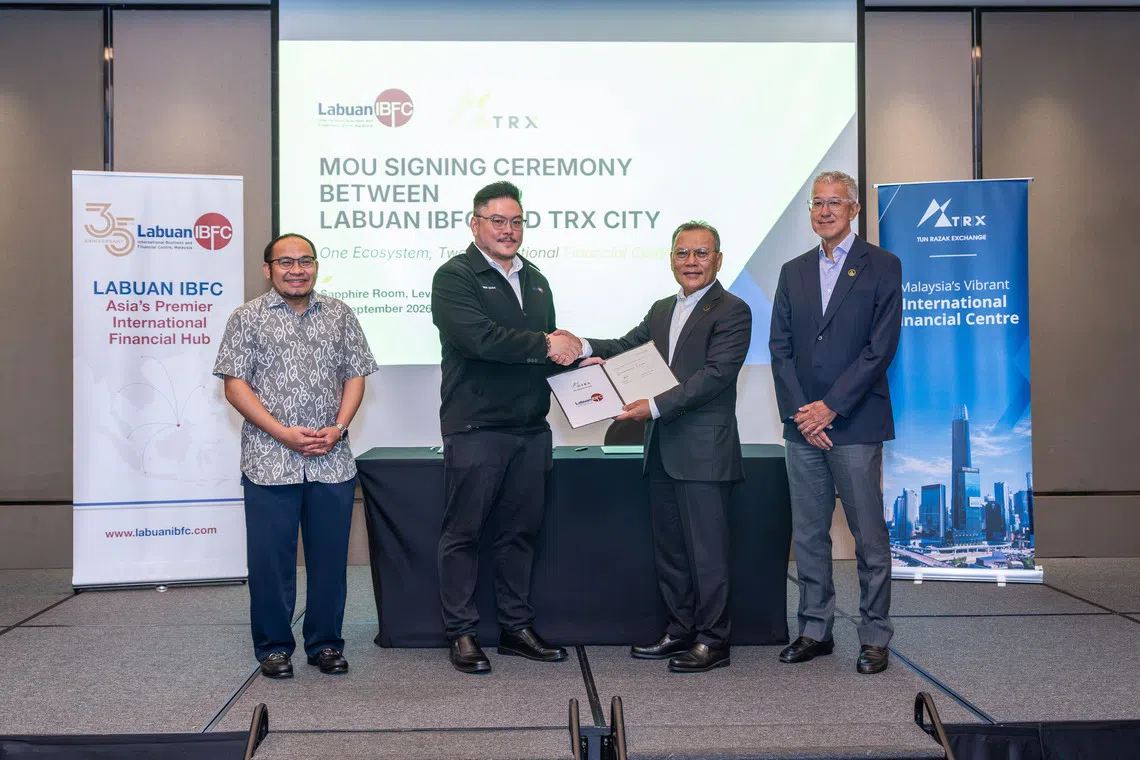
Established in 1990, Labuan IBFC operates as an international financial jurisdiction with its own regulatory and tax framework, specialising in cross-border banking, insurance, wealth management and international business.
It has around 5,000 active entities and business structures, including international banks, insurers and digital financial-services providers.
TRX is Kuala Lumpur’s premier onshore financial district, designed to cluster leading banks, technology innovators, professional services and top-tier talent.
As master developer and steward, TRX City – a wholly owned subsidiary of the Minister of Finance (Incorporated) – drives the district’s vision beyond urban management and towards accelerating foreign investment and regional growth.
SEE ALSO





The 28-hectare international financial centre now serves as a hub for over 120 companies and 30,000 workers. Major financial institutions including HSBC, Prudential and Affin Bank sit alongside technology companies such as Ant International, consultants and other professional-services firms at TRX.
Labuan IBFC CEO Ben Quah described the combination as one in which TRX supplies the “hardware” and Labuan, the “software”.
“We’re talking about the structures, the frameworks and the things that can make companies go regional or global,” he said at a fireside chat following the signing.
In practical terms, a company incorporated in Labuan could set up a marketing office in TRX while retaining its Labuan structure. This would give the company a presence in Kuala Lumpur and access to its workforce and business network without having to relocate its international structure.
Conversely, a financial institution already operating in TRX could turn to Labuan for licences, holding-company structures or other solutions when expanding overseas.
“If you put one plus one together, I don’t think the answer will be two. The result will be a multiplier,” Quah said.
The tie-up effectively creates a two-way pipeline. Labuan companies looking for a Kuala Lumpur presence can consider TRX, and businesses in TRX seeking to serve international customers can tap Labuan’s cross-border capabilities.
Labuan’s principal offerings range from banking, wealth management and insurance to digital financial services and Islamic finance. These include structures for commercial and investment banks, foundations and funds, captive insurers and digital financial businesses.
Quah said Labuan was ranked second in Asia for captive insurance, a segment that remains relatively underdeveloped in the region. Its framework enables companies to establish their own insurance entities to manage group risks.
He added that Labuan’s ability to combine different offerings, such as digital financial services with Islamic finance, could help Malaysia distinguish itself from other Asian financial centres.
Labuan has risen from 55th to 44th place in the latest Global Financial Centres Index, Quah said, in a reflection of its growing profile as an international financial jurisdiction.
Collaborate instead of competing
TRX City CEO Azmar Talib said the partnership would strengthen Malaysia’s financial ecosystem without creating overlapping institutions or incentives.
He noted that TRX was not intended to become a separate financial jurisdiction; instead, its role is to provide the business infrastructure, connectivity and professional talent needed by financial institutions and supporting industries.
“We do not want to duplicate what already exists or create something unnecessarily… We believe it is best to work with Labuan IBFC, which is already well established,” he added.
The broader TRX development is planned to comprise about 24 million square feet of space, approximately half of which will be offices. For now, nearly seven million square feet has been completed.
Azmar said TRX would remain focused on financial services and related businesses, although the district is unlikely to be occupied exclusively by financial institutions.
The collaboration comes as companies reassess supply chains, diversify their regional operations and seek structures connecting capital, investment and risk management across borders.
Quah said the combined proposition would give Malaysia a clearer story when approaching overseas investors: world-class infrastructure in Kuala Lumpur, access to multilingual talent and competitive operating costs, alongside Labuan’s international financial framework.
The two organisations plan to conduct joint overseas roadshows and promotional activities. Their focus will include businesses from Asian markets such as Singapore, Taiwan, mainland China, South Korea and Japan, alongside investors from the Middle East.
Decoding Asia newsletter: your guide to navigating Asia in a new global order. Sign up here to get Decoding Asia newsletter. Delivered to your inbox. Free.
Copyright SPH Media. All rights reserved.
TRENDING NOW

He built the Vingroup empire. Now South-east Asia’s richest man is handing some key roles to his sons
Chagee, Mixue and Luckin won the market. Sustaining their edge is the harder part

From Haidilao to Oriental Kopi: How some of Asia’s favourite F&B players are faring in 2026

CPIB hauls Multi-Chem CEO, COO in for questioning; stock hits ‘circuit breaker’

