



Vietnam’s FTSE upgrade looms, but foreign investors need more convincing
Passive inflows are set to begin with index inclusion, but active foreign investors remain selective
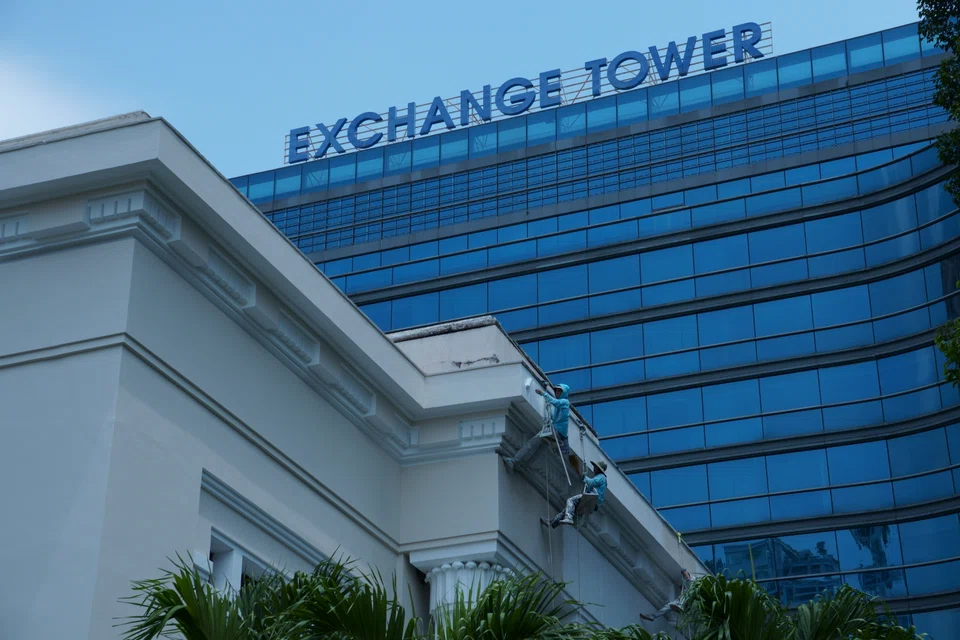
VIETNAM is days away from a milestone designed to pull its stock market deeper into the global investment mainstream. Yet, some foreign fund managers are still waiting for a better reason to buy.
Index provider FTSE Russell will reclassify Vietnam from a frontier market to “secondary emerging” status from Sep 21, after confirming in April that the country had met the requirements for the move after various reforms.
The inclusion will be phased through 2027 rather than implemented all at once.
The first wave of index-linked money is already approaching. SSI Research estimates funds tracking FTSE’s Global Equity Index Series will make an initial round of purchases on Sep 18, with about US$240 million of net exchange-traded fund inflows spread across 27 Vietnamese stocks.
The trading will coincide with portfolio rebalancing by other foreign ETFs including Xtrackers, VanEck and Fubon, potentially creating unusually large stock-level flows before the official upgrade.
Active investors remain selective
But beyond the mechanical buying, the response from active foreign investors is far less uniform.
Some international fund managers interviewed by The Business Times ahead of the upgrade have not rushed to build exposure to Vietnam.
“The market depth has not improved (from a year ago), in fact it continued to deteriorate,” said Pon Van Compernolle of Maybank Securities Thailand, who is overseeing Maybank’s private-fund business targeting South-east Asian equities.
Vietnam currently has a zero weighting in the fund’s Asean mandate, he said, adding that it may consider allocating to the country if pricing becomes more attractive.
SEE ALSO




Another unresolved question is how much investable depth exists beyond Vietnam’s largest stocks.
“Vietnam has continued to exhibit fantastic macro data with high GDP (gross domestic product) growth rates. However the issue remains the breadth of the equity market,” Van Compernolle added.
Near 70 per cent of the market capitalisation is weighted to the banking sector and Vingroup-related entities, he pointed out. That concentration makes it difficult to find attractive risk-return opportunities outside those groups.
Christina McGuire, founder and chief investment officer of London-based Elephant Asset Management, which manages about US$300 million, is similarly staying out.
Her firm was not invested in Vietnam a year ago when she joined Maybank’s site tour in Vietnam last October, and remains uninvested today.
For that to change, she wants to see “improvement in the geopolitical backdrop, further improvement in corporate governance of Vietnamese companies, (and) more clarity on US tariffs”.
Their caution highlights the gap between two kinds of foreign capital arriving in Vietnam’s upgrade.
Passive funds have little discretion once Vietnamese stocks enter the benchmark. Active managers can wait, demand better valuations or allocate somewhere else.
Foreign flows begin to turn
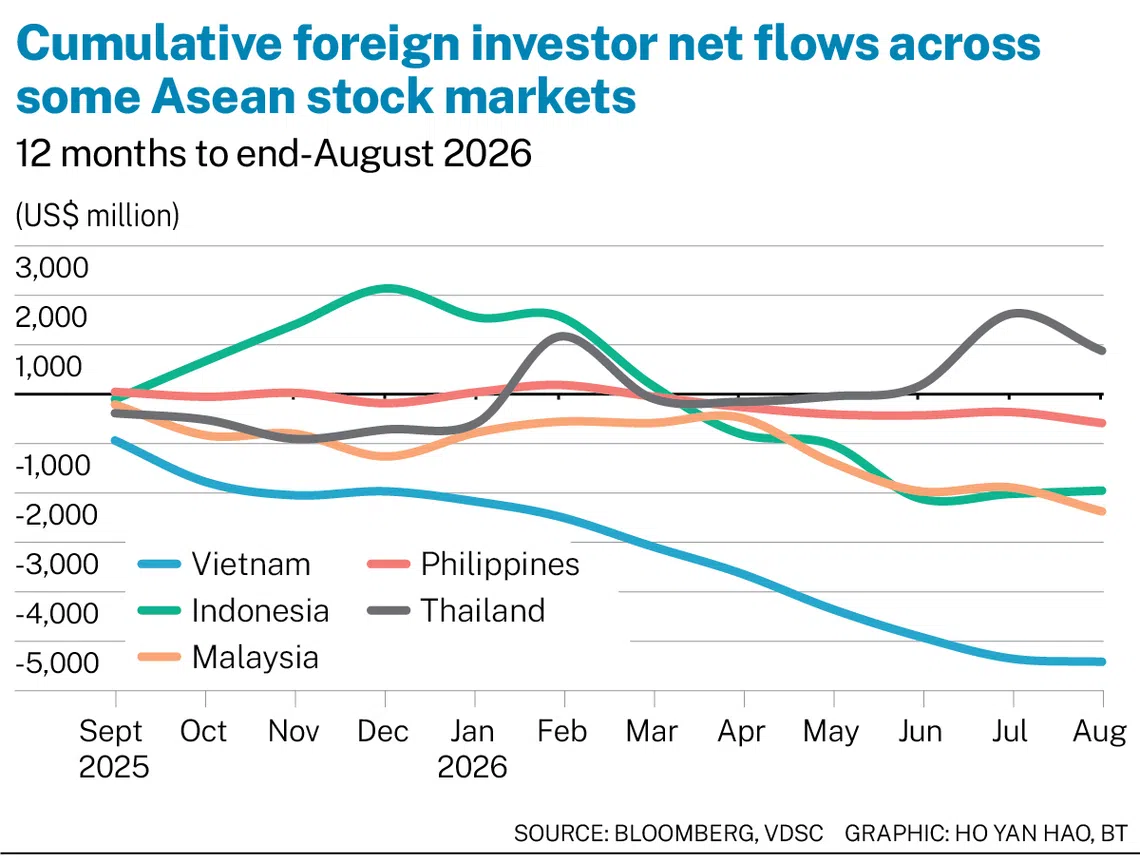
Overseas investors have sold over 95 trillion dong (US$3.6 billion) of Vietnamese stocks so far this year, following an outflow of about US$5 billion in 2025.
Liquidity has remained subdued since the second quarter due to uncertain global monetary and geopolitical outlook, inflation pressure, high interest rates and heavy foreign outflows.
But flows have turned more positive ahead of the upgrade.
Foreign investors were net buyers of more than 1.8 trillion dong of shares over three consecutive sessions this week. On Sep 15 alone, net purchases topped 30 million shares, the highest daily volume in five months.
Still, those purchases do not necessarily signal the beginning of a broad foreign rush. Vietnamese brokerage Viet Dragon Securities noted that markets previously upgraded by FTSE often experience a surge in trading around implementation, but the increase did not necessarily translate into sustained liquidity or further price gains.
According to its analysis of previous FTSE upgrades elsewhere, the median market return 12 months after inclusion was minus 10.5 per cent.
Still, expectations for the longer-term flows are much larger than the initial index purchases.
Hanoi-based financial consulting firm Virtus Prosperity estimates Vietnam could attract about US$6 billion to US$7 billion from September 2026 to end-2027.
It expects around US$2.3 billion to come from passive capital, with a further US$3.7 billion to US$4.7 billion potentially coming from active institutional investors.
“Index fund-related flows may be the first catalyst, but the greater value lies in Vietnam’s ability to attract and retain international institutional capital over many years to come,” said Tran Trong Duc, founder and CEO of Virtus Prosperity.
Private capital looks beyond large caps
Duc said the impact of the FTSE inclusion could extend well beyond foreign funds buying listed stocks and “ripple across the entire capital-market ecosystem”.
“The market upgrade does not just bring in additional capital, it also creates an incentive for Vietnamese companies to upgrade themselves,” he added.
Private-equity capital can come in more robustly and help a company grow and strengthen its governance, improving its ability to pursue an initial public offering or listing. Stronger exit opportunities through the public markets, in turn, can encourage fresh capital to enter earlier-stage companies.
“As exit opportunities improve, funds will also gain greater confidence to invest in Vietnamese companies at an earlier stage,” Duc said. “I believe this can create a virtuous circle.”
Brookland Group & Partners, a private-capital firm based in Dubai and Singapore, is already putting money into smaller Vietnamese companies.
The firm recently agreed to invest up to US$5 million of equity into Big Investment Group, which is planning to shift from the Unlisted Public Company Market to Vietnam’s main bourse – the Ho Chi Minh Stock Exchange – in Q4 2026.
Brookland executives told BT that the firm could ultimately seek to deploy “a couple of billion dollars” in Vietnam, and is in discussions that could lead to further deals similar to Big Investment, though there was no specific timeline.
“We have a strong commitment to Vietnam going forward, particularly as the market moves towards emerging-market status,” said Martin Doan, managing partner at Brookland, noting that the firm expects to be active “as that momentum builds”.
He opined that the Vietnam market’s current liquidity does not match its potential. “A fund like ours can improve companies’ liquidity profiles and their access to institutional capital, which they very much need at this stage.”
John Hall, also managing partner at Brookland, pointed out that foreign investors have historically found it difficult to enter the market and deploy capital.
“Vietnam is not priced appropriately compared with other emerging markets with similar profiles,” he added.
“We therefore welcome more institutional investment, which should reduce the cost of capital,” Hall stated. “Together with the country’s other advantages, that creates the right conditions for an economy that is already booming to grow even further.” THE BUSINESS TIMES
Decoding Asia newsletter: your guide to navigating Asia in a new global order. Sign up here to get Decoding Asia newsletter. Delivered to your inbox. Free.
Share with us your feedback on BT's products and services
TRENDING NOW

DBS, OCBC, UOB rout lops billions off STI as inflation, rate concerns spook investors

Grab CEO’s wife Chloe Tong on life with Anthony Tan and finding her purpose

OCBC sheds S$8 billion in value as shares close nearly 6% down; analysts cautious on banks

Deal between tycoon friends sparks scrutiny of Philippine power sector

