



Who is Suahasil Nazara, the technocrat now holding Indonesia’s purse strings?
He is the country’s third finance minister in under two years; one of his biggest challenges will be reducing policy uncertainty

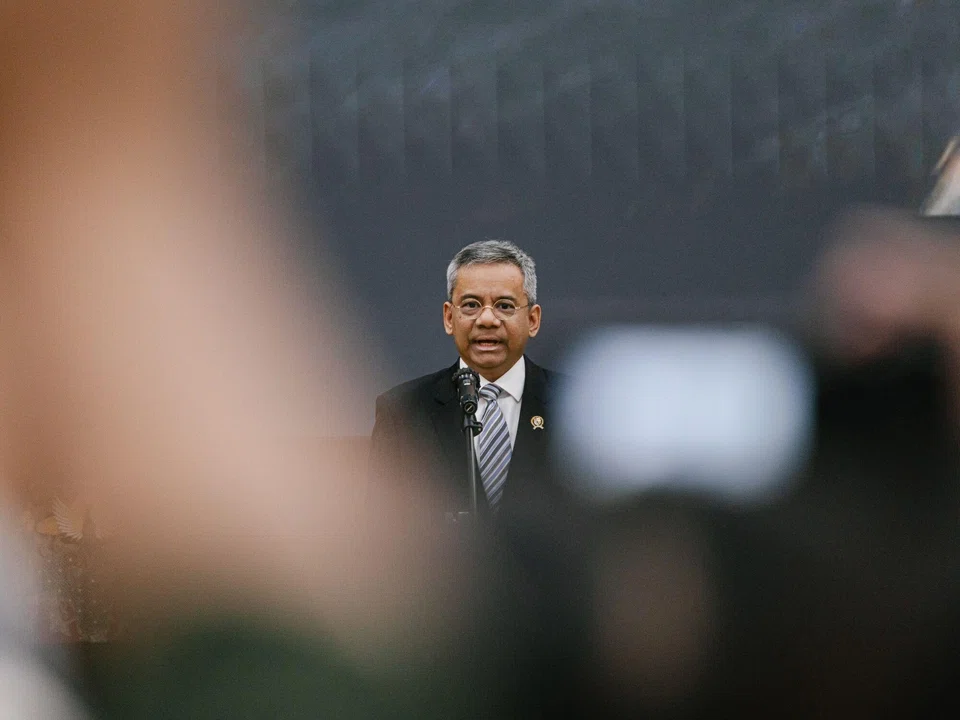
[JAKARTA] Indonesia has appointed Suahasil Nazara as finance minister at a time when investors and businesses are seeking greater certainty over the government’s economic direction.
On Monday (Sep 14), President Prabowo Subianto elevated the 55-year-old to the top job, replacing Purbaya Yudhi Sadewa and making Suahasil the third finance minister since Prabowo took office in October 2024.
His appointment puts an experienced technocrat in charge of the ministry at a particularly demanding time.
The government is seeking 8 per cent growth while maintaining fiscal discipline and investor confidence amid a weakening rupiah, which has been among the region’s worst-performing currencies.
Here is what to know about Suahasil, his policy approach and the challenges awaiting him at the Finance Ministry.
Who is Suahasil Nazara?
Born in Jakarta on Nov 23, 1970, Suahasil hails from a political family. His father, Hanati Nazara, served as regent of Nias, an island off the western coast of Sumatra, from 1981 to 1986 before later becoming a member of Indonesia’s House of Representatives.
An economist by training, Suahasil spent much of his early career in academia before moving into government.
He earned his economics degree from the University of Indonesia in 1994, followed by a master’s degree from Cornell University and a PhD from the University of Illinois at Urbana-Champaign.
Suahasil joined the University of Indonesia’s economics faculty in 1999 and became a professor in 2009.
His government career began with work on fiscal decentralisation and regional autonomy, followed by a stint on the National Economic Committee from 2013 to 2014.
His career at the Finance Ministry accelerated in 2015, when he was appointed acting head of the Fiscal Policy Agency, working alongside then-finance minister Mulyani Indrawati.
In October 2019, then president Joko Widodo appointed him deputy finance minister. He retained the position under Prabowo after the new administration took office in 2024.
Big spending needed
For Suahasil, one of his immediate challenges will be finding enough fiscal space to fund Prabowo’s ambitious spending agenda without undermining the credibility of the Budget, a balancing act that has tested his two predecessors.
Indonesia plans to spend more than 4,000 trillion rupiah (US$230 billion) in 2027, a sum equivalent to roughly a fifth of the country’s annual economic output.
The scale of the Budget reflects the government’s push to fund Prabowo’s flagship programmes, while keeping the fiscal deficit within the legal ceiling of 3 per cent of gross domestic product.
Economists see that the balancing act could prove challenging as revenue growth remains uncertain and borrowing costs stay elevated. Fakhrul Fulvian, chief economist at Trimegah Sekuritas, said that Suahasil will need to rebuild confidence in the government’s fiscal framework.
“He will also need to ensure that the government’s fiscal and quasi-fiscal tools are deployed in a coherent way and towards clearly defined objectives,” added Fakhrul.
Suahasil has pledged to keep Indonesia’s state Budget healthy and credible while ensuring it continues to fund the government’s priority programmes, including keeping the fiscal deficit within the statutory ceiling of 3 per cent of gross domestic product.
Walking a tight rope
Suahasil’s appointment comes as Indonesia faces a tougher global backdrop, with key factors for the Budget – such as inflation and currency exchange – coming under increasing pressure.
Higher global borrowing costs and elevated oil prices driven by the conflict in the Middle East could increase Indonesia’s import bill and the government’s spending on fuel subsidies and compensation, while putting further pressure on the current account.
Ricky Ho, chief investment officer and portfolio manager at Singapore-based fund Four Capital, said that higher oil prices could push inflation up and weaken household purchasing power, leaving Bank Indonesia (BI) with even less room to ease monetary policy.
Under Purbaya, fiscal policy took on a somewhat more expansionary tilt, with the government using measures to channel additional liquidity into the financial system while seeking to support economic activity.
Radhika Rao, senior economist at DBS, expects the new minister to favour fiscal prudence rather than fiscal activism, including adherence to fiscal thresholds, reallocating expenditure rather than relying excessively on additional borrowing, and maintaining buffers against unexpected shocks.
Plans to increase onshore liquidity are also likely to remain in place, Rao said, although the deployment and end-use of funds could be guided by a clearer framework to improve policy effectiveness.
“Coordination with BI and the extent of collaboration on bond issuances and liquidity management will also warrant attention,” she added.
Seeking greater certainty
One of Suahasil’s biggest challenges will be reducing policy uncertainty, which has become an important concern for markets and businesses in Indonesia.
Over the past two years, South-east Asia’s biggest economy has introduced various policy instruments and institutions. They range from increased spending on flagship programmes and the establishment of sovereign wealth fund Danantara, to a broader set of export-related measures.
The policies have left investors scrambling to navigate Indonesia’s shifting policy landscape and assess its impact on investment and capital flows.
Shinta Kamdani, chief executive of Sintesa Group and chairwoman of the Indonesian Employers Association, noted that Suahasil’s extensive experience at the Finance Ministry could help provide policy continuity at a time when companies are seeking greater certainty rather than another abrupt shift in direction.
She highlighted taxation, customs, investment incentives and government spending as areas where greater policy predictability, clearer communication and closer consultation with businesses would be important for investment and business planning.
“We hope any policy changes are implemented in a measured manner, with clear communication and sufficient room for dialogue with the business community, so companies have greater certainty when planning investments and expansion,” Shinta added.
Decoding Asia newsletter: your guide to navigating Asia in a new global order. Sign up here to get Decoding Asia newsletter. Delivered to your inbox. Free.
Copyright SPH Media. All rights reserved.
TRENDING NOW

DBS, OCBC, UOB rout lops billions off STI as inflation, rate concerns spook investors

Grab CEO’s wife Chloe Tong on life with Anthony Tan and finding her purpose

OCBC sheds S$8 billion in value as shares close nearly 6% down; analysts cautious on banks

Deal between tycoon friends sparks scrutiny of Philippine power sector

