After Fed’s expected hold on rates, Warsh paints sanguine picture of US economy
There will be nine rate-setting meetings in 2027, instead of the usual 10
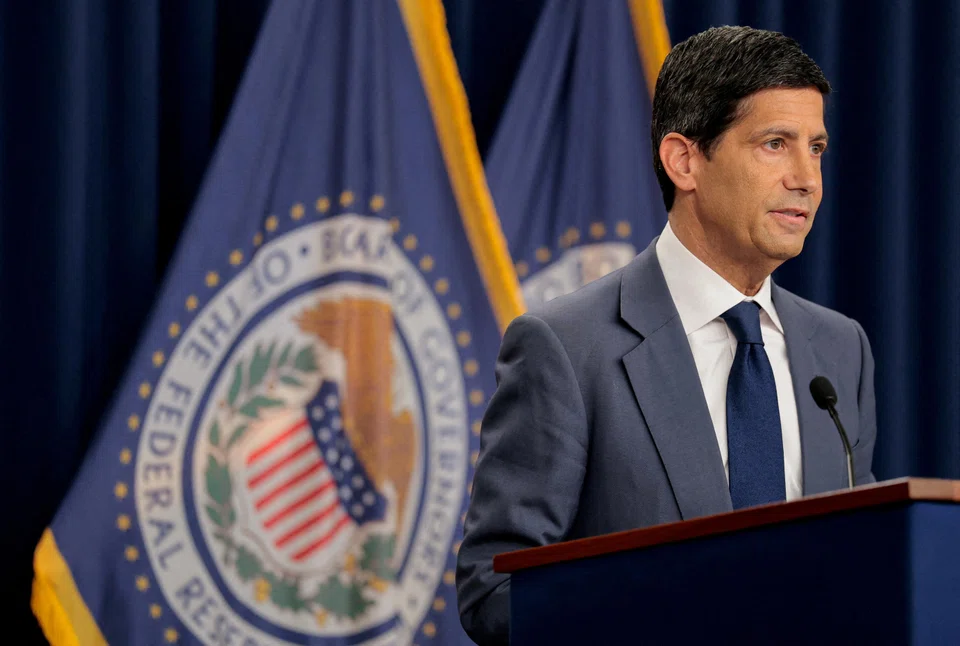
THE US Federal Reserve held rates steady on Wednesday (Oct 28), as most analysts had predicted, but the market response to chairman Kevin Warsh’s rationale suggested there was some confusion about his plan to fight inflation.
The central bank maintained the Fed funds rate in a range of between 3.75 and 4 per cent, with just two dissenters out of 12 voters on the rate-setting committee.
Fed governor Lisa Cook, already the target of an ouster campaign by US President Donald Trump, went against the president’s wishes and voted for a quarter-of-a-percentage-point rate hike. She was joined by Cleveland Fed president Beth Hammack.
Policy-sensitive short-term Treasury yields rose slightly in the immediate aftermath of the split decision, as traders interpreted the move as merely postponing the hike until December. Short-term yields, however, fell during Warsh’s post-meeting press conference.
One brokerage noted that Warsh sent three signs that he was leaning against rate hikes in the near future.
“Unlike the Bank of Canada (which raised rates on Wednesday), he was not worried about oil price pass-through and businesses’ ability to push prices higher,” said strategists at Standard Chartered Global Research in a note to clients.
Indeed, Warsh hardly discussed recent hot inflation data at all, concentrating on longer-term inflation trends.
Second, Warsh emphasised his belief that the September rate hike had already nudged markets in the right direction, the StanChart analysts said. Financial conditions had tightened for both consumers and businesses, he said – a reference to the slowdown in the housing market and recent volatility in technology-related corporate credit.
“Market participants are somewhat more discerning (about which companies, securities or properties they invest in),” said Warsh.
And, third, the StanChart strategists noted that Warsh kept pointing, with a measure of pride, to how sensitive artificial-intelligence investments had become to interest-rate moves.
He was citing this as evidence that the “medicine” of the September rate hike was already taking effect. Speaking in these terms, he had the aspect of a doctor reassuring the patient that the treatment plan would work, as long as they gave it time.
Impact of AI
Warsh also pushed back on the idea that AI ebullience was causing the economy to overheat. Indeed, he painted a sanguine picture of the US economy during the current AI boom.
The labour market seemed to be recovering momentum, he said, and there were signs that the historic growth in business investment was “broadening out” from data centre development.
The Fed is closely monitoring the impact of AI on the economy and will soon hold a summit on the matter in San Francisco.
Still, Warsh suggested the worst fears about the technology’s negative impact on the jobs market and inflation may be unfounded. On the contrary, he said there was hope that productivity improvements driven by AI’s time-saving efficiency could allow the economy to grow faster for longer without creating inflationary pressure.
It was not all wine and roses, of course. Warsh acknowledged that the Fed’s six-year long failure to get inflation back to its 2 per cent target was frustrating Americans. Despite this prolonged bout of price increases, he said, inflation expectations remain anchored.
The biggest change on Wednesday was related to the Fed’s calendar.
Warsh said there would be only nine rate-setting meetings in 2027, instead of the usual 10. The Fed’s board would still meet on 10 occasions, but one meeting would be set aside for the “left side of the decimal point”, as Warsh put it.
Rather than the usual discussion of a short-term policy decision, the 10th meeting would allow central bankers to discuss long-term strategy and economic trends.
Reactions to Warsh
The stock market rose modestly due to Warsh’s unexpectedly dovish take on the economy and interest-rate levels. However, on the Treasury market, long-term yields rose.
Despite Warsh’s insistence that the Fed would take care of it, the rise in the yields of the 30-year bond could be an indication that the bond vigilantes are saddling up again and preparing to fight inflation by driving up the costs of mortgages and other loans – with or without the Fed’s help.
Also on Wednesday, oil futures tested six-month highs after reports that the US was preparing to escalate military action in Iran after the midterm elections.
The disruption has already caused oil prices to almost double from pre-war levels. Diesel futures are sitting near record highs in much of the US, pushing up the prices of everything that has to be shipped.
One long-time market watcher argued that Warsh’s determination not to sound alarmist on inflation will soon look like complacency.
“The Fed decided to hold rates in a passive stance, which marked the explicit confirmation that they are actively ignoring the inflation picture,” said German economist Felix Nikolas Prehn in his Substack newsletter Capital Flows.
“This policy error is being underestimated by positioning and will continue to be downplayed by market participants.”
Decoding Asia newsletter: your guide to navigating Asia in a new global order. Sign up here to get Decoding Asia newsletter. Delivered to your inbox. Free.
Share with us your feedback on BT's products and services