



China’s first humanoid robot incubator has its eyes set on South-east Asia – starting with a Singapore office
It hopes to connect Chinese manufacturers with the city-state’s various application scenarios
[SHANGHAI] A Chinese humanoid robotics incubator is planning to set up an office in Singapore amid a concerted artificial intelligence push in the city-state, including planned large-scale smart robot trials.
The Shanghai Humanoid Robot Innovation Incubator, the first in China focusing on humanoid robots, is looking to open its Singapore office in the second half of the year.
In China, which is famous for its humanoid robots with life-like movements, the incubator has helped companies trial or go to market with several robotics products.
Rong Guoqiang, general manager of the incubator, noted Singapore’s “strong technological concentration and excellent digital infrastructure”.
He pointed to a marriage of two attributes: China’s robotics industry has very strong capabilities in testing and development, which can be done at relatively low cost, whereas Singapore has needs in specific scenarios such as education, healthcare and in households.
“The robot itself is very well made, and it can be applied in healthcare, finance, security patrols and night-time operational support,” Rong said in Mandarin.
“But robots must be integrated with specific scenarios. In practical terms, that means combining digitalised demand structures with large AI models before real deployment can happen.”
Rong said that it is hoped the Singapore office can establish these structures.
“We hope to recruit people who are very familiar with Singapore’s local policies, regulations, licensing systems and digital applications. That way, we can connect China’s large number of humanoid robot manufacturers with Singapore’s various application scenarios,” he said.

He added that there are plans to hire for a “double-digit” number of roles.
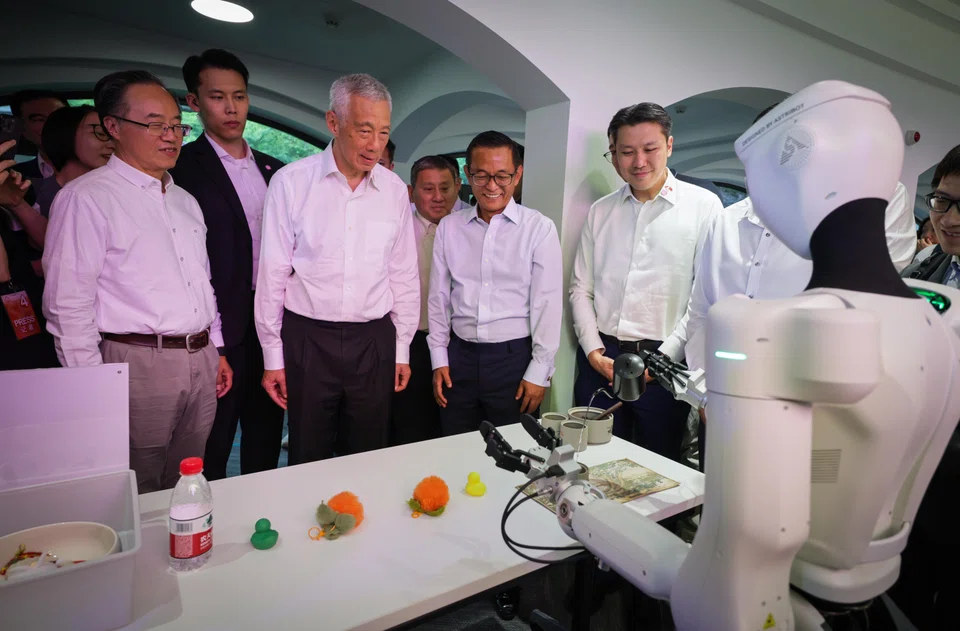
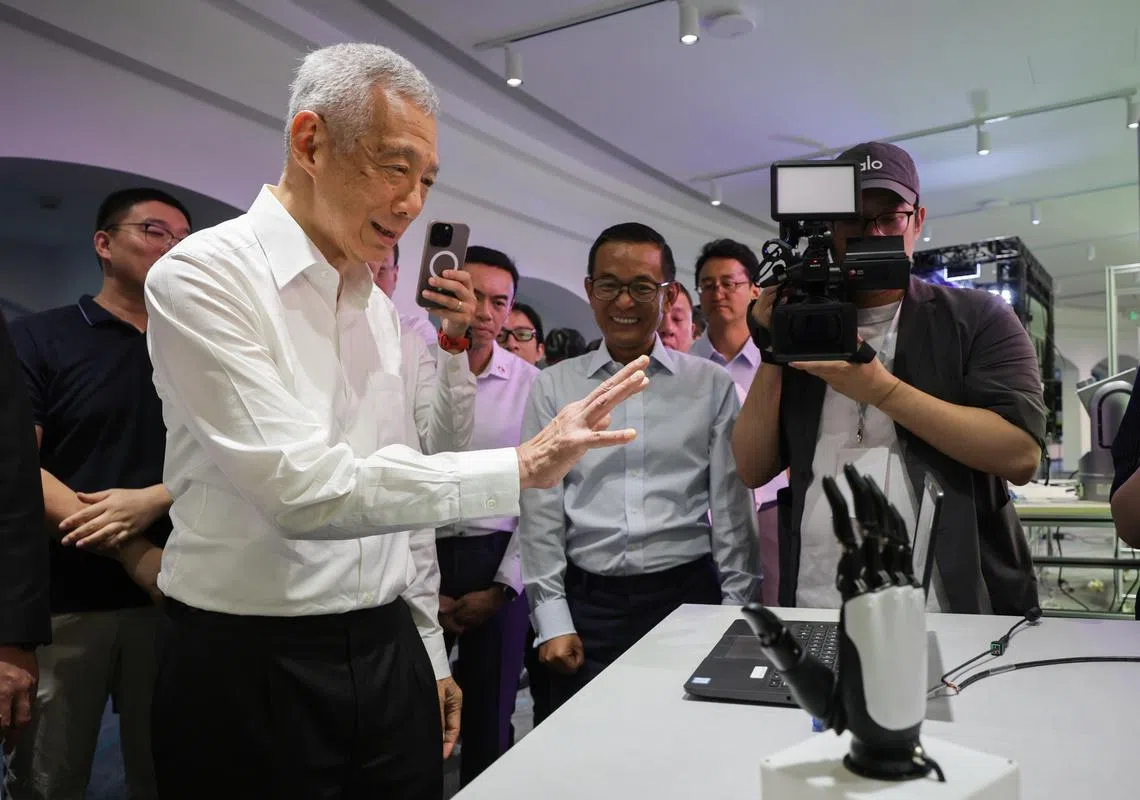
Senior Minister Lee Hsien Loong, on the fourth day of his five-day visit to China, toured the incubator facility, where he observed several robot demonstrations.
He arrived in Shanghai on Wednesday (May 20) from Nanning in Guangxi where he visited a port facility and a logistics park; he also met the Guangxi party secretary Chen Gang.
Adding value to Singapore
Rong said the incubator is already in talks with various universities and medical institutions in Singapore.
“We (also) hope to bring Chinese companies to Singapore. But it’s not simply about relocating them there; it’s about helping them contribute meaningful services, (and) value to Singapore,” he said.
“We hope these companies can work together with local Singaporean companies and professionals to form new types of businesses and... services.”
Rong said that the firm began preparing for overseas expansion at the end of 2025 and the beginning of this year, and gradually began expanding into South-east Asia and Hong Kong.
“Besides Hong Kong and Singapore, we may also make arrangements and deployments in Malaysia,” he said.
“Objectively speaking, we believe South-east Asia has enormous future demand for humanoid robots. In particular, there are many manufacturing enterprises in South-east Asia whose demand for humanoid robots has not yet been fully developed.”
China, which is dominating the humanoid robot market, released its new Five-Year Plan in March with a focus on adopting AI tech and dominate emerging tech, such as humanoid robots and quantum computing.
This comes amid an ongoing battle with the US for tech supremacy on chips and other tech.
Singapore is making its own AI push. The government announced this week that it is seeking to broaden AI adoption among Singapore-based small and medium-sized enterprises by supporting 10,000 firms over the next three years.
Other refreshed priorities include nurturing and continuing to attract top-tier AI talent, as well as building capabilities across AI research.
The Infocomm Media Development Authority, JTC Corporation and the Singapore Institute of Technology are also embarking on new collaborations with eight industry leaders at the Punggol Digital District to bring physical AI to the real world.
A test bed will be launched later in 2026 to research, test and deploy physical AI. America’s OpenAI has also committed more than S$300 million to strengthen Singapore’s AI ecosystem.
Decoding Asia newsletter: your guide to navigating Asia in a new global order. Sign up here to get Decoding Asia newsletter. Delivered to your inbox. Free.
Copyright SPH Media. All rights reserved.
TRENDING NOW

Once staunchly pro-China, Malaysian Chinese businesses are now distancing themselves from Beijing

Looking beyond looming CEO succession, should UOB potentially pursue a transformative merger?

Could stablecoins be the future of money?

Grab CEO’s wife Chloe Tong on life with Anthony Tan and finding her purpose

