



‘The value of not panicking’: Analysts urge caution amid wild swings in markets as Gulf conflict continues
Selling prematurely can be an ‘expensive mistake,’ says one analyst

[SINGAPORE] Analysts are warning investors to maintain a “cautious” stance as markets swing on the back of developments in the Gulf conflict.
Oil prices sank to US$90 per barrel after surging to nearly US$120 on Monday (Mar 9). Spot gold prices have also see-sawed, dipping 1 per cent to US$5,095 per troy ounce at Monday’s open before rising 1.4 per cent to US$5,164.71 in the evening in Asia.
Broader Asia markets rebounded, too. Singapore’s Straits Times Index (STI) closed 2.2 per cent higher on Tuesday, South Korea’s Kospi ended 5.4 per cent up after a long rout last week, and Japan’s Nikkei 225 finished 2.9 per cent higher.
In the West, US counters closed higher on Monday, with the S&P 500 and Nasdaq both gaining ground as investors moved back into risk assets.
Such reactions suggest that investors are already “positioning for a cooling of tensions in the Middle East”, even though there has been no diplomatic breakthrough, said Nigel Green, chief executive officer of deVere Group.
“The reality is that markets often move first and verify later,” he noted. “Markets might currently be leaning toward a de-escalation scenario, but investors need to remember how quickly geopolitical realities can change.”
Experts say that acting prematurely may therefore not be the best move for investor portfolios over the long term.
Ipek Ozkardeskaya, senior analyst at Swissquote, said the best thing to do is to “hold on and avoid reacting in panic”.
This is due to “little clarity” about the US’ plans in the war, she explained. Ozkardeskaya noted that officials’ statements sometimes contradict each other, and price action will ultimately depend on geopolitical developments.
Duncan Lamont, head of strategic research at Schroders, said that selling equities in response to market disruption would be an “expensive mistake” for investors.
While shifting into cash or safe-haven assets such as short-term government bonds may seem to be the most prudent response, historical data shows the average gains of markets within the course of a year often exceed the losses, he added.
Based on the MSCI World Index, stocks fell by an average of 15 per cent and rose 23 per cent each year from 1972 to 2024.
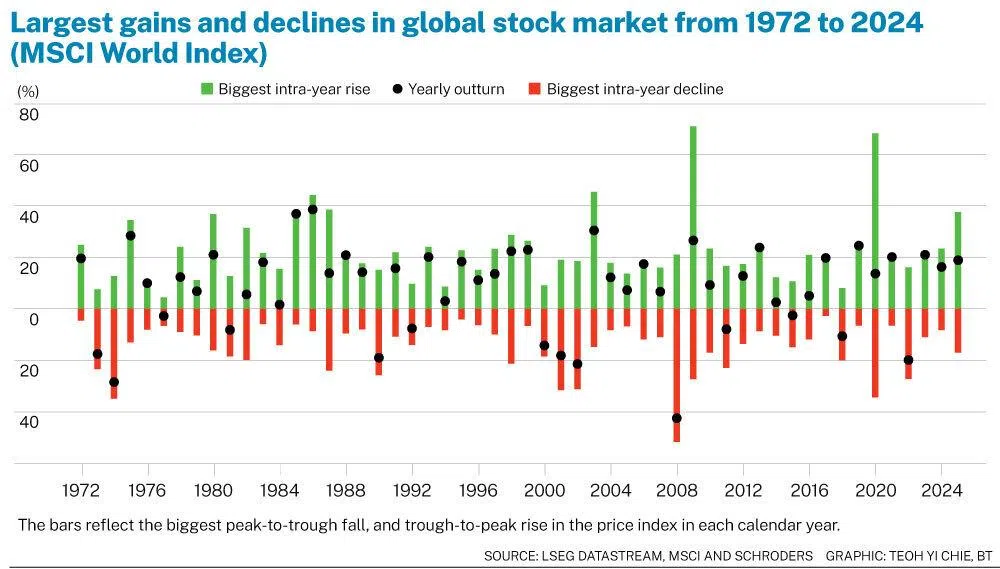
“For equity markets, history certainly shows the value of not panicking amid market turmoil,” said Lamont.
“In periods of uncertainty or shock, markets can often sell off indiscriminately,” he noted. “Good companies are sold alongside bad ones, becoming mispriced.”
Other risks of timing the market include returning to the markets only after the largest uptick occurs – as recoveries can come in abrupt bursts – and capturing losses in a short-term downturn when selling equities amid turmoil.
Impact on Singapore
Chua Han Teng, senior economist at DBS Bank, said Singapore will be affected by the conflict in the Middle East due to its dependence on energy imports.
The Republic relies “heavily” on natural gas for electricity generation, accounting for over 90 per cent of the energy mix, with costs tied to oil prices by commercial contracts, he wrote in a Tuesday report.
That said, it has “ample policy space” to tackle the external shock from current geopolitical uncertainty, Chua noted.
“We think the government has significant room to deploy targeted cost-of-living support measures, should energy-driven inflation place meaningful pressures on households over the coming months, consistent with its response in past high inflation periods in 2022 and 2023,” he said.
Chua Jen-Ai, Asia equity research analyst at Julius Baer, also maintains a positive view on Singapore in the South-east Asian equities space. She noted that the country is “likely to be a beneficiary of safe-haven flows”.
“The street believes that the Middle East conflict may tilt the Monetary Authority of Singapore’s assessment of risks to the inflation outlook to the upside, increasing the odds of an earlier steepening of the Singapore dollar effective exchange rate slope in April,” she said in a Monday note.
DBS on Mar 5 lifted its STI end-2026 target to 5,250, reflecting a 7 per cent upside, assuming present tensions are short-lived and do not lead to major market disruption. “We see technical support for the STI at 4,760 to 4,800, with the next support around 4,700, and therefore recommend buying on market dips.”
Defence counters such as ST Engineering , oil and gas names Nam Cheong and Seatrium , as well as stocks defensive with yield such as Netlink , “could benefit if tensions persist”, while high oil prices would be “negative for transport stocks”, DBS added.
Decoding Asia newsletter: your guide to navigating Asia in a new global order. Sign up here to get Decoding Asia newsletter. Delivered to your inbox. Free.
Copyright SPH Media. All rights reserved.
TRENDING NOW

Malaysian king buys stake in Singapore-listed mining firm expanding into rare earths

Family offices ‘kept captive’ by relationship managers turn to independent advisers, direct deals

Once staunchly pro-China, Malaysian Chinese businesses are now distancing themselves from Beijing

Could stablecoins be the future of money?

