

Signs of higher voter turnout in Johor state polls than in 2022 – what does this mean for contenders?
Voter turnout may surpass the 55% of the last Johor state election in 2022
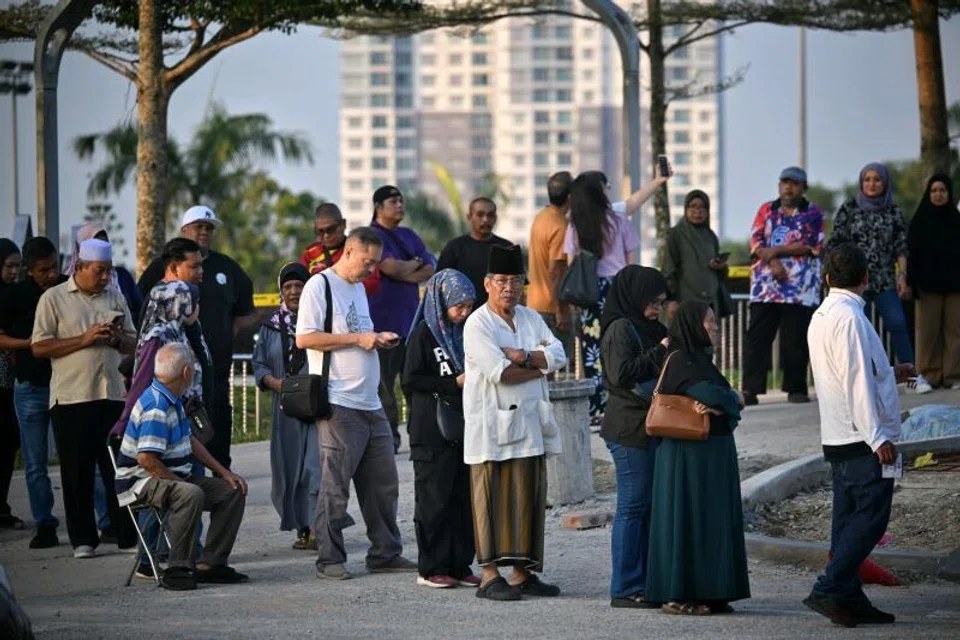
[JOHOR BAHRU] Johor’s state polls on Saturday (Jul) 11 will be closely watched for clues to Malaysia’s national political direction, with the next general election due to be called by February 2028.
Polls opened at 8 am across the state’s 1,076 polling stations, where up to 2.7 million voters will pick their representatives from 172 candidates to fill Johor’s 56 constituencies.
So far, there are signs that voter turnout will be higher than the 55 per cent at the last Johor state election in 2022. As at 11 am, the turnout was 26.4 per cent, up from 21.3 per cent at the same hour in 2022.
The Election Commission is projecting that seven in 10 eligible voters will cast their ballots, with train and bus tickets to Johor reportedly sold out ahead of polling day.
Larkin voter Ally Chang was first in line at Tanjung Puteri Primary School along Jalan Dato Jaafar to dip her index finger in purple ink at the ballot box. She had been queuing since 7 am.
“My hope is that Johor will continue to prosper,” said the 44-year-old accountant.
Second in the queue was retiree Md Sis Talkam, 79, who fussed about being made to wait under the morning sun. “Usually they open the voting centre early and I’m done by 7.30 am. I pity the elderly who have to wait and dry themselves out in the hot sun.”
However, over in Muar, heavy morning rain has dampened voter turnout, with Simpang Jeram and Bentayan constituencies recording the lowest turnout numbers across Johor.
At a breakfast place in Jalan Khalidi, Rosli Mat Noor, 46, said there is no need to rush.

“We have all day,” he said.
Malaysian United Democratic Alliance (MUDA) candidate for Simpang Jeram, Ainie Haziqah, meanwhile is concerned as storm clouds continue to hang over Muar, one hour since polling began. “I hope it will slowly subside,” Ainie told The Straits Times.
Cross-border traffic
Cross-border traffic from Singapore into Johor Bahru on Friday, the day before Polling Day, was moderate. Congestion across the Causeway was minimal for a Friday night, with longer queues for cars.
South-bound traffic on the North-South Expressway was reportedly congested as voters living in Klang Valley head back to their hometown after work to cast their ballots.
Nasuha Suhaimie, 34, a bank employee who will be voting in Tiram in Johor likened the trip home to a “balik kampung” rush. Her trip from Kuala Lumpur took over six hours.
Johorean Chong Li Yun who rode pillion across the border on her partner’s motorcycle around 11 pm on Friday described traffic as “smooth like butter”.
Singaporeans on online traffic monitoring Facebook pages asked regular visitors to take a break from shopping this weekend. “Let the Johoreans go back with less traffic, Johor will always be there,” one wrote.
At around 9 pm on Friday, some 200 Johoreans returning from Singapore gathered at JB Sentral to board eight coaches bound for Kluang, Batu Pahat, Segamat, Labis and Muar.
ST understands the buses were arranged by Malaysian NGO SKLHA Youth and Rakyat Supervision, coordinated by members of the Pakatan Harapan (PH) alliance.
Jane Low, 29, who works in Singapore in IT support and is bound for Segamat, said the federal government has done well the past four years and that her vote shows her hope for the country to continue to prosper.
“I hope that all races, Malay, Indians and Chinese can all live and work together,” she said.
Last appeal to voters
In their last sprint before Polling Day, parties fell back on familiar political rhetoric.
Campaign flashpoints included renewed calls for jailed former prime minister Najib Razak’s release and racial issues sparked by Johor caretaker menteri besar Onn Hafiz’s pledge not to work with the Chinese-majority Democratic Action Party (DAP) if Barisan Nasional (BN) forms the next state government in Johor.
Parties also turned to crowd-pleasers at their final rallies, offering everything from free durians to performances by popular artists.
On Thursday, hands and camera phones were raised to welcome Prime Minister Anwar Ibrahim, who apologised for his late arrival just before midnight at a campaign event for the Puteri Wangsa candidate.
It was his third campaigning stop that day, a day after crooning My Way with his visiting Thai counterpart Anutin Charnvirakul.
In a call to voters to come home to vote, PM Anwar said the votes cast on Saturday represent the “power of the people of Johor” and that voters should not “compromise on your humour and dignity”.
“No sakau (stealing) in this nation!” said Anwar, who is Pakatan Harapan chairman, invoking his government’s anti-corruption rally to the crowd of more than 1,000 gathered in a field surrounded by vendors selling snacks and Harapan gear in the coalition’s red.
In the final week of campaigning, BN candidates were seen on social media reaching out to non-Malay voters during rallies and walkabouts.
Candidate Pandak Ahmad for instance - who is defending his seat in Kota Iskandar where a sizeable 35 per cent are Chinese and 17 per cent are Indians - uploaded several videos on his social media accounts meeting elderly Chinese folks in markets and parks.
At a BN rally in Johor Bahru’s Kempas suburb on Thursday, former health minister Khairy Jamaluddin weighed in on the Najib controversy.
He said that Najib’s jail verdict has already been decided and that if there is any authority that could free Najib, it would be the King.
In a rare call to “non-Barisan Nasional” supporters, the podcaster - also known for his moniker KJ - appealed to these voters to support former economy minister Rafizi Ramli’s Bersama instead.
“If there are Pakatan voters out there, of course the best is to vote Barisan Nasional. But if you can’t support Barisan, then I urge you to go out there and vote Bersama,” Khairy said.
Calling Anwar’s reform movement “reformati” instead of “reformasi”, Khairy said Rafizi is a man of principles and had left Anwar’s Parti Keadilan Rakyat (PKR) because he had lost trust over the latter’s reform promises.
Split in opposition coalition PN
Meanwhile, opposition coalition Perikatan Nasional (PN), which posed an existential threat to BN in 2022, is contesting just 33 seats at this state election, while being mired in internal squabbling between its main component parties Parti Islam SeMalaysia (PAS) and Bersatu.
The tensions have effectively split PN’s campaign in two, with both parties running largely separate operations despite contesting under the same banner.
For Bersatu, even the presence of former prime minister Muhyiddin Yassin — a long-serving former Johor menteri besar — has failed to generate much enthusiasm. At a rally in Parit Raja, Batu Paha on Tuesday, the veteran leader spoke to rows of largely empty seats.
His speech focused heavily on attacking the DAP, which he accused of being “anti-Islam, anti-Malay, as well as the Malay language”. Muhyiddin also criticised BN for cooperating with DAP at the federal level while campaigning against the party in Johor.
“Are these the people we want to support?” Muhyiddin asked the crowd.
For PAS, the Johor election is seen as part of a broader effort to build political momentum against Anwar’s PH coalition ahead of the next general election and prevent Anwar from returning as prime minister for a second term.
PN election director Annuar Musa said a rejection of PH and DAP by Johor voters would provide momentum for the Negeri Sembilan election, scheduled for Aug 1.
“If Johor returns a government without DAP, then in Negeri Sembilan we will also topple the PH government and replace it with a government of PN and like-minded parties,” Annuar said at the bloc’s “grand finale” campaign in Muar on Wednesday.
What to watch the moment ballots close later at 5 pm
Once voting ends at 5 pm, attention will quickly shift beyond who wins the 56 seats in the state assembly.
While the results will determine who governs the southernmost state, there are other key metrics when the dust settles. These will be more pertinent when it comes to whether Prime Minister Anwar Ibrahim can secure a second term as Malaysia’s leader.
After a two-week campaign, the UMNO-led Barisan Nasional (BN) coalition will be looking to further its dominance in its birth state by increasing its tally beyond the 40 seats it won in March 2022.
But seat numbers alone will not determine whether BN is truly on the comeback trail after its worst-ever general election showing in 2022, when it won just 30 of Parliament’s 222 seats.
As Iseas-Yusof Ishak Institute’s Malaysia studies programme coordinator Francis Hutchinson noted in an Asian Insider podcast episode, BN has consistently won just under 600,000 votes in Johor at both the 2018 and 2022 general elections.
It also won a similar number of votes in the 2022 Johor state election, which was held eight months before the national polls.
“This (number) speaks to the machinery, the discipline that BN has … If we see a swing up from this number, this means that ‘Rumah Bangsa’ is working,” said Hutchinson, referring to the “House of the Nation” initiative that’s allowing exiled members and leaders like former ministers Khairy Jamaluddin and Hishammuddin Hussein to return to the fold.
Such a result would also show that supporters are returning after UMNO lost federal power for the first time in 2018, an election which saw many from its core Malay Muslim votebank pick the likes of Parti Pribumi Bersatu Malaysia – then part of ruling coalition PH – and Parti Islam SeMalaysia (PAS) instead.
For Anwar’s PH, however, its fortunes have long depended on its ability to energise Malaysians to vote against the once-dominant UMNO.
That messaging – that BN is rife with corruption and racism – has been a tough sell since PH and BN formed a unity government following Malaysia’s first ever hung Parliament in 2022.
“Pakatan Harapan has a higher outstation voter base, so this will help us understand if there’s a bit of still of mojo, that even for a state election that’s not so important, the base comes out by itself, organises itself to come out to vote,” Hutchinson said on the Asian Insider podcast.
Among Malaysia’s three main national coalitions, opposition Perikatan Nasional (PN) entered the Johor election with little expectation of forming the state government.
PN is contesting in just 33 seats, while an ongoing rift between Islamist PAS and Malay nationalist party Bersatu has seen the two parties campaign separately rather than as a united front.
Still, there is keen interest on whether PAS can continue to make inroads outside of its northern strongholds.
Observers will also see if Bersatu, rocked by a swathe of defections to sacked deputy president Hamzah Zainudin’s Parti Wawasan Negara, can maintain its foothold around former prime minister Muhyiddin Yassin’s base of Pagoh in central Johor.
“He (Muhyiddin)’s been associated with that constituency since 1978. The Education Hub in Pagoh… was something… he brought there during his time as a Cabinet member,” Hutchinson added. THE STRAITS TIMES
Decoding Asia newsletter: your guide to navigating Asia in a new global order. Sign up here to get Decoding Asia newsletter. Delivered to your inbox. Free.
Share with us your feedback on BT's products and services






