

Singapore proposes a UN framework convention on AI safety
He says new institutions will also be necessary amid loud calls for AI safety from top AI tech leaders, safety researchers and lawmakers
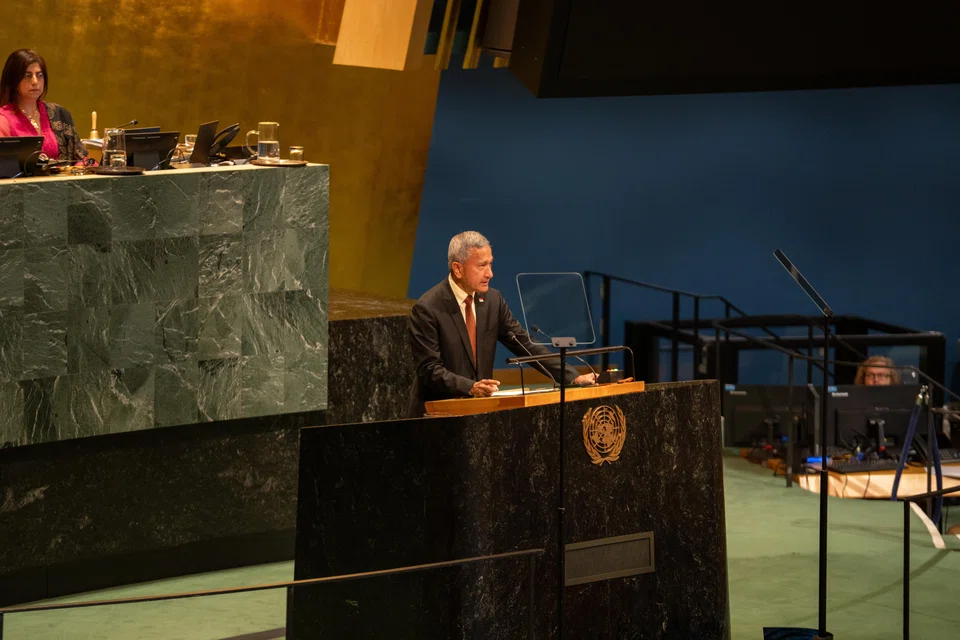
[PHILADELPHIA] As the US and China accelerate their artificial intelligence push, it is too late to ask for a safety pause, but what would help is the creation of institutions that can set safeguards and standards, Singapore Foreign Minister Vivian Balakrishnan told the United Nations in a speech on Saturday (Sep 26).
“We must collectively formulate new rules and be prepared to create new institutions, if necessary, for new technologies,” Balakrishnan said while delivering Singapore’s national statement at the General Debate of the UN General Assembly (UNGA) in New York.
“We must explore all options, including the idea of a UN Framework Convention on AI Safeguards,” he said in a 20-minute speech that advocated revitalising multilateralism to tackle acute geopolitical challenges.
A framework convention, like the one adopted by the UN on climate change, could be in the form of a broad international treaty that establishes foundational principles and cooperative institutions and provides the architecture for international action.
A similar call was made by Turkish President Recep Erdogan who used his address at the UN to stress the need for a common international legal framework for AI.
Balakrishnan said new institutions would also be necessary amid loud calls for AI safety from top AI tech leaders, safety researchers and lawmakers who warn that AI capabilities are advancing faster than the human ability to safely manage them.
“We may also need an international institution that can perform for AI some of the functions that currently exist for institutions that perform this function of setting common technical standards,” the minister said, citing the examples of the International Telecommunications Union (ITU), which manages global telecommunications and digital networks and the International Atomic Energy Agency (IAEA) which oversees the peaceful and safe use of nuclear technology.
Balakrishnan said the risks arose from three possibilities – the loss of control of autonomous systems; the misuse by rogue actors to create bio weapons or other weapons of mass destruction, and pervasive political and socio-economic disruption.
“But the genie is already out of the bottle,” he added, in a reference to the clamour for safety as well as the nascent efforts between the US and China to set up a dialogue on the issue.
SEE ALSO

“It is too late to call for a halt, especially given the superpower rivalry and the huge financial incentives for companies who already have frontier models,” he said.
He used the analogy of a car and traffic lights to bring the point home.
“To drive a high-performance car quickly and safely, you need a powerful engine, but equally, you need good brakes,” he said.
“And especially if you are going to go beyond your neighbourhood or cross boundaries, you need effective shared rules, traffic lights, insurance, norms of behaviour, and seat belts,” he added.
“Our safeguards must keep pace,” he said, calling for rigorous testing and evaluation before deployment.
“We need clear limits on what autonomous systems can do, and mechanisms to intervene when they behave in ways we do not care,” he said.
He also said these mechanisms had to be universally recognisable.
“Since the risks from AI do not remain confined behind borders, it means we also need rules of the road that will form a shared global understanding of how we will collectively confront this challenge, just as all of us instinctively understand traffic lights the same way, whether we’re here in New York, or in Beijing, Moscow, or Singapore,” he added.
Above all, human beings must ultimately remain in charge.
“Do you want the nuclear button to be in the hands of a human being or an AI?” he asked.
Any durable international approach must also give all states a meaningful stake, he added, not only those with the “most advanced models, the deepest pockets or the largest set of armaments.”
Singapore is contributing to ongoing efforts too, he added.
“This week, we joined the call for greater safety and security of frontier AI models,” he said.
Over 20 countries and the European Union signed a declaration led by Finland and Norway on the sidelines of the UNGA in New York. It calls for binding international government oversight over frontier AI models, rather than corporate self-regulation
Global cooperation over AI must begin now, Balakrishnan said.
“Rules do not stop us or slow us down. They give us the assurance and the confidence so that we can move faster and more effectively for the benefit of all our peoples.”
Why China is dogged in pursuit of AI
During a Sep 25 conversation with former Australian prime minister Kevin Rudd, who is now global president and chief executive of Asia Society in New York, Minister Balakrishnan zeroed in on the US-China battle over AI.
China sees the AI race through a deeply historical lens, he said. Having missed the 20th century industrial revolution, it is especially keen not to miss the boat a second time.
“Because China missed it, China underwent a century plus of humiliation and unequal treaties. This time, China has absolutely no intention of missing it again,” Balakrishnan said in a wide-ranging, hour-long discussion which challenged the ways in which the US seizes the competition from China.
“You need to understand it is not just a matter of competition with America, being number one or number two, and I am projecting into China’s motivations, but China says: ‘this is my turn, my time in the sunshine. Why should anyone get in the way, especially when I have the human talent, the brain power?’,” he said.
“So can you understand from China’s perspective, ‘I am not going to make the strategic mistake made a century and a half ago. This is a strategic opportunity and I do not want anyone to get in my way. And all I am asking for is a level playing field, and access to technology, and to get ahead as quickly as I can’,” he said.
Rudd pointed out that China was heavily using state subsidies to win the AI race, a part of the frequent western criticism of the Chinese economy where domestic consumption remains weak and growth comes from exports.
Balakrishnan agreed on the pervasive use of subsidies but said they did not fully explain the country’s successes with AI. China also has a scientific and technological backbone, he pointed out, that has beaten the US and western European nations in manufacturing and adoption of robotics, electric vehicles and renewable energy.
What also eggs on the Chinese AI companies is the cut-throat domestic competition which results in the creation of cheap and efficient Chinese AI models, he added.
The US, he said, had a longstanding ecosystem edge that “quickly converts technology into products and services and companies and a profit generating machine.”
‘Even big powers need partners’
In his UN speech, Balakrishnan also renewed a call for multilateralism in the face of rising trade barriers, supply chain disruptions, worsening climate change and massive tech-disruptions.
“Our interstate relations are increasingly dictated by raw power, where the outcomes are determined on the basis of size, leverage, and coercion, and this poses obviously a clear and present danger for smaller states like Singapore,” he said.
“But the point I wanted to make is that even the more powerful states would ultimately pay a price because hard power, on its own, cannot secure supply chains, protect populations from pandemics, or stabilise a warming planet. Even big powers need partners to secure their long-term national interests,” he said.
The question was not whether we need multilateralism but how to make it fit for purpose, he said, suggesting that international law must be consistently complied with while existing international institutions are reformed.
In particular, he dwelt on the importance of maintaining freedom of navigation and overflight to protect global supply chains in the wake of the Iran war which has halted crucial oil, gas and fertiliser shipments across the Strait of Hormuz.
“Transit passage through straits used for international navigation is a right for all of us,” he said.
“It’s not a privilege subject to fees and tolls, and this is customary international law, which means it is binding on all states, whether or not they consider themselves parties to Unclos,” he said.
Unclos, the United Nations Convention on the Law of the Sea, an international treaty adopted in 1982, establishes a legal framework governing all activities in the world’s oceans and seas. It was concluded under the presidency of former Singaporean diplomat Tommy Koh.
“The largest economies depend on the open sea lanes as much as the smallest, and we in Singapore hold ourselves to the same standard,” said Balakrishnan.
“The Strait of Singapore is less than two nautical miles at its narrowest, and yet nearly a quarter of the world’s sea-born trade passes through the Strait of Singapore,” he said.
Singapore, along with Indonesia and Malaysia, the other two littoral states of the Straits of Malacca and Singapore, have worked with other users of these straits to keep the straits open, secure, and accessible to everyone, he said. THE STRAITS TIMES
Decoding Asia newsletter: your guide to navigating Asia in a new global order. Sign up here to get Decoding Asia newsletter. Delivered to your inbox. Free.
Share with us your feedback on BT's products and services
TRENDING NOW

Grab CEO’s wife Chloe Tong on life with Anthony Tan and finding her purpose

He built the Vingroup empire. Now South-east Asia’s richest man is handing some key roles to his sons
US says China to buy 10 million tonnes of coal in 2027 and 2028

Tokyo reverses baby bust with AI matchmaking and generous subsidies

