

Trump complained about the weak yen. Days later, Japan PM Takaichi signals the end of reflation
Analysts see this as political signalling to appease Washington – without clear change in substance
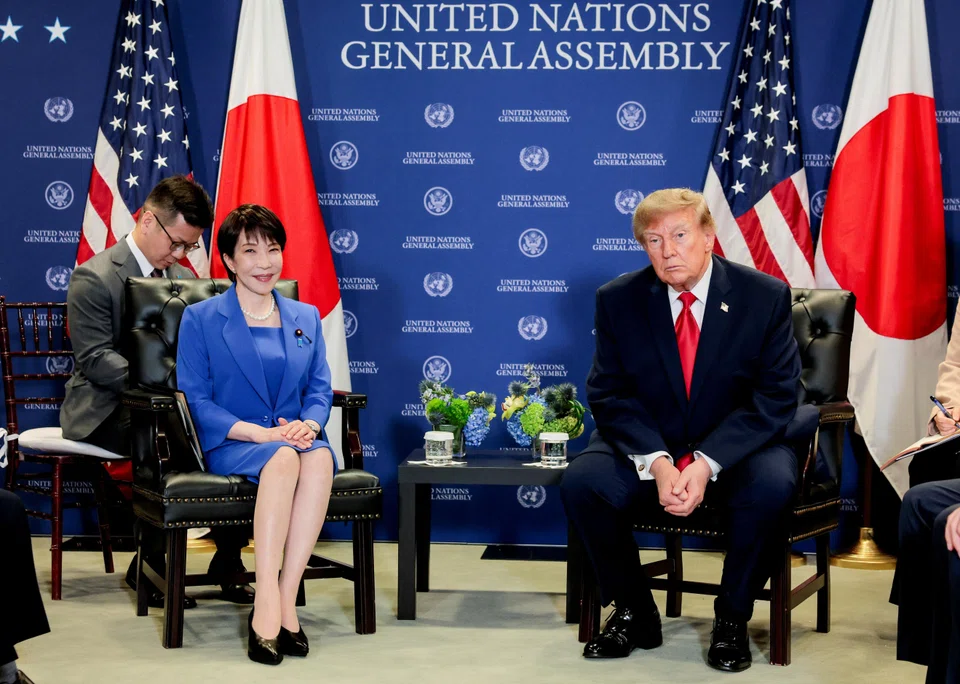
[TOKYO] Ever since US President Donald Trump voiced frustration over the weak yen during a late-September summit with Japanese Prime Minister Sanae Takaichi, Tokyo has moved quickly to declare that its era of reflation is over.
Delivering her parliamentary policy speech on Monday (Oct 5), Takaichi described 2026 as the “first year of responsible, proactive fiscal policy”.
On Thursday, she rejected the “reflationary” label at a parliamentary debate, saying: “We are promoting domestic investment to raise Japan’s potential growth rate, increase quality employment and incomes, improve consumer sentiment, boost corporate earnings and ultimately lead to a natural tax-revenue increase.”
Notwithstanding Takaichi’s expansive policy programmes, her underlying message was unmistakable: Gone is the era of Abenomics, the signature policy package championed by her late political mentor and former prime minister Shinzo Abe.
Reflationary economics, as symbolised by Abenomics in Japan, uses government and central bank policies to stimulate economic activity to reverse deflation or a downturn.
For over a decade, Abenomics attempted to shock Japan out of its long deflationary slumber through reflation by pumping money into the economy via low interest rates, heavy government spending and central bank money printing.
Analysts who spoke to The Straits Times, however, believe that Takaichi’s move was calculated political signalling aimed at appeasing Washington and calming volatile financial markets – without a clear change in substance.
The “reflation is over” messaging followed a tense exchange with Trump in New York on Sep 22.
In an interview with Nippon TV on Oct 1, Takaichi acknowledged that Trump had complained that US exporters were suffering due to the cheap yen, conceding that the currency’s undervaluation was indeed a problem.


Yet, behind closed doors, her reaction was reportedly far sharper. The Nikkei newspaper quoted Takaichi venting to her aides after the meeting: “Why does Japan have to listen to the US’ concerns?”
The immediate pressure stems from a growing global interest rate gap.
As major central banks raised interest rates to fight inflation, Japan kept its borrowing costs low. Global investors dumped the yen to seek higher returns elsewhere, driving its value down by over 50 per cent against the US dollar since 2020 to near 40-year lows of around 164 to the greenback in July.
A weak yen is cheered by foreign tourists and inflates the foreign earnings of Japanese exporters, but it undercuts US manufacturers as Japanese alternatives become cheaper worldwide.
At home, it hurts households by driving up import costs for daily groceries and fuel. In Tokyo, core consumer inflation rose to 2.7 per cent year on year in September.
Managing bilateral trade friction while relying on Washington as its sole security partner is a familiar dance for Tokyo.
Former Bank of Japan (BOJ) board member Sayuri Shirai, now a professor at Keio University, told ST: “Washington has considerable political leverage, particularly when exchange rates become linked to trade negotiations and the broader bilateral relationship.”
She added: “US pressure makes it harder for Tokyo to appear comfortable with persistent yen weakness. The risk of friction would increase if Washington concluded that Japan was deliberately pursuing policies that perpetuate an undervalued yen.”
Stefan Angrick, head of Asia-Pacific economics at Moody’s Analytics, told ST he believed the debate was “mostly about messaging rather than economic substance”.
“To the extent that Japan now has inflation, conditions are clearly different from the deflationary decades before the pandemic. Moving away from the language of reflation is, therefore, sensible and probably politically expedient,” he said.
“Even advocates of more proactive fiscal policy would agree that the government doesn’t want to create the impression that ‘anything goes’,” he added.
Historically, Washington has not hesitated to use its trade leverage against Tokyo, from the 1970s trade disputes and the 1985 Plaza Accord – which forced a massive yen appreciation – to the 1989 Structural Impediments Initiative targeting Japanese market entry barriers.
More recent US administrations have pushed Tokyo to buy more American automobiles and agricultural products.
And Trump’s threats to impose “reciprocal” tariffs resulted in Japan – already the largest foreign direct investor in the US – pledging US$550 billion (S$704 billion) in strategic US investments.
“Stop the reflation”
Now, with the cheap yen frustrating US exporters and unsettling the US Treasury market, where Japan is the largest foreign holder of American government debt, US Treasury Secretary Scott Bessent has bluntly warned Tokyo to “stop the reflation”.
To prop up the tumbling currency, the Japanese authorities have poured more than 27 trillion yen into market interventions in 2026 alone.
In July, Washington and Tokyo even executed a rare joint intervention, stepping into foreign exchange markets together to buy yen for the first time since the 1998 Asian financial crisis, though the currency gains proved short-lived.
Compounding the problem, financial markets remain deeply nervous about Japan’s underlying fiscal health. Gross public debt stands at about 200 per cent of gross domestic product, the highest in the developed world.
Takaichi, widely regarded as a fiscal dove who favours heavy spending over budget restraint, is perceived to have been wary of the BOJ raising interest rates, given that higher borrowing costs could derail her economic agenda.
On Oct 1, the release of a summary of opinions from the BOJ’s mid-September meeting – when the benchmark interest rate was raised to 1.25 per cent, its highest level in 31 years – revealed that a Cabinet Office representative had warned central bankers to “examine carefully the cumulative effects of past policy rate hikes”.
Markets interpreted this remark as political pressure against further rate hikes, sparking another round of yen selling.
Four days later in Parliament, Takaichi sought to reassure investors by emphasising her commitment to “responsible, proactive fiscal policy”.
But she did not provide clear details, even as she told markets “not to worry” about how her administration would cover an estimated 10 trillion yen tax revenue loss resulting from a planned two-year cut to the food consumption tax.
She also announced that her government would finalise a Growth Strategy Implementation Plan by end-2026, spelling out strategic priorities across 17 growth sectors, including artificial intelligence, semiconductors and shipbuilding. This builds on a broader commitment to mobilise 370 trillion yen in combined public and private investment by 2040.
More than slogans
This was not enough to convince veteran economist Richard Katz, who dismissed Takaichi’s growth plans as an “economic fantasy” built on weak foundations.
“There’s this myth that technology and investment automatically create growth. It’s not true,” Katz said.
“What creates growth are smart companies that know how to use investment and technology to turn them into economic value... The real underlying reason why the yen is so weak is because Japanese industry has become less competitive on the global stage.”
Keio University’s Shirai said Takaichi must tackle structural weaknesses rather than rely on policy slogans.
“The key question is what replaces the earlier emphasis on monetary easing and fiscal expansion,” Shirai noted, adding that Tokyo must deliver “concrete measures that improve productivity, business investment and household purchasing power”.
This requires clear strategies to alleviate severe labour shortages, accelerate digital transformation and ensure AI investments translate into broad-based productivity gains across businesses.
“Large spending commitments do not automatically generate stronger growth or enough additional tax revenue to pay for themselves,” Shirai warned.
“Japan needs to prioritise projects with demonstrable economic benefits.”
Only if Takaichi demonstrates that her policies generate sustained growth and real income gains will Japan win lasting confidence in financial markets.
“That is ultimately a more meaningful test than whether the government calls its policies ‘reflationary’ or ‘responsible’,” Shirai said. THE STRAITS TIMES
Decoding Asia newsletter: your guide to navigating Asia in a new global order. Sign up here to get Decoding Asia newsletter. Delivered to your inbox. Free.
Share with us your feedback on BT's products and services
TRENDING NOW

Inside Singapore’s government team that kills its own products

Once staunchly pro-China, Malaysian Chinese businesses are now distancing themselves from Beijing

Cliff Tan has 7 million followers and a 4-month waitlist. Why won’t he expand his business?

Grab CEO’s wife Chloe Tong on life with Anthony Tan and finding her purpose

