US to curb Chinese access to AI chips as Trump heads to Asia
Shipments of chips to Singapore, Malaysia, Indonesia and Thailand will require a US export licence

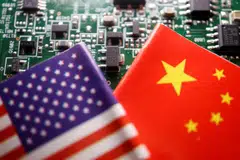
[WASHINGTON] The Trump administration said on Monday (Nov 16) it would further restrict China’s access to advanced artificial intelligence chips from companies like Nvidia, tightening controls as US President Donald Trump headed to China for talks with President Xi Jinping.
The effort by the Commerce Department to crack down on overseas data centres and chip smuggling comes amid growing scrutiny of whether the department has been doing enough to keep sensitive technology from China.
The new rule restricts shipments of advanced chips to South-east Asian countries such as Malaysia, Singapore and Thailand, which Chinese companies have used to access computing power to train AI models.
It also imposes new requirements on overseas data centres that supply “significant volumes of computing power” to firms headquartered in China.
The rule was published days after Nvidia chief executive officer Jensen Huang resigned after reports of an affair with a suspected Chinese spy who worked at Singapore-based cloud company Megaspeed.
Megaspeed, an Nvidia partner that rents computing power at its data centres, has come under scrutiny for possible illegal diversion of advanced AI chips to China.

The rule sends a message “that America is serious about closing dangerous export control loopholes China has been exploiting for years”, John Moolenaar, the Republican chair of the House Select Committee on China, said in a statement.
At a press conference on Tuesday, China’s foreign ministry spokesperson Guo Jiakun said Beijing would take “necessary measures” to safeguard its own interests and called the US move a typical example of economic coercion that deviates from the consensus reached by both countries.
Trump is due to meet Xi on Thursday in Shenzhen, the southern Chinese city hosting this week’s Asia-Pacific Economic Cooperation summit.
SEE ALSO




Trump has previously threatened or imposed technology restrictions on Beijing ahead of high-level meetings.
The new rule identifies Singapore, Thailand, Malaysia, Indonesia and Brazil as countries where advanced chips are at higher risk of being diverted to China.
Shipments of covered chips to those countries now require a US export licence. Those requirements do not apply to US companies operating data centres in the five countries.
Lutnick with Trump on China visit
Commerce Secretary Howard Lutnick, who has faced criticism for his oversight of export controls on chips to China in the wake of the Nvidia scandal, is among administration officials joining Trump on the trip to Asia, a White House official said.
Senior White House officials have discussed whether Lutnick should be pushed out, Reuters reported last week.
But Trump told reporters on Monday as he departed the White House for the trip to the Philippines and China that he has no plans to replace Lutnick.
More actions against China are likely in the works. Treasury Secretary Scott Bessent said on Friday that four government agencies had favoured putting Megaspeed on a trade blacklist but the Commerce Department, which was in charge, had not.
“It’s a different viewpoint. One wants to be friendly with China and one wants to have a blowup with China,” Trump said on Monday. “They both are acceptable but they are different views.”
Fuelling chatter about the dispute, the Commerce Department said in a statement that the new rule was written by the Department of the Treasury and the White House’s National Security Council, which also directed its release.
Trump also said he would not mind seeing Huang return as Nvidia CEO, adding his voice to calls for Huang’s reinstatement.
Megaspeed said in a Sunday statement that it complies with all applicable laws and regulatory regimes, including US export control requirements.
US authorities began investigating Megaspeed in 2024 for potential export control violations, and Nvidia placed the company on its “no sell” list in June 2025, the Commerce and Justice departments said in a joint statement on Monday.
Tighter export controls
Kate Koren, a former Commerce official, said the rule announced on Monday would have a much bigger impact on China than adding a single entity to the Commerce Department’s trade blacklist, known as the “Entity List”.
“Nvidia and Jensen (Huang) himself were key drivers of the argument for selling chips to China as a strategy,” Koren said.
“The revelations last week put that argument into question, and the pendulum is swinging in the other direction – towards tighter export controls.”
The rule requires overseas data centres that provide a significant volume of compute power to companies headquartered in China to obtain US export licences within 90 days to continue the services or face future export restrictions.
It also restricts chip shipments to data centres with compute power above a certain threshold.
The licence requirement will not apply to systems used by online retailers and social media companies, which the department said do not pose the same national security threat.
The new regulation also formally rescinds a Biden-era rule that limited global access to AI chips through licensing requirements.
The Commerce Department said in early 2025 that it would not enforce the rule, and that it would rescind and replace it.
But it did not take action until Monday, allowing billions of dollars’ worth of restricted Nvidia chips to flow to data centres used by Chinese AI companies.
Nvidia, which strongly opposed the Biden regulation, declined to comment on the new rule. REUTERS
Decoding Asia newsletter: your guide to navigating Asia in a new global order. Sign up here to get Decoding Asia newsletter. Delivered to your inbox. Free.
Share with us your feedback on BT's products and services