

Trump hails ‘very good’ Iran talks after annihilation threat
The president says the three-hour meeting was ‘very productive’
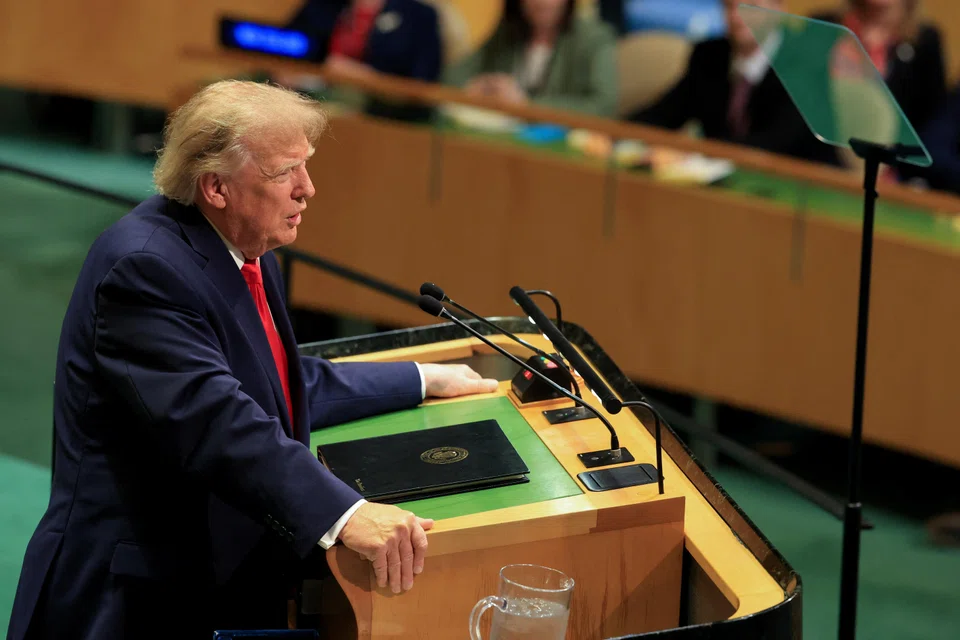
[WASHINGTON] US President Donald Trump said US officials had “very good” talks with Iranian envoys in New York, reviving fragile hopes for a new diplomatic off-ramp hours after he again threatened to annihilate the country.
Steve Witkoff, a Trump envoy, said the talks were conducted with the Iranians through mediators shuttling between each delegation.
Witkoff and Jared Kushner, the president’s son in law, participated on behalf of the US. They had led negotiations with Iran that preceded the US and Israeli military campaign that began in late February and has roiled the Middle East, as well as global energy markets.
Trump said the three-hour session – held on the sidelines of the United Nations General Assembly gathering – was “very productive” and another was being planned for the near future. Iran has yet to comment on the meeting or say who attended.
The talks could raise hopes of some sort of agreement to end the conflict as Trump faces mounting political opposition to the war, though he has insisted that will not sway him.
But it is not clear what, if any, progress was made and the president has also regularly predicted the conflict will drag on past the November midterm elections in the US.
“I feel very good right now,” Witkoff responded when asked about the meeting. In a statement posted to X on Tuesday (Sep 22) night, he said the US hopes the talks “will prove constructive and promising” and the mediators will continue their work. He did not elaborate.
Trump referred again to the Tuesday meeting before discussions with Gulf officials in New York – a broad group that included members of the six-nation Gulf Cooperation Council as well as others in the Middle East including Syria, Iraq, Jordan and Turkey.
The tone of those remarks stood in stark contrast to Trump’s aggressive stance during his speech to the General Assembly earlier on Tuesday. In that address, he repeated his past threats to wipe out the country unless its leaders come to an agreement.
SEE ALSO


“Will a deal be made with Iran that lets them rebuild and create a far greater country than it ever was before – maybe one of the greatest in the Middle East or even the world – or do I annihilate the Islamic Republic and do it quickly?” Trump said.
The US administration has signalled a renewed effort to bring the war in the Middle East to a close, with Trump claiming in his speech that the conflict would end just after the US elections.
Iranian Foreign Ministry spokesman Esmail Baghaei told the state-run Islamic Republic News Agency that the purpose of the meetings in New York was to convey the Islamic Republic’s demands.
Qatar helped bring about the talks, Baghaei added in the report on Wednesday.
Before arriving in New York, Trump had indicated openness to meeting with Iranian President Masoud Pezeshkian.
The mere possibility of a meeting – as well as reports Iran could reopen the Strait of Hormuz if the US drops its blockade – helped drive a decline in Brent crude on Tuesday.
The contradictory remarks demonstrated Trump’s penchant for swerving between renewed threats and promises of imminent peace. He is under pressure to end the war as soon as possible given its unpopularity with voters at home.
The war has pushed petrol prices higher, led Iran to target US bases in the region, killed 19 US service members and disrupted the flow of oil around the world.
Iran has so far refused to give up its chokehold over the Strait of Hormuz, while Iran-funded Houthi rebels in Yemen are again threatening to target shipping in the Red Sea.
The Gulf Cooperation Council states are keen to end a conflict that has seen their territories and ships attacked by thousands of Iranian missiles and drones.
It is also causing their economies to contract or slow significantly, largely because of the disruption to traffic through the Strait of Hormuz.
Hostilities are far less intense than at the height of the war in March and early April. Yet the two sides appear far from recommitting to a ceasefire that was signed in June but quickly broke down.
Trump has repeatedly insisted that Iran give up any plan to develop a nuclear weapon – something the country has said it does not want – as well as ease its stranglehold over the strait and stop funding proxy groups including the Houthis, Hezbollah in Lebanon and Hamas in the Gaza Strip.
Iran’s leaders, for their part, have demanded relief from years of crushing sanctions imposed by the US and a promise that Trump and his successors will not attack their country again. BLOOMBERG
Decoding Asia newsletter: your guide to navigating Asia in a new global order. Sign up here to get Decoding Asia newsletter. Delivered to your inbox. Free.
Share with us your feedback on BT's products and services
TRENDING NOW

LTA proposes combining car COE categories, adding rebate-surcharge system

StarHub to acquire MyRepublic’s mobile business amid ongoing telco consolidation

DBS, OCBC, UOB rout lops billions off STI as inflation, rate concerns spook investors

Grab CEO’s wife Chloe Tong on life with Anthony Tan and finding her purpose

