2026 Mini John Cooper Works review: Uniquely fun, but one rival could spoil the party
The John Cooper Works isn’t what it used to be, but it continues to brighten the motoring world
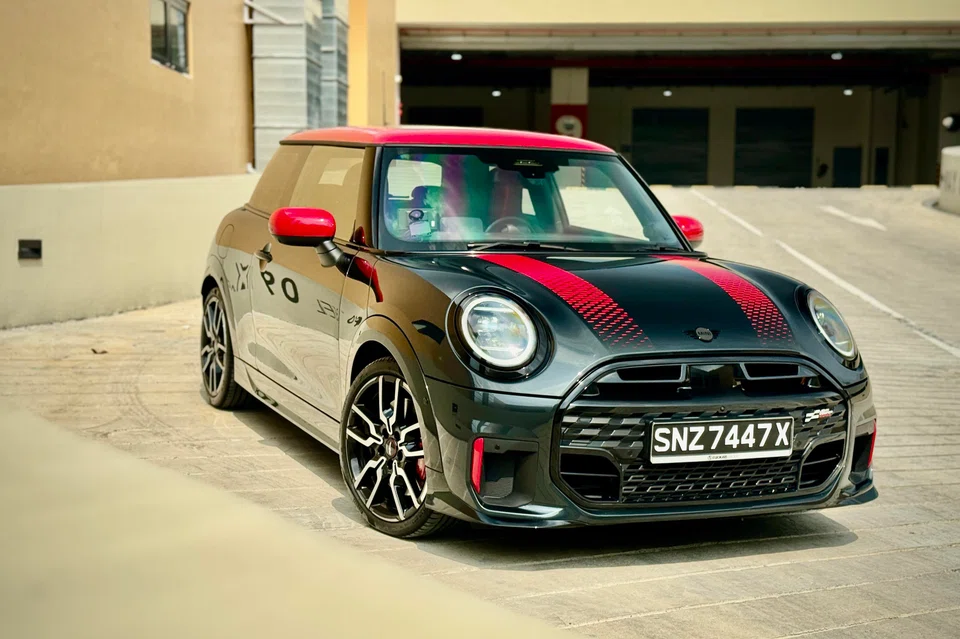
[SINGAPORE] Every driver lining up on the Marina Bay grid for the Singapore Grand Prix cut his teeth in a go-kart, so I wonder what they would make (or their public-relations handlers would tell them to make of the Mini John Cooper Works (JCW).
After all, Mini insists that its cars are imbued with “go-kart feeling”, and the JCW is the purest expression of this idea.
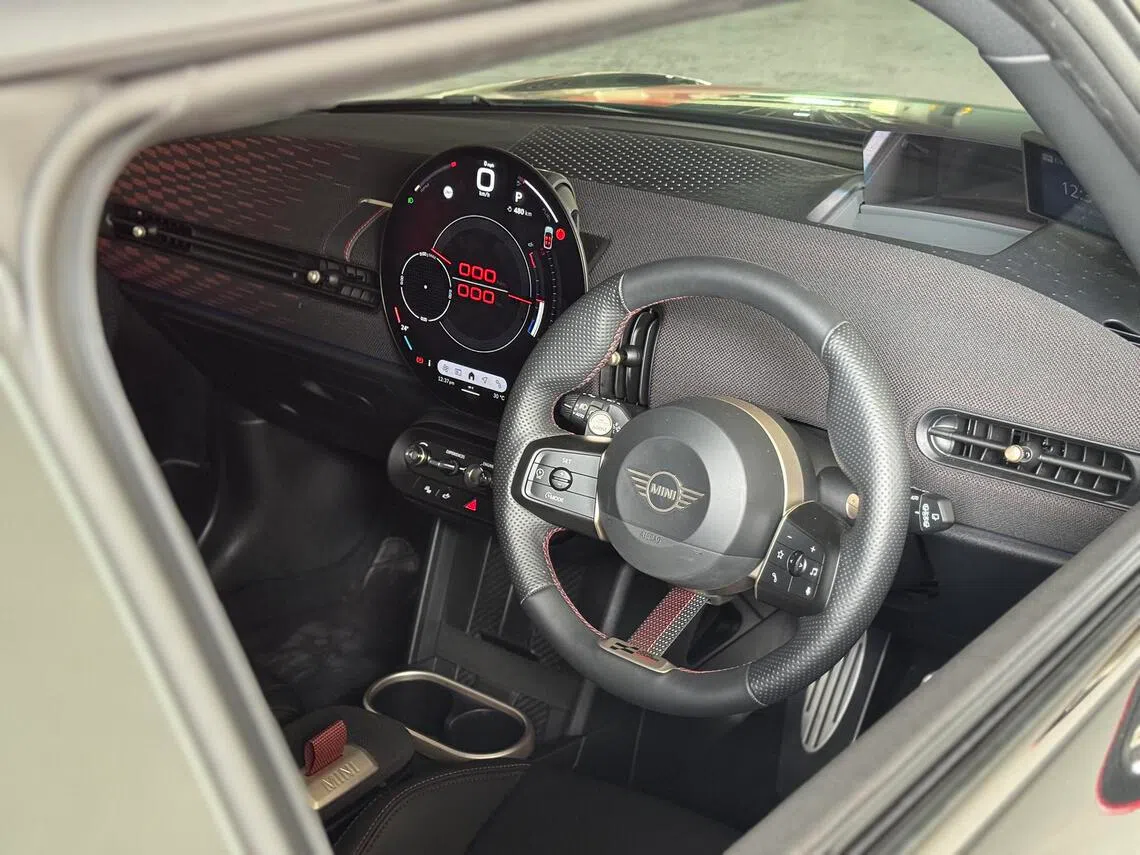
It even has a Go-Kart mode, which sharpens the throttle response and adds heft to the steering, then puts power, torque and g-force readouts on the round central screen, in case you need a reminder that you’re having fun.
Karts are where racers learn their craft because they respond to every twitch of your wrist and, having no suspension, transmit every bump straight to your vertebrae.
Presumably, the original Mini was a bit like that, owing to its tiny size, wheel-at-each-corner layout and the fact that it rode on rubber cones instead of actual springs.
John Cooper, the English spannerman and racing driver, obviously saw something in the car, and his 1961 Mini Cooper was the result of a serious mechanical makeover.
He boosted a stock Mini’s power by more than half and fitted front disc brakes; Monte Carlo Rally wins followed in 1964, 1965 and 1967. His team also happened to win the Formula 1 constructors’ title in 1959 and 1960, so the John Cooper Works label means something.
On a Mini, it signals that a model sits one rung above the sporty Cooper S trim. The first factory-built JCW, launched in 2008, had reinforced pistons, a strengthened cylinder head and a bigger turbocharger, all borrowed from Mini’s racing programme at the time, all parts that a regular Cooper S didn’t get.
These days, JCW feels less like an engineering programme and more like a trim level. The current car even rides on touring tyres, which is like getting a sprinter to wear comfy loafers instead of running shoes.
Still, the new JCW might be the most fun car I’ve driven all year. It’s a heavy facelift of the last one rather than a clean-sheet design, sharing its platform and 2.0-litre turbo engine, though the cabin has been redone to match the latest Minis.
Power is unchanged at 231 horsepower, but torque rises from 320 Nm to 380 Nm, and a seven-speed dual-clutch gearbox replaces the old automatic.
It’s not all that fast by today’s standards, but I’ll be darned if the thing doesn’t feel alive. Lean on the throttle and it’s like you’ve angered the engine and exhaust, and even the car itself.
The wheel bucks in your hands from the ensuing surge of torque steer, and the hard suspension lets you know just why Mini people compare it to a go-kart.
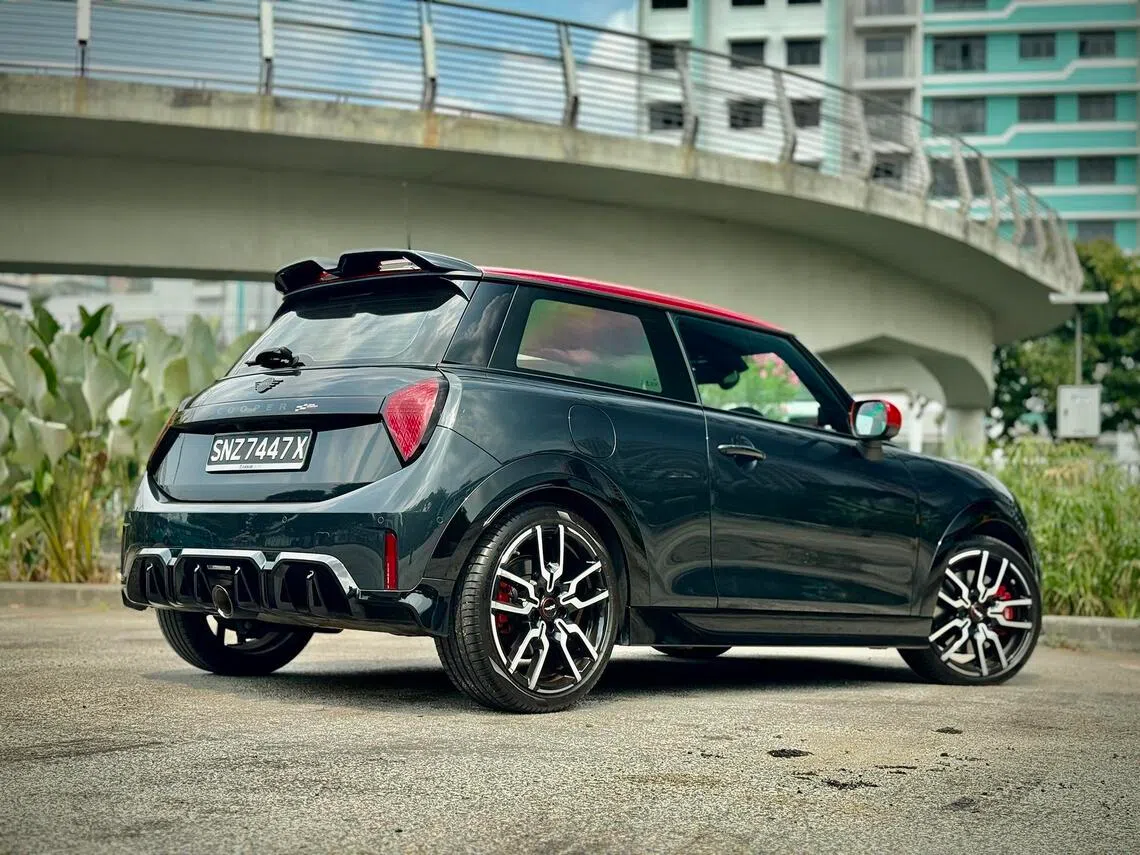
The car’s raucous attitude extends to its styling flourishes, whether in the gloss-black grille or bonnet stripes, or the single fat tailpipe poking out of the middle of the rear diffuser, like a tongue stuck out at the cars behind.
The cabin is just as playful, with red stitching everywhere, racing-style bucket seats, a dashboard covered in knitted fabric, and a strip of red-and-black fabric on the steering wheel that looks like a tiny racing flag.
It makes for a delightful car, but there’s no getting away from the fact that it’s also a basic one. The tailgate is manual, cabin storage is scarce and the boot is tiny. Two adults will squeeze into the back with some cajoling, but they will resent you for it.
If high performance hijinks are your thing, the obvious alternative is the Volkswagen Golf GTI, which is more grown-up in terms of size and spirit. It’s a more comfortable and practical car, while the JCW is louder and cruder.
But the Mini is a thing of joy that continues to brighten the motoring world. It may be too late for me to start in karts and work my way up to a seat at Marina Bay, but driving the JCW could feel like the next best thing.
Mini John Cooper Works
Engine 1,998 cc, in-line four turbocharged Power 231 hp from 5,000 to 6,000 rpm Torque 380 Nm from 1,500 to 4,000 rpm Gearbox 7-speed dual-clutch automatic 0-100 kmh 6.1 seconds Top speed 250 kmh Fuel efficiency 7.0 L/100 km Agent Eurokars Habitat Price S$319,888 with COE Available Now
Decoding Asia newsletter: your guide to navigating Asia in a new global order. Sign up here to get Decoding Asia newsletter. Delivered to your inbox. Free.
Share with us your feedback on BT's products and services