

20 ideas for what to drink with Thanksgiving dinner
These are fresh and lively, and not so high in alcohol that they can’t sustain you over a long gathering
THANKSGIVING preparations are under way, or at least, thinking about Thanksgiving preparations is. To turkey or not to turkey? Sides? Who’s bringing what, and where will everybody sit?
You know what’s not a problem? Which drinks to serve.
Wine’s a natural choice. So is cider. It’s important to have non-alcoholic options. But with wine, sadly, comes anxiety. Will it go with the food? Do I have the right glasses? Will so-and-so approve of my choices?
The great thing about Thanksgiving is that nobody cares too much about the wine. We come for each other: family and friends, old and new, those loved ones we may only see once a year. Together, we intend to stuff our faces. Judgments (about wine, at least) belong in the compost heap.
Nonetheless, wine plays an important role. It makes everything taste better. It’s festive. It smooths any initial social friction. While you don’t want to fret about what you’re serving, you at least want something halfway decent.
This is so easy. If you have a good wine shop, the work is already done. You can pick almost anything you want and all will be fine. If it really is a good shop, give the store a budget and have them pick the bottles. Or you may already have your favorites.

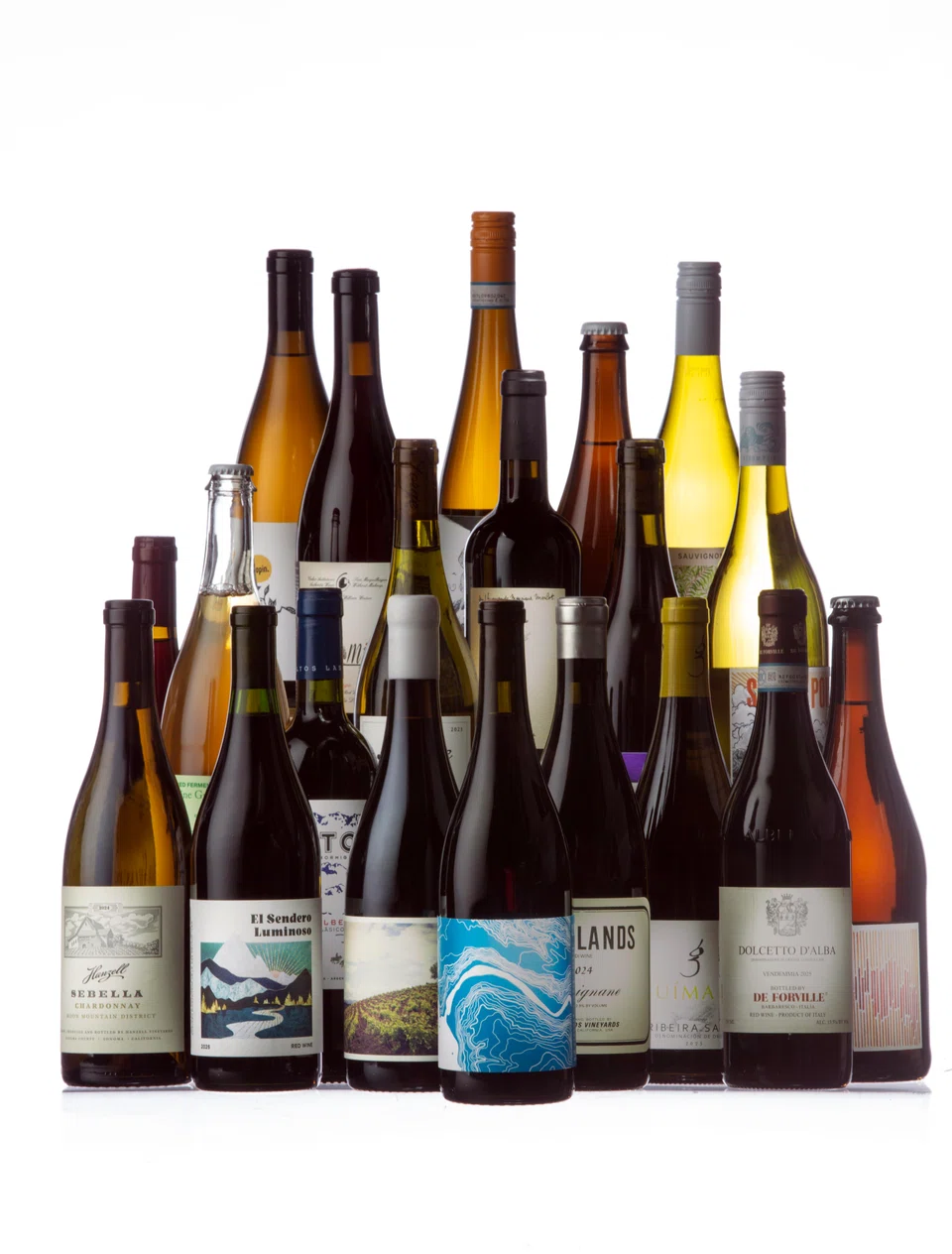
If not, I suggest these 20 options, mostly wine but also a cider and a couple of non-alcoholic alternatives. These will go with anything. They are fresh and lively, and not so high in alcohol that they can’t sustain you over the course of a long gathering.
You certainly won’t find all 20 wherever you shop, but you might find a few. Use these suggestions as ideas; you may not find the Lapalu Beaujolais-Villages that I recommend, for example, but you can ask your merchant for another good Beaujolais in the same price range.
You could also check my suggestions from last year. If it’s ciders you want and you can’t find Patois, a brand I love, I also recommend Aaron Burr Cidery, Sundstrom, Floral Terranes, Treasury, Eve’s Cidery and Horse & Plow.
If you’re looking for non-alcoholic beverages, many areas have shops that specialise in them. I shopped at Spirited Away in New York.
Here are a few important considerations: Unless you are serving a small meal divided into courses, you don’t need to think about matching wines to foods. But you do want to give people a choice between whites and reds. Have plenty of both – they can be many bottles of one red and one white, or an assortment of different wines, whatever is easier or preferable.
The usual formula is one bottle per drinking person. That sounds like a lot, and you probably won’t finish all the wine. That’s ideal. Better too much than running out.
You want sparkling wine? Rose or orange wine? Fine, they can be fun supplements, but not replacements for the whites and reds.
Thanksgiving is very much not the time for out-of-the-box selections, insisting that people try something new or educating them about your wine preferences. It’s for togetherness. Wine is a useful supporting player, but don’t try to make it a star.
Finally, and I say this every year: Stemmed glasses are great. So are juice glasses and tumblers if they’re easier. But don’t use disposable plastic cups, especially cheap plastic stemmed glasses. They fall apart easily and wine will spill. Avoid them, and your clothing will thank you, your rugs will thank you, and you’ll have more wine to drink.
Altos Las Hormigas Mendoza Malbec Clasico 2023, 13.5%, US$15
Too often, inexpensive Mendoza malbecs are overpoweringly fruity and sweet. But Altos Las Hormigas, through its range of malbecs, has mastered the craft of making balanced, enticing wines.
The Clasico, its least expensive malbec, is not complex. But this straightforward wine balances restrained fruit flavours with a gravelly sort of minerality that is always pleasing. (Skurnik Wines, New York)
Storm Point Swartland Chenin Blanc 2025, 12.5%, US$16
I’ve written about this wine before, but here’s a new vintage that would still be a superb accompaniment to the Thanksgiving meal.
This wine has all the characteristics of a more expensive chenin blanc – complex yet easygoing, with the floral, honeyed, sweet-dry flavours characteristic of the grape. And it’s a great value. (Vine Street Imports, Mount Laurel, New Jersey)
Famille Hubert Blaye Cotes de Bordeaux Les Vacances de Monsieur Merlot 2024, 11.5%, US$18
Famille Hubert, with its host of labels including Chateau Peybonhomme-les-Tours and Chateau la Grolet, is that rare Bordeaux producer that farms biodynamically and offers delicious wines at inexpensive prices. This bottle is typical: joyously pure and juicy, refreshing with an underlying earthy note. (Fruit of the Vines, Long Island City, New York)
Nicolas Idiart Val de Loire Sauvignon Blanc 2025, 11.5%, US$18
This fresh, clean, lively white is the sort of crowd-pleaser that large gatherings require. It’s straightforward, refreshing and uncomplicated, yet enjoyable rather than inoffensive. I would not serve this to a small group of geeky wine lovers, but I’d be happy to drink this at a party. (Cellier Wines, Southold, New York)
De Forville Dolcetto d’Alba 2025, 13.5%, US$20
Dolcetto is a perennially underrated grape from the Piedmont region of Italy. Nebbiolo, the grape of grand wines such as barolo and barbaresco, gets most of the attention, but the daily drinks are made of other, less-exalted grapes like dolcetto. De Forville is a reliable producer of barbarescos as well as dolcettos. I love this wine’s refreshing, slightly bitter quality balanced by stony flavors of dark fruits. (Rosenthal Wine Merchant, New York)
Ungrafted Itata Cinsault 2025, 13.5%, US$20
Most of the familiar wine grapes in the world grow on vines grafted onto American root stocks. Why? In the 19th century, phylloxera, a ravenous aphid, attacked the roots of vinifera vines, the species that accounts for these grapes. But Chile has largely escaped the phylloxera plague, so it has a lot of ungrafted vineyards, but few old ones. The wine label Ungrafted prospects through Chile for these old ungrafted, vineyards. This cinsault comes from granite soils in the Itata Valley. It’s stony with light flavours of red fruits, and has quickly become a favourite bottle. (Polaner Selections, Mount Kisco, New York)
Filipa Pato & William Wouters Bairrada Dinamica 2025, 12%, US$23
The motto of this husband-and-wife team is “authentic wines without make-up”. Working primarily in the Bairrada region of Portugal, they make superb wines including Dinamica, a red made of the biodynamically farmed baga. It’s lightly tannic and floral with chalky fruit flavours. (Skurnik Wines)
Unified Ferments Jasmine Green Nonalcoholic Fermented Beverage, US$26
I haven’t found many good non-alcoholic wines. After the alcohol is removed, they taste odd and out of balance to me. I far prefer wine alternatives like this one from Unified Ferments, which combines kombucha culture with jasmine tea, water and a bit of sugar, to create this gentle, floral, lightly carbonated tea-like beverage. It’s intriguing, delightful and easy to drink.
Jean-Claude Lapalu Beaujolais-Villages Vieilles Vignes 2024, 12%, US$27
Good beaujolais is a prototypical Thanksgiving wine, lively and full of energy. This Beaujolais-Villages is an excellent example. It’s light-bodied and graceful with gently fruity, mineral flavours. Jean-Claude Lapalu farms organically and makes wines with minimal intervention. (Bobo Selections/T Edward Wines, New York)
Forge Cellars Seneca Lake Willow Vineyard Dry Riesling 2023, 12.2%, US$27
Forge Cellars in the Finger Lakes of New York is a partnership between Louis Barruol, whose family has made wine in the southern Rhone for generations, and Rick Rainey, who’s in the wine world by choice rather than heritage. I love Forge’s single-vineyard dry rieslings, like this one from the Willow Vineyard. It balances apricot flavour with light, earthy ones.
Outward Central Coast El Sendero Luminoso 2025, 13%, US$28
In a short time, I’ve become a big fan of the wines of Outward. This partnership between Natalie Siddique and Ryan Pace, based on the San Luis Obispo Coast, makes expressive wines either from grapes they purchase that are farmed organically or, from their own vineyards, regeneratively. This red, made of syrah, mourvedre and vaccarese, a southern Rhone grape grown in tiny quantities in California, is lively and fruity, yet pure, precise and delicious.
Stefano Zoli Verdicchio di Matelica 2025, 13.5%, US$28
I’m a big fan of the wines of Verdicchio di Matelica from the Marche region of Italy. The wines always seem livelier, with greater minerality than the fruitier wines of Verdicchio dei Castelli di Jesi, its neighboring appellation, which is lower in altitude and closer to the Adriatic. Stefano Zoli’s wines are new to me, but I really like this bottle. The fruit is ripe. Yet, with lively acidity, the wine is well-balanced, with bracing focus. (Stelle Wine, New York)
Guimaro Ribeira Sacra Blanco 2025, 12.5%, US$29
Ribeira Sacra in north-western Spain is one of the most striking wine regions, with ancient, terraced vineyards rising on impossibly steep slopes above a network of rivers. It was largely ignored until a revival that began in the 1990s.
With his family, Pedro Rodriguez of Guimaro’s been one of the modern pioneers who rejuvenated the region. His wines are lovely, including this entry level white, made entirely out of organically farmed godello. It’s fruity, pure and bright yet focused, precise and delicious. (Jose Pastor Selections/Llaurador Wines, Fairfax, California)
Patois Virginia Quaker Run Orchard Ancestral Method Sparkling Cider 2022, 7.8%, US$29
Patois in Virginia makes some of my favorite ciders. The husband-and-wife proprietors, Patrick Collins and Danielle LeCompte, get apples from different parts of the state. This bottle was made with apples harvested in 2022 from the Quaker Run Orchard in Madison, Virginia. It was produced like a petillant naturel and disgorged earlier this year. It’s deeply flavoured and complex, with cheesy, herbal flavours.
Lioco Mendocino County Pinot Noir 2024, 13.5%, US$29
Lioco primarily makes wines from selected vineyards in Northern California. It’s run by the husband-and-wife team of Matt and Sara Licklider and has a 20-year track record of making balanced, nuanced wines. The grapes from this entry-level pinot noir come from a variety of sites throughout Mendocino. It’s fresh and full of energy, with flavours of red fruits and herbs.
Emme Redwood Valley Ricetti Vineyard Colombard Amando el Sol 2024, 11.5%, US$32
Colombard, or French colombard, as it’s known in California, is an unsung workhorse in the state’s wine industry. Most people are probably unaware of it, but it’s the fourth-most planted white grape in California, after chardonnay, sauvignon blanc and pinot gris. Colombard and pinot gris are mostly planted in the Central Valley and used for cheap, anonymous blends.
But Rosalind Reynolds of Emme demonstrates how appealing the colombard can be when made with care and consideration. She uses organically farmed grapes from Mendocino for this lovely, bright, refreshing white.
Sandlands Lodi Carignane 2024, 12.9%, US$34
Aside from his own vines, Tegan Passalacqua, the proprietor of Sandlands, seeks out historic California vineyards to use for his wines. This wine, for which Passalacqua uses the old California spelling for the grape better known as carignan, comes from Lodi. It’s dry and restrained, with hints of the grape’s typical exuberant fruit tempered by chalky notes.
Villbrygg Skog 03 Nonalcoholic Sparkling Fermented Infusion, US$36
This excellent sparkling wine alternative from Norway offers a starkly different set of flavours from the one made by Unified Ferments. Skog 03 is made from sparkling water infused and fermented with a selection of botanicals, including yarrow, birch leaves and lemongrass. It’s woodsy, airy and lifted by citrus tones. (Less Than 0.5%, Brooklyn)
Nathan K Finger Lakes Cabernet Franc 2021, 12%, US$36
I love Finger Lakes cabernet franc. It’s a true cool-climate wine, lighter and more graceful than cab francs from warmer areas like California. This wine, with earthy, floral aromas, offers intensity without weight. The proprietor of Nathan K, Nathan Kendall, is a sensitive translator of Finger Lakes terroirs.
Hanzell Moon Mountain District Sebella Chardonnay, 13.7%, US$40
Hanzell is one of California’s historic chardonnay producers, along with Stony Hill in Napa Valley and Mount Eden Estate in the Santa Cruz Mountains. Sebella comes from younger, organically farmed vines. It has the body and richness of its more expensive siblings along with floral aromas and stony minerality. This would not be my first choice for a crowd, but it’s just right for an intimate, sit-down Thanksgiving. NYTIMES
Decoding Asia newsletter: your guide to navigating Asia in a new global order. Sign up here to get Decoding Asia newsletter. Delivered to your inbox. Free.
Share with us your feedback on BT's products and services
TRENDING NOW

Motoring tycoon Peter Kwee is back in court: Here are his previous legal battles

Demand, tech capabilities position Apac and AI as Skyscanner’s next growth frontiers: CEO Bryan Batista

Beyond the greenback, Vietnam’s big borrowers turn to Asian-currency bonds

Nvidia’s outlook cut to stable by Moody’s on governance concerns

