The story around the racing: Why F1 continues to make for such compelling viewing
More than just a sport, Formula 1 is an entertainment platform and many of the drivers are global celebrities
[SINGAPORE] Even if it were presented as fiction, the 1994 Formula 1 (F1) season would probably still be rejected as implausible.
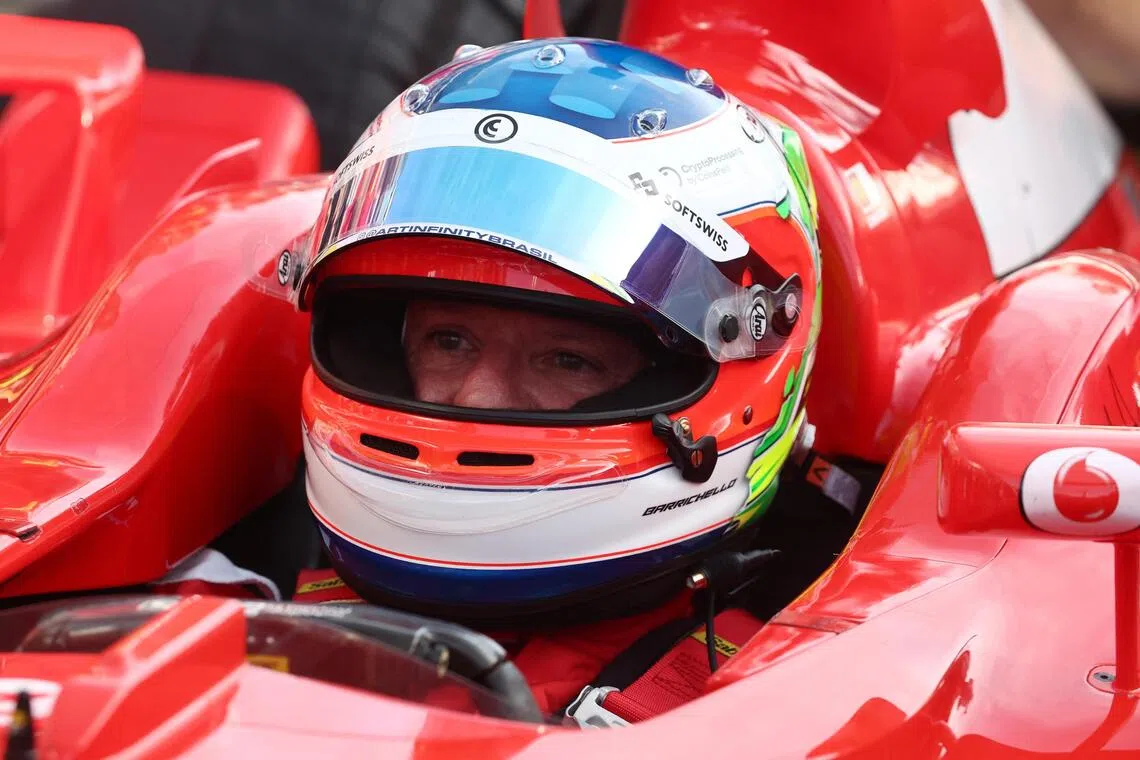
The San Marino Grand Prix that year seemed cursed. Rubens Barrichello was knocked unconscious in a violent crash during practice. It got much worse when Roland Ratzenberger was killed in qualifying, and three-time F1 champion Ayrton Senna perished during the race itself after a crash.
Two weeks later in Monaco, a driver lay in a coma after a crash. Then another flew off the track while testing at Silverstone, ending up in a spectator tunnel with broken legs. At Barcelona a fortnight after that, the man recruited to replace Ratzenberger was hospitalised.
Some wondered if the accidents would ever stop.
Damon Hill – carrying the Williams team after Senna’s death – won that race in Spain, 26 years after his father Graham did likewise for Lotus following the loss of that team’s leading driver, Jim Clark.
The championship became a battle between Hill and Michael Schumacher, whose Benetton team frequently drew scrutiny, not least in the collision that settled the title in Adelaide.
The Netflix documentary Schumacher: The Birth of a Legend, released on Friday (Oct 2), revisits that extraordinary year – which happened to be my first covering F1 on television across Asia for Star Sports.
Benetton’s cars were quick from the opening race and stirred suspicion. There were allegations of illegal electronic aids, including traction control.
At the German Grand Prix, a refuelling stop turned into a fireball around Schumacher’s team-mate Jos Verstappen, the father of Max. A filter had been removed from the system, admitting fuel faster than the rules allowed.
Schumacher lost the opportunity to score points in four of the 16 races. He was excluded from the British Grand Prix for breaking the rules on the formation lap, banned from two more in punishment, and disqualified in Belgium over a technical issue.
It seemed like most of the world was against the 25-year-old.
But not in Germany. The ban would have kept him out of his home Grand Prix and supporters threatened to light bonfires at Hockenheim. He was allowed to race on appeal. The TV audience in Germany doubled during that turbulent season and doubled again as Schumacher became an established star.
This was the beginning of something F1 would eventually learn to exploit commercially: the drivers as the product. Nobody needed to understand the technology to have an opinion about Schumacher. They could admire or dislike him, argue about him – identify with him.
F1 is “more than a sport; it’s an entertainment platform”, Stefano Domenicali told US talk show host Jimmy Fallon recently. Making celebrities of the drivers is how it got there.
That the CEO of F1 was a guest on The Tonight Show highlights how the sport has become mainstream. A market that once struggled to sustain a single Grand Prix now sells out in Austin, Miami and Las Vegas.
Of today’s 827 million F1 fans globally, roughly one in three arrived in the past five years through a widening of the demographics. Women now account for 42 per cent, and 43 per cent is under 35. F1 claims over 220 million fans in China and a base in India that has more than doubled in six years to almost 80 million.
Nothing did more than the Netflix series Drive to Survive, the format of which every sport has since tried to copy. It took the personalities, rivalries and controversies that had always existed in F1 and packaged them for an audience that did not necessarily care about racing.
The Covid-19 pandemic helped. With events cancelled and millions stranded at home, the series found an unusually large captive audience.
F1 then returned faster than any other global sport and, in 2021, converted them with a dramatic title fight between Lewis Hamilton and Max Verstappen that ran to the finale in Abu Dhabi.
Social media extended the relationship with the drivers beyond race weekend. And F1: The Movie put the sport in front of another new audience, becoming the highest-grossing sports film of all time and Brad Pitt’s most lucrative. His returning veteran character might owe something to Nigel Mansell – brought back by Williams to support Hill for the final rounds of 1994.
Before any of those initiatives, there was another. F1’s new owners arrived talking about turning every Grand Prix into a Super Bowl. Singapore had done this a decade earlier.
Competing in the supporting race at that inaugural Grand Prix in 2008, I could see the Marina Bay circuit was designed to showcase the city to a global TV audience. The entire weekend was built around entertainment, to attract tourism and business.
More than 300,000 people will attend this year’s Grand Prix that takes place from Oct 9 to 11, with about half of them from overseas – drawn as much by the 30-plus musical acts as by the 22 Grand Prix drivers.
F1 has achieved its recent success not because the cars got faster or the racing closer. It is the story around the racing – the show – that has made it so compelling. The organisers of the Singapore Grand Prix understood that instinctively. Or perhaps they were watching closely in 1994.
The writer is a Singapore-based British motorsport marketing specialist, TV presenter and former racing driver
Decoding Asia newsletter: your guide to navigating Asia in a new global order. Sign up here to get Decoding Asia newsletter. Delivered to your inbox. Free.
Share with us your feedback on BT's products and services