

Issue 165: All eyes on Singapore’s green bond auction; a call for insurance consistency
This week in ESG: Singapore reopens S$1 billion of 50-year green bonds; insurance companies’ split personality on climate risk

Sustainable finance
A reopening and a litmus test
Note: ESG Insights will take a break on Oct 3 and return on Oct 10.
Singapore’s latest green bond offering arrives in a drought for South-east Asia’s sustainable debt scene, and its performance could help set the tone for the market as the year enters its final quarter.
Data compiled by LSEG show a sharp drop in South-east Asia’s environmental, social and governance (ESG) debt issuance during the second quarter of 2025. ESG debt refers to bonds and loans labelled as green, social, sustainability or sustainability-linked.
A tough market
Second-quarter ESG bonds issued in the region raised US$1.6 billion, 74.8 per cent below the US$6.2 billion raised a year ago. The fall was sharpest for green bonds, with issuance shrinking to US$241.7 million for the environment-related instruments, just over 5 per cent of the US$4.8 billion sold in the year-ago period. Issuance of sustainability bonds, which must be used to fund both environmental and social outcomes, declined 7 per cent to US$1.2 billion.
Sustainability-linked bonds, which vary borrowing costs based on whether the borrower meets sustainability targets, was the sole bright spot among ESG bonds, with issuance growing 13 per cent to US$153.2 million from a year-ago US$135.4 million. But with sustainability-linked bonds accounting for only a tenth of the new-issuance market, the increase was nowhere near enough to offset the green-bond drop.
A less-drastic but still significant slowdown took place in the ESG loans market. New ESG loan proceeds in South-east Asia decreased by 7.6 per cent to US$7.7 billion in Q2 2025 from US$8.4 billion a year ago.
Green loans were once again the main drag, with proceeds almost halving to US$2.6 billion from a year-ago US$5 billion. However, proceeds from sustainability-linked loans rose 53.5 per cent to US$5.1 billion from US$3.3 billion one year earlier.
South-east Asia was an underperformer compared to the rest of the world – including other parts of Asia – where issuance volumes actually rose.
Sustainable finance analysts attribute some of that slowdown to economic and market uncertainties in the wake of the US tariffs, which have hit trade-exposed South-east Asia particularly hard. Expectations of lower interest rates have also led some issuers to hold back on their borrowing plans.
Reopening test
Singapore has reopened its 50-year sovereign green bonds – officially Green Singapore Government Securities (Infrastructure), or Green Singa bonds – in an auction that closes at noon on Friday.
A clue that this might be one of the least welcoming markets since the bond series was first launched in 2022, is that Singapore is offering only S$1 billion of bonds this round. This is the smallest reopening for the bond so far.
The first reopening, in 2023, was undertaken through syndication. Singapore indicated a minimum of S$1.8 billion in the initial offer, then upsized it to S$2.8 billion at pricing. In 2024, S$1.5 billion was offered through an auction. The original launch of the bond series was S$2.4 billion, itself upsized from an early indication of a minimum of S$1.5 billion.
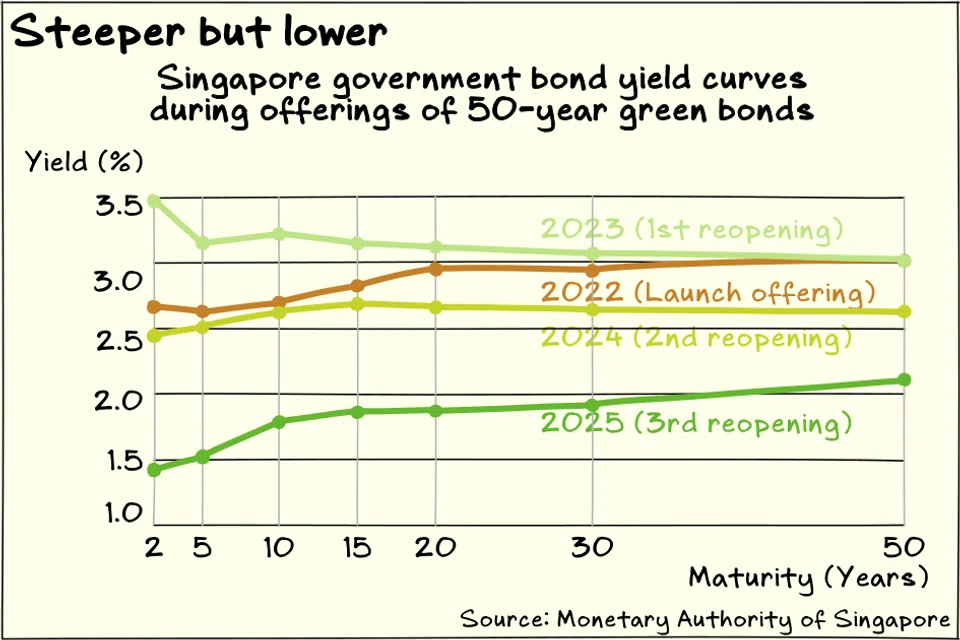
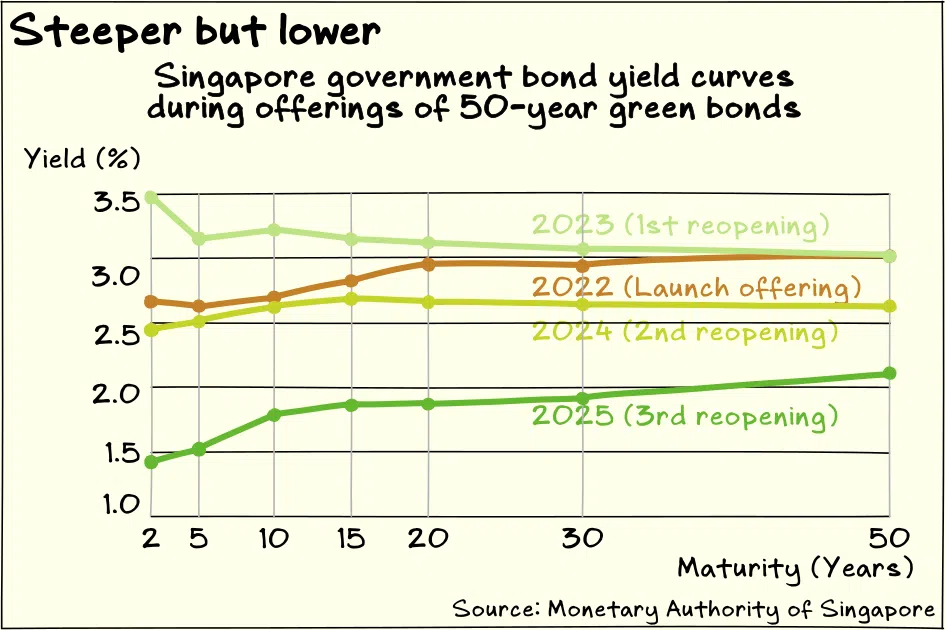
The earlier offerings were all priced when the yield curves were remarkably flat. A yield curve shows debt yields at various maturities. A flat yield curve means that demand for longer-term debt is relatively strong compared to shorter-term debt; conversely, a steep yield curve means that demand for longer-term debt is weaker compared to shorter-term debt. In 2022, the difference between two-year and 50-year Singapore government bonds was just 36 basis points (bps). In 2024, that spread was an even flatter 19 bps. In between, in 2023, the yield curve was even inverted, with the two-to-50-year spread at negative 45 bps.
At the moment, however, the two-to-50-year spread is 67 bps, which suggests relatively weaker demand for long-term debt at the moment compared to shorter-term bonds.
The smaller offering size might help to support pricing for the deal. There are also signs that the regional green bond market might be coming back to life. First, the US Federal Reserve this month cut its policy target rate, by 25 bps, for the first time this year.
Another hopeful sign was Indonesia’s offering of 10-year sovereign green sukuk in July. That offering priced at 5.2 per cent, below initial indications for around 5.5 per cent. That the deal landed at a tighter yield than price talk reflects strong demand.
Singapore’s offering is Singapore-dollar-denominated, and will be at a substantially longer tenor, so there is some uncertainty about how much of the Indonesian performance will translate to the current reopening. But if the Singapore deal performs well, it could breathe some warm air into a frigid South-east Asian sustainable debt market.
Regardless of the outcome, from an absolute amount perspective, Singapore will probably lower its overall borrowing cost with the latest deal.
The current yield for the Singapore 50-year bond is about 2.1 per cent, which is substantially less than the 3.04 per cent yield from the original launch. In fact, the current 50-year yield is the lowest prevailing rate compared to the three other times that Singapore has offered this series of bonds.
That’s positive for Singapore from a fiscal standpoint. The proceeds from the bonds go towards Singapore’s green infrastructure, and the lower the borrowing costs, the less the burden of those projects on the national coffers.
Climate impact
Self-harming insurers
Within the financial sector, perhaps the group with the strongest economic incentive to address climate change would be the insurers.
They are risk experts, after all, and their bottom line hinges on them managing to avoid payouts as much as possible. Global warming increases the risk of climate-related catastrophes, not to mention less dramatic but just as damaging outcomes like poorer health.
That’s why it’s important to point out, as the Financial Times’ Patrick Jenkins does, how insurers might be engaging in corporate self-harm by not taking a more consistent stance to address climate change.
The industry’s role is worth a closer examination in South-east Asia, which is one of the most exposed regions of the world to climate change. The Asian Development Bank estimates that, under a high-end emissions scenario, Vietnam and Indonesia could lose just under 5 per cent of GDP to climate change by 2035. By 2070, Indonesia could lose 27 per cent while Vietnam could lose 30 per cent of GDP.
The good news is that the region’s insurers have been working on addressing climate change and sustainability, with the Association of Southeast Asian Nations (Asean) Insurance Council introducing training and certification initiatives for climate risk management within the industry, for instance.
Regional insurers have also created the Asean Renewable Energy Pool, which facilitates the provision of insurance to the emerging renewable energy sector in the region.
It might be worth exploring ways to take the collaboration further. One area that might need better alignment is in asset management. As investors, regional insurers can be leaders in setting climate targets for themselves and their investees. They can be more active in enforcing market discipline on climate-related issues through their voting choices and their engagement with companies.
Other ESG reads
- Companies transparent about their struggle in the low-carbon transition show leadership: Norges Bank
- Climate reporting timelines have been extended but progress remains on track
- Vietnam shifts gears to e-bikes, ignites fierce race among mobility platforms, EV makers to win over riders
- China’s new market tool steers clean energy to where it’s needed
- KKR, Blackstone make US$17 billion natural gas bet after AI boost
- Climate goals and fossil fuel plans don’t add up, experts say






