

Issue 172: Asean Taxonomy’s unfinished business; data centres encroach on palm oil
This week in ESG: Asean launches complete version of sustainable finance criteria; Malaysian plantations to build green data centres

Sustainable finance
More work ahead for complete Asean Taxonomy
Four years after its launch, the Asean Taxonomy is finally complete, providing markets in South-east Asia with a comprehensive regional definition of activities that are eligible for sustainable finance in nine priority areas.
Yet the emergence of significantly different taxonomies among the region’s major economies suggest that a mountain of work lies ahead to improve interoperability in South-east Asia’s developing sustainable finance ecosystem.
Sustainable finance taxonomies provide essential guidance on what qualifies for sustainable financing. Without credible taxonomies, financiers and borrowers would have to come up with their own criteria, opening the doors for greenwashing.
That Asean even has a regional taxonomy is remarkable, considering how different the 11 member states are in terms of their physical and socioeconomic circumstances. The GDP per capita for Singapore in 2024 was US$84,714, about 74 times that of Myanmar’s, which was US$1,144. Singapore is a small, urban city state, while Indonesia is one of the largest countries in the world by population and land area.
The latest version of the Asean Taxonomy is considered complete because it now provides the technical screening criteria (TSCs) for all six focus sectors and three enabling sectors of the Plus Standards; the previous edition had just three sectors.
The Asean Taxonomy has reached consensus despite those differences with the help of some innovations.
The first is to take a multi-tiered approach. That approach manifests on two levels. At the fundamental layer, the Asean Taxonomy provides a principles-based Foundation Framework for markets that are less developed and a more advanced set of “Plus Standards” that use specific, science-based TSCs. The idea is to provide countries that have less mature sustainable financing markets an accessible entry point through the Foundation Framework to access capital, and also an opportunity to widen that access as these markets become more sophisticated.
The second level of the multi-tiered approach is the adoption of a traffic light system to distinguish between “green” activities that meet core environmental objectives, “amber” activities that aren’t inherently environmentally friendly but enable the transition to greener outcomes, and “red” activities that don’t qualify at all.
The traffic light, which Singapore uses as well, is another innovation that importantly creates a mechanism to facilitate transition finance. The amber tier provides a path that can channel capital to activities such as the early retirement of coal-fired power plants – an activity that is critical for cutting the region’s emissions but difficult to finance.
However, the existence of the Asean taxonomy hasn’t stopped South-east Asia’s largest economies from coming up with their own taxonomies. Indonesia, Malaysia, the Philippines, Singapore, Thailand and Vietnam all have their own taxonomies, and all of them are different.
Malaysia and the Philippines have principles-based taxonomies, but while the Philippines uses a traffic light, Malaysia doesn’t. Indonesia, Singapore, Thailand and Vietnam have more specific criteria, but Vietnam doesn’t use a traffic light, and Indonesia uses “green” and “transition” tiers.
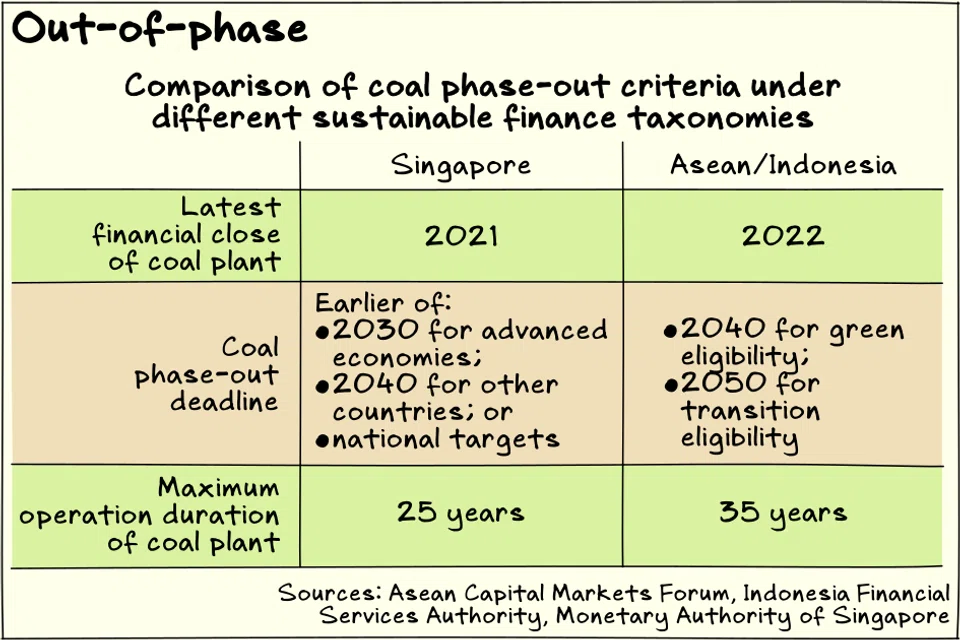
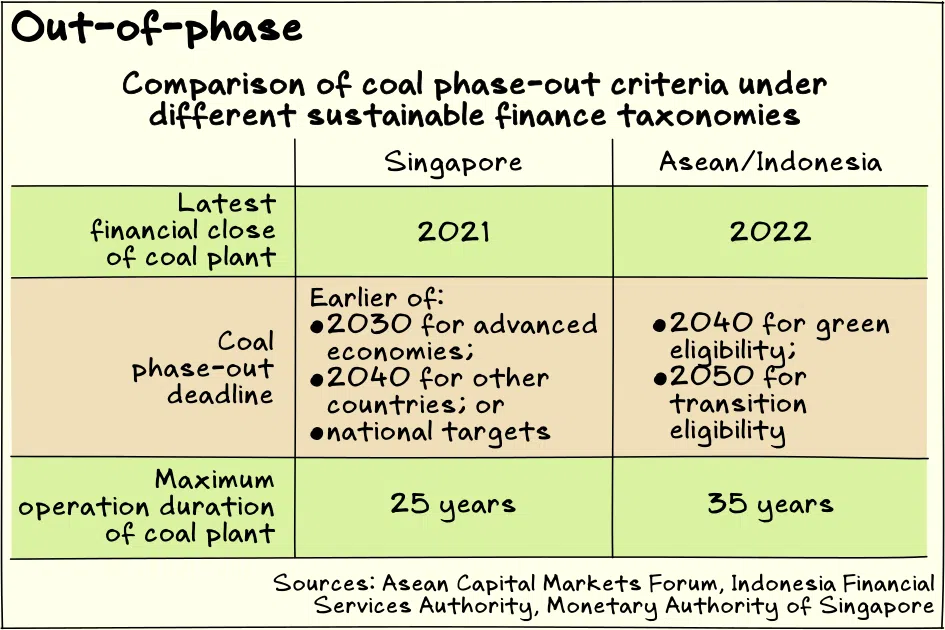
The criteria used are also different. Take coal phase-out, for example. Under Indonesia’s taxonomy, early retirement of a coal-fired power plant by 2040 would qualify for a green label, while coal phase-out by 2050 qualifies for a transition label. Those match timing criteria used in the Asean Taxonomy.
However, under the Singapore-Asia Taxonomy the coal plant must be retired by 2030 in advanced economies and in other countries by 2040 in accordance with the International Energy Agency’s Net Zero pathway. Singapore has also chosen not to apply its traffic light system to coal phase-out, arguing that assessing the credibility of transition plans in coal phase-outs cannot be performed with a taxonomy alone.
There is therefore considerable work required to better align the region’s taxonomies, or at least improve interoperability. Too many taxonomies can chill the market if participants have to navigate all those different standards.
As PwC puts it in a report about sustainable finance in South-east Asia: “Fragmented regulations and the absence of standardised green finance definitions pose challenges, risking inconsistencies and potential greenwashing with high initial costs and economic pressures in emerging markets further complicating the adoption of green finance, as immediate economic needs often overshadow long-term sustainability goals.”
But the authors of South-east Asia’s taxonomies can draw encouragement from the fact that the Asean Taxonomy and the process by which it was built provides a starting point for better alignment. While countries might differ on the levels of thresholds in their taxonomies, they should at least come to agreement on what kinds of thresholds to set. There’s also value in mapping the different taxonomies so that it’s easier for market participants to discern where the similarities and differences lie.
It’s often said that perfection shouldn’t be the enemy of progress, and that adage holds true in the case of the Asean Taxonomy. The idea of creating a common rulebook for sustainable finance in diverse Asean has been an outrageously ambitious endeavour from the start, and for all its flaws the Asean Taxonomy is an impressive achievement. The same common purpose that kept the Asean Taxonomy moving forward should now be channelled towards making it even stronger.
Sustainable investing
Cropping plantations by a bit
Palm oil producers in Malaysia are now building solar-powered data centres on their plantations and claiming this as becoming greener.
Independent observers are a little more sceptical, arguing that the planned data centres are still only a sliver of the companies’ business, and won’t have a meaningful impact on how green the core palm oil production operations are.
There are several concerns about palm oil players allocating some of their land for data centres.
The first is that from a land use perspective, a data centre – even one that is green – isn’t necessarily better than growing palm oil crops. Data centres, especially those in tropical Malaysia, use a lot of water and electricity for cooling and processing. A solar-powered data centre might have a lower emissions intensity, but its water usage will still be relatively high.
It could also be argued that both data centres and palm oil crops are less sustainable than natural forest, which not only helps to store carbon but has natural capital benefits as well. It’s important to ensure that after allocating part of a plantation to data centres, a plantation owner doesn’t clear additional forest to get back real estate for crops.
Building a data centre on the plantation means that some of the land currently set aside for palm oil production will no longer be available for palm oil production. That could lead to lower supply of palm oil and its byproducts, which have many uses, including food and sustainable fuels. It’s worth investigating whether a data centre is a better use of that land than producing palm oil.
The sustainability question boils down to which is the most beneficial use of the land between data centres, palm oil and natural forest. It’s fair to doubt the utility of a data centre amid the current frenzy over artificial intelligence, which seems to devour ballooning amounts of data and electricity with diminishing returns. What’s going to happen to these data centres if the artificial intelligence bubble bursts and there is a surplus of data centre capacity? If the data centres are no longer profitable, would the plantation owners tear them down and revert the land for crops? What a waste of carbon that whole process would be.
Other ESG reads
- Temasek leads US$80 million funding in power infrastructure provider Amperesand
- COP30: Singapore, Thailand looking to launch call for carbon project applications in Q1 2026
- Singapore, Bhutan call for carbon credit project applications
- Regulators, industry groups may need to fill gap left by closure of climate banking alliance, say observers
- Rich nations must hit net zero and pay up on climate, India says
- Europe and the Indo-Pacific: Partners for a resilient future






