Issue 19: Disclosure is not equal to effectiveness; rise of green leases

In this issue: The Corporate Disclosure on Business Integrity report can’t tell us which companies have better integrity, only which ones are more transparent about it, while green leases are rising in popularity in South-east Asia.
Singapore
More than words
What does the latest Corporate Disclosure on Business Integrity in Asean 2022 report tell us about the level of business integrity among the region’s largest listed companies?
Nothing. The report only looks at whether indicators of business integrity are reported by companies, but doesn’t test whether those disclosures are true or, in the case of processes and systems, effective.
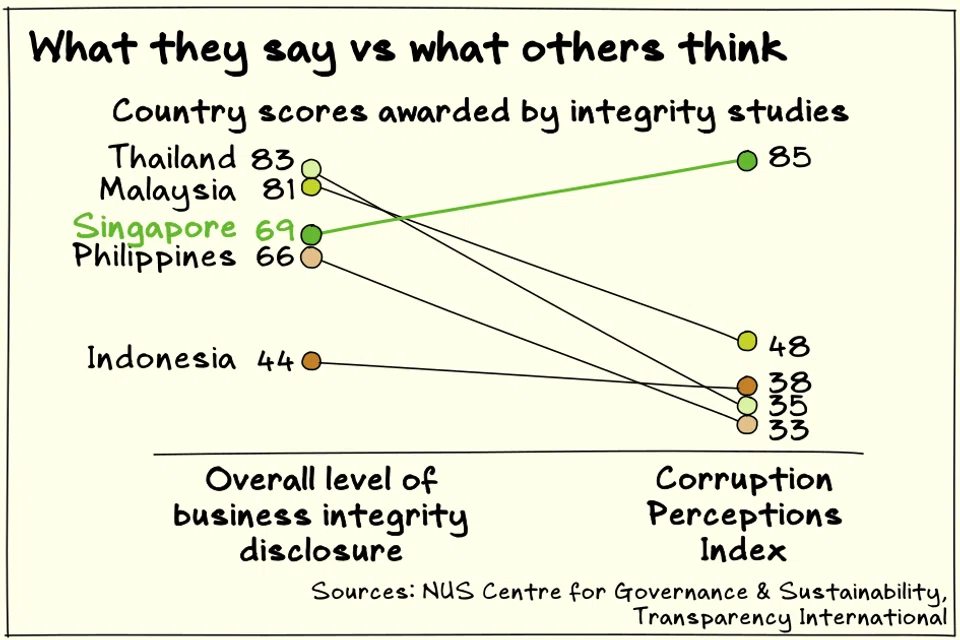
So what are we to make of the fact that Singapore companies had poorer overall scores, on average, than their counterparts in Malaysia and Thailand? Or that the gap between the Singapore average and the averages in those two other countries widened?
We certainly can’t conclude that business integrity, which is mostly about corruption, is worse in Singapore than in the other two countries. As a country, Singapore is generally understood to be one of the least corrupt nations in the world. Transparency International’s latest Corruption Perceptions Index had Singapore in joint fourth in the world, together with Norway and Sweden, with a score of 85 out of a best possible 100. Malaysia’s score of 48 put it 62nd in the rankings, while Thailand ranked 110 with a score of 35.
Professor Lawrence Loh of the National University of Singapore’s Centre for Governance and Sustainability readily acknowledges the limitations of the project, and has cautioned investors about the risks of misrepresentation in the disclosures. His centre carried out the Corporate Disclosure on Business Integrity study with the Securities Investors Association (Singapore) and the Asean CSR Network.
In fact, Prof Loh noted that companies in countries that are more corrupt may have more anti-corruption disclosures because there is a greater need to address these known issues for stakeholders.
Are these disclosure studies therefore meaningless? After all, you wouldn’t typically expect the integrity of businesses in a country to be very far off from the overall level of corruption in the country; yet the correlation between the Corporate Disclosure on Business Integrity report and the Corruption Perceptions Index appears quite weak.
Improving disclosure is quite fundamental to improving governance, because only what is reported can be scrutinised. Singapore companies might have anti-corruption policies that apply to all employees and directors; but if they don’t disclose those policies to the public, it’s hard to take their word that those policies are robust. It’s also hoped that companies feel pressure to be accountable for things that they disclose, so the mere act of reporting about something will drive improvements.
From the perspective of policies and regulations, disclosure levels can help to reveal data gaps. But ensuring the quality of the data and figuring out how to close the gaps are separate issues.
The challenge is in educating stakeholders to understand the limitations of these studies. It would be counterproductive if investors took the Corporate Disclosure on Business Integrity scores to imply that the large listed companies in Malaysia and Thailand were less exposed to corruption risks than the ones in Singapore, and if capital were allocated based on that misperception.
Other Singapore stories
- Not just to please investors, transition plans should be part of a company’s overall strategy: climate bonds panel
- Asia must tailor, tighten OECD’s one-size-fits-all corporate governance principles: panellists
South-east Asia
The green lease cometh
Landlords and tenants in the Asia-Pacific region are increasingly adopting green leases, according to a report by real estate consultancy JLL.
Already, 42 per cent of corporates in the survey of 340 corporate sustainability professionals in the region said they had signed leases that incorporate “green” clauses as at June 2022. JLL expects the percentage to increase to about 85 per cent in three years.
Landlords have to count tenants’ energy use as part of their Scope 3 greenhouse gas emissions (Scope 1 covers direct emissions from a company’s operations, Scope 2 covers indirect emissions from energy sources, and Scope 3 covers indirect emissions from upstream and downstream activities). While voluntary initiatives such as Earth Hour can encourage tenants to reduce their emissions, there’s nothing quite like the weight of a contract to make things happen.
Tenants also want to ensure that their landlords maintain the green credentials for which the tenants are presumably paying.
It seems inevitable that most leases will eventually include climate-related obligations for both tenants and landlords.
Other South-east Asia reads
- Asia’s chance to grow as consequential investors
- Cutting carbon: Benefits must flow to communities, not just businesses, panellists say
Good reads
The United Nations Climate Change Conference (Cop27) is happening in November, and expectations are that governments’ ambitions will be tempered by economic realities.