

Issue 212: Banking the Asean Power Grid; mobile operators’ gridlocked emissions
This week in ESG: Sustainable finance group urges bankability for cross-border electricity trading deals; Asia-Pacific mobile telcos’ emissions grow 6% from 2019 to 2024

Sustainable finance
Building a bankable Asean Power Grid
At the heart of project finance is predictability.
In determining whether to finance an infrastructure project, a lender or investor needs to gaze far into the future, past the initial years of building with no income, then past the years of operations required to finally achieve cost recovery.
Without enough predictability, capital providers do not have enough confidence in their future gazing to commit, and the project cannot proceed.
That’s the key message from Singapore’s sustainable finance industry on accelerating the plodding Asean Power Grid (APG).
“Cross-border power infrastructure is inherently complex,” say the authors of the report by the Singapore Sustainable Finance Association (SSFA). “That complexity is financeable. What is not financeable is the ambiguity in risk allocation, regulatory frameworks, and revenue assumptions.”
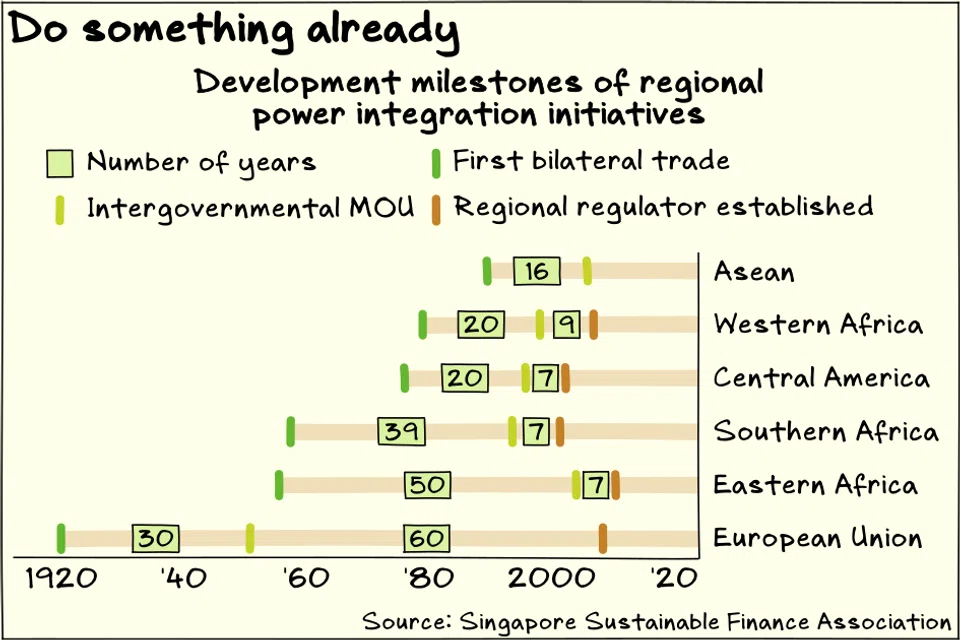
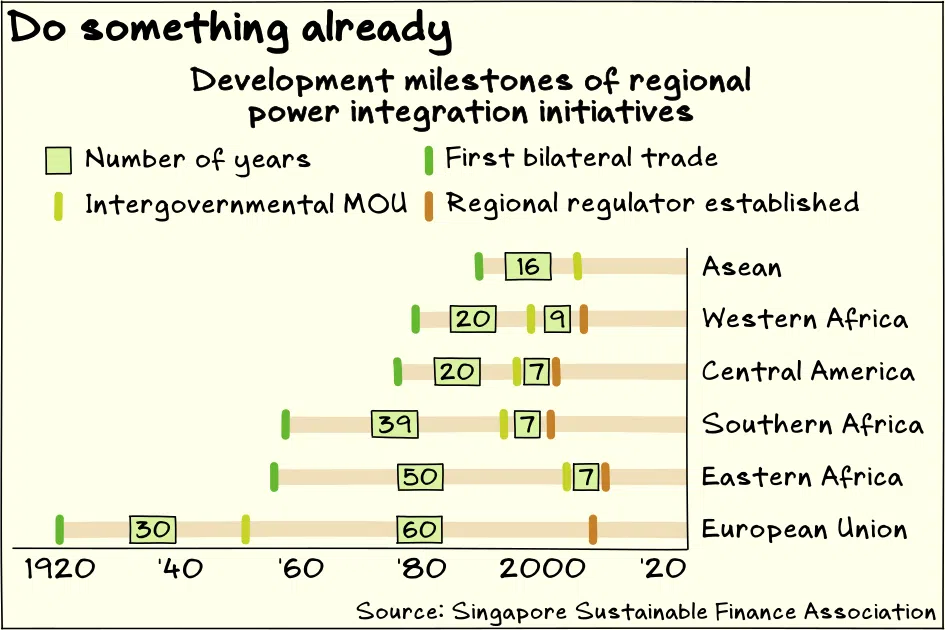
Hong Kong had just been handed over to China and Google had not yet been founded in 1997 when the APG was first proposed. Despite multiple updates and ongoing commitment by the Association of Southeast Asian Nations, the APG has seen only piecemeal and intermittent progress. The vision of interconnected electrical grids across the region remains unrealised.
However, the report observes that progress on the APG could be heading into an execution-focused phase. The catalysts for that shift include Malaysia’s chairmanship of Asean in 2025 helping to shift focus towards actionable sub-regional projects, as well as political and capital interests beginning to align as energy security becomes a priority.
The report examines what it might take to scale up cross-border electricity trading in the region by creating “bankable” projects that can access private capital. It takes a bilateral-first approach, arguing that electricity trading deals between two countries are more easily accomplished, and create stepping stones that can eventually be joined into a more robust regional pathway.
The authors identify three key drivers of bankability.
The first is to address the risk of stranded assets by preserving “revenue continuity”. A power generation asset cannot make money without a transmission asset, and vice versa, so projects and the regulatory frameworks in which they operate need to ensure that interests and obligations are aligned between those assets. For instance, a special purpose vehicle that owns both generation and transmission assets could ease lenders’ concerns about mismatched development schedules. When generation and transmission ownership are separate, offtake frameworks can consider protections such as deemed generation – where a generator is paid regardless of the state of the transmission infrastructure.
The second driver is to close a structural pricing gap between what users are ready to pay for imports and the costs that developers must recover. Lenders need to be confident that buyers of green electricity in the import market will have commercial incentive to pay a green premium for the life of the financing, which could be 20 to 25 years. One solution offered by the authors is to apply a mix of revenue streams to address different types of development or operating costs. For instance, interconnection or transmission costs could be paid by a single public entity and hence shared by the entire electricity market, reducing the burden on single developers. Also, agreement on cross-border renewable energy certificates is critical to allow projects to collect green premiums.
The third driver is to create a layered legal architecture to lock in political intent for the long term. Lenders require the certainty of “a complete and enforceable regulatory chain across all jurisdictions”, the report states. Regulators and policymakers on both sides of a trading agreement need to align their rules and ensure that obligations and risks are properly allocated.
One of the core principles in the report is the importance of proper risk allocation. The fundamental premise is that risk should be borne by the party that is “best placed to control, manage or price it, rather than left with whichever party happens to hold it by default”.
For example, Indonesia gives constitutional priority to domestic supply and gives the government regulatory flexibility to adjust export terms, which places all of the regulatory risk on the project even though the project has no control over the rules. Mechanisms to adequately compensate exporters when domestic supply is prioritised can help to more appropriately shift that risk towards the regulators.
Without proper risk allocation, lenders are reluctant to finance projects because it adds to the risks and uncertainties of future income.
The report’s comprehensive diagnosis of the bankability gaps is largely confined to the technical aspects of improving financing, but stops short of addressing the reasons that policies and regulations are so misaligned in the first place. That might make a worthy follow-up.
For instance, Indonesia has said that its decision to impose a five-year cap on electricity export permits is to prioritise energy security and domestic supply. Getting that policy changed to improve bankability requires finding solutions to those non-financing concerns.
Perhaps a key ingredient that needs substantially more investment is educating stakeholders on all sides about the mutual benefits of interconnectivity and about the solutions available to address their concerns. As Singapore climate ambassador Ravi Menon said in a recent speech, Asean members must figure out how to make electricity trading benefit all parties. Taking a leaf out of the environmental, social and governance playbook, figuring that out must involve engagement with a broad spectrum of stakeholders. For example, the APG cannot be built if only the finance ministry is on board, but not the energy, trade, labour and defence ministries. Communities affected by the developments must understand what they stand to gain in exchange for the disruption.
Singapore takes over the Asean chairmanship in 2027, and has an opportunity to take APG progress even further. Many of the issues described in the report would be known to policymakers and regulators working on the Asean Power Grid and on bilateral electricity trading deals. Project finance is not a new form of financing by any means. Even regional power grids are not novel, with cross-border networks set up in Europe, Central America and various African regions. For South-east Asia, it’s not the means to get to bankability that’s missing, but the will.
Energy transition
Grid limits to decarbonising mobile operations
Greenhouse gas emissions by Asia-Pacific mobile operators continue to grow, and prospects for lowering them appear to be mixed.
Asia-Pacific mobile operators reported about 23 million tonnes of carbon dioxide equivalent (MtCO2e) in 2024, an increase of about 6 per cent over a five-year period from 2019, according to data compiled by the GSM Association (GSMA), an industry group. The emissions data comprises Scope 1 and 2 emissions – greenhouse gases produced from operations and from purchased electricity, heating and cooling – from mobile network operators and their related tower companies.
South-east Asia accounts for around 20 per cent of the region’s emissions in 2024. The region’s emissions intensity has also been growing. Emissions have been climbing since 2019 despite a decline in mobile connections.
The good news is that the region has multiple avenues to improve emissions. GSMA notes that sunsetting older, less-efficient 2G and 3G towers has driven significant reductions in electricity consumption in developed markets like Australia, Japan and Singapore. Switching from copper to fibre in fixed networks also improves electricity consumption.
Many towers in the region also rely on diesel for power, and connecting those towers to electricity grids or to on-site solar and hybrid solutions can also reduce emissions.
However, emissions reduction for many operators in South-east Asia is limited by the energy mix of local electrical grids, which are predominantly fossil fuel-based in the region. Because many of the mobile operators are still heavily reliant on their local grids for electricity, the pace at which they can decarbonise their operations is tied to how quickly their grids are greened, which is to say not very quickly at all.
The limiting effect of the electrical grid echoes jurisdictional impact in credit ratings, where the credit rating of a country caps the ratings of issuers based in that country. The implication is the same: Effective national policy lifts all boats in the same waters.
Other ESG reads
- VinFast steps into real estate with stake in massive Hanoi project
- Singapore sells less marine fuel in August as higher prices bite
- Vietnam warns of blackouts from 2027 as power projects stutter
- Raising the ambition: Five capabilities for the independent director
- Asean is disproportionately affected by climate change. This also presents opportunities
TRENDING NOW

He built the Vingroup empire. Now South-east Asia’s richest man is handing some key roles to his sons

Chagee, Mixue and Luckin won the market. Sustaining their edge is the harder part

From Haidilao to Oriental Kopi: How some of Asia’s favourite F&B players are faring in 2026

CPIB hauls Multi-Chem CEO, COO in for questioning; stock hits ‘circuit breaker’

