

Issue 79: Implementing Article 6 carbon credit trading; COP28 finds a path forward

In this issue: Singapore’s first Article 6 implementation deal contains an Overall Mitigation in Global Emissions feature, while a pledge to “transition” away from fossil fuels secures consensus in Dubai.
Singapore & S-E Asia
Opening the carbon credit trade route
Singapore will now be able to use carbon credits generated in another country to meet its emissions reduction targets, following a landmark carbon credits implementation agreement with Papua New Guinea.
The Papua New Guinea implementation agreement is expected to be the first of many. Singapore has “substantively concluded” negotiations with Bhutan, Ghana, Vietnam and Paraguay, and has signed memorandums of understanding with at least another 10 countries.
The thing that’s being “implemented” by these agreements is a carbon trading mechanism that is aligned with Paris Agreement rules. A key part of that mechanism is a “corresponding adjustment”, which means that whatever credits Singapore buys from Papua New Guinea can only be used to offset Singapore’s emissions; Papua New Guinea will not be able to claim those reductions for its climate targets after selling them.
OMG: Emissions!
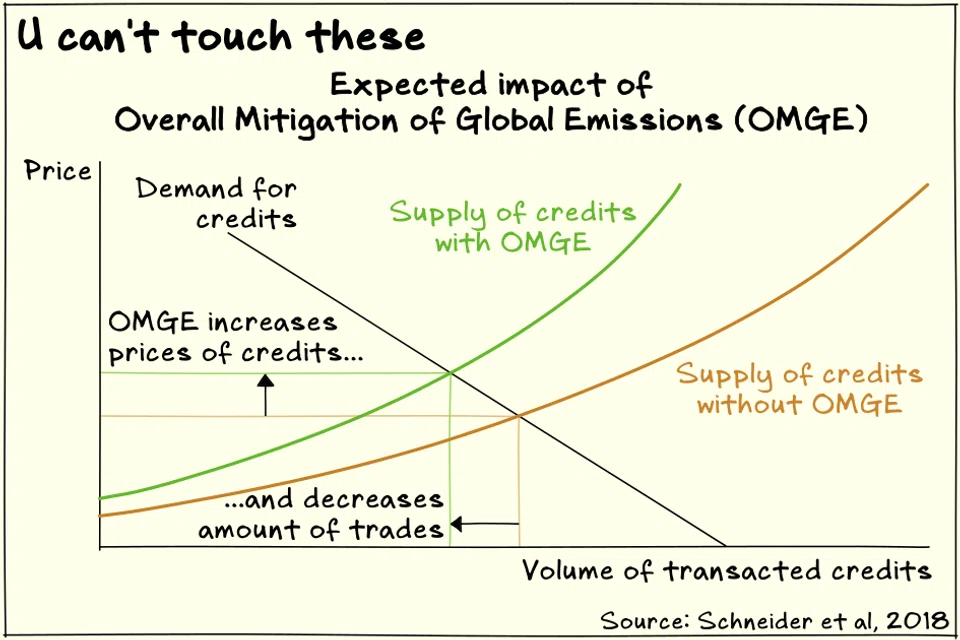
One of the more interesting parts of the agreement is an “Overall Mitigation in Global Emissions” (OMGE) feature, which aims to ensure that the carbon credit trading between the two countries leads to actual emissions reductions.
This feature exists because there is no actual reduction in global emissions when a carbon credit from Papua New Guinea is used to offset the same amount of emissions produced in Singapore. An unmitigated carbon trading system therefore does not result in any overall reduction in emissions.
To address that, the Singapore-Papua New Guinea deal uses an OMGE mechanism to cancel at least 2 per cent of participating credits at first issuance, which is the minimum recommended under the Paris Agreement. Here’s how it works: A forest conservation project in Papua New Guinea that has been issued 1,000 carbon credits might want to make those credits eligible for sale to Singapore.
Obtaining eligibility will require the project to immediately cancel 20 carbon credits upon qualification. Cancellation means the credits cannot be sold or used for offsetting. Since these reductions will not be offset by emissions, they represent actual emissions reductions.
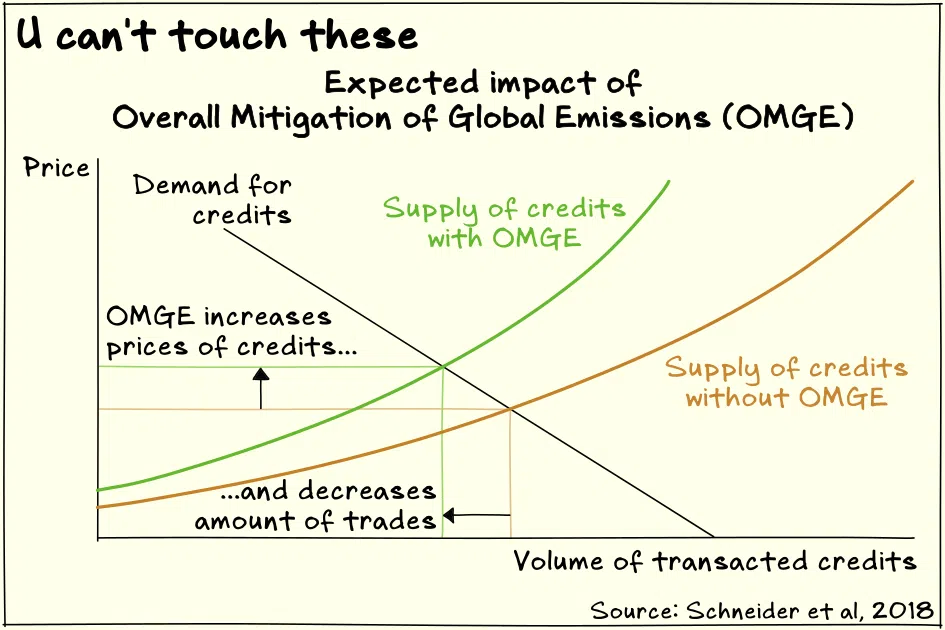
An analysis by the Stockholm Environment Institute and the NewClimate Institute found OMGE will lead to higher prices for carbon credits under the programme since this reduces the available supply of carbon credits and raises the cost of producing carbon credits. Assuming that demand is elastic with price, the upward shift of the supply curve will lead to a drop in the number of offset credits traded between the two countries, compared with a situation in which there is no OMGE.
The analysis suggests, however, that the amount of emissions reduced might increase despite the decrease in transacted credits. This is partly because of the cancelled credits. The other reason is that the less reliance on offsets to achieve an emissions target, the more actual emissions reductions have to be used to achieve those targets.
This would be the case in Singapore, which is signing implementation agreements in support of the country’s goal of achieving net zero emissions by 2050. Beginning in 2024, companies that are subject to Singapore’s carbon tax may purchase these credits to offset up to 5 per cent of their taxable emissions. It will be interesting to see if and how the OMGE mechanism affects decisions.
The tax factor
It’s also useful to understand Singapore’s implementation agreements as part of a larger market-driven emissions mitigation approach that includes the carbon tax.
Singapore’s carbon tax – imposed only on major sources of emissions such as power plants – currently stands at S$5 per tonne of emissions and will grow to S$25 per tonne in 2024. By 2030, the tax rate is expected to be between S$50 and S$80 per tonne.
Because the credits covered by the implementation agreements may be used to offset taxable emissions, a significant source of demand for those credits is expected to come from the companies that are liable for the carbon tax.
The carbon tax rate will therefore influence the price of carbon credits that comply with the Singapore regime. In essence, it makes little sense for a company to buy credits if they cost more than the prevailing tax rate. A power plant owner should rationally pay the carbon tax of S$50 on a tonne of emissions rather than pay S$51 for a credit to offset the same tonne of emissions.
This could limit the ability of Singapore offtakers to support costly carbon credit projects – managed early phase-outs of coal-fired power plants, for instance – since it might be difficult to find a Singapore buyer willing to pay more than the prevailing carbon tax rate.
Other Singapore and S-E Asia reads
- South-east Asian investors bullish on electric bikes, clean energy in 2024
- Keppel, Greenko founders to explore sustainable fuel production in South-east Asia, Middle East
COP28
A way forward with ‘transition’
The 28th edition of the annual United Nations Climate Change Conference (COP28) ended in what has become the standard plot by now: increasingly acrimonious grandstanding that push negotiations past the intended deadline before an agreement is quickly reached as fatigued diplomats succumb to the practicalities of trying to catch their flights home.
This year’s climate deal contained a pledge to “transition” away from fossil fuels, managing to find a commendable way to avoid the highly charged battle between whether to “phase down” or “phase out” fossil fuels. By calling for an energy transition that is “just, orderly and equitable”, and aimed at net zero by 2050, the final text found a way to accommodate all parties.
Could the outcome have been more ambitious? Most definitely. It is unavoidable that climate progress through COP happens in small steps, though. With consensus required from almost 200 countries, leaps and bounds are unrealistic. What’s important is to ensure that progress, however small, continues in the right direction and to prevent backtracking. It’s a little like stalactites and stalagmites in caves, where great outcomes can emerge as long as progress isn’t impeded.
The consensus for South-east Asia and Singapore seems to be that this was a positive conference for the region. While the global negotiations were marked by controversies and disagreements, South-east Asia seemed to be pulling in largely the same direction in terms of seeking and demonstrating progress in its energy transition. The announcement of coal phase-out projects in Indonesia, a phase-out strategy in Vietnam and Singapore-led initiatives focused on financing the region’s transition were among the notable developments that resonated with observers.
A note: I’ll be taking a short break from the newsletter, and will return on Jan 26, 2024. While I’m away, my fine colleagues Sharanya Pillai, Janice Lim and Wong Pei Ting will take turns to help out with the newsletter. In the meantime, I hope everyone has a good holiday season. Catch up again in the new year. – Kenneth Lim
Other South-east Asia reads
- Climate talks always fail, but they are failing better
- Singapore won’t claim from climate loss & damage fund; will help other countries access money from it: Grace Fu
Other good reads
TRENDING NOW
Motoring tycoon Peter Kwee is back in court: Here are his previous legal battles

Demand, tech capabilities position Apac and AI as Skyscanner’s next growth frontiers: CEO Bryan Batista
Beyond the greenback, Vietnam’s big borrowers turn to Asian-currency bonds

Nvidia’s outlook cut to stable by Moody’s on governance concerns

