

Issue 81: Assessing renewable energy costs; weak demand for ESG funds

In this issue: Renewable energy faces cost issues in South-east Asia, while capital flows into regional ESG funds see a sharp decline.
Singapore & S-E Asia
Are renewable energy costs affordable enough in South-east Asia?
Investors in Singapore are becoming bullish on renewable energy as its growth accelerates amid the global push towards a low-carbon economy.
Companies pivoting to renewable energy are performing slightly better than the broader market, propping up stock indices focusing on environmental, social and governance (ESG) strategies, as reported by my colleague Sharanya Pillai.
With interest rates expected to come down slightly in 2024, this could boost renewable energy-related stocks even further. Renewables are typically more sensitive to rate hikes because clean energy projects require high amounts of capital at the outset.
This may not be the case in South-east Asia, however, as the region already faces elevated development costs for solar and wind projects due to the lack of deployment scale and underdevelopment of supply chains.
This is in addition to increased borrowing costs over the last year as a result of higher interest rates.
Sure, the costs of renewables everywhere, including South-east Asia, have come down significantly over the last decade.
According to BloombergNEF, the benchmark levelised cost of electricity (LCOE) – which is a measurement of the lifetime costs of generating electricity – generated from new solar photovoltaic (PV) cells became lower than the benchmark LCOE of new coal in South-east Asia this year, no doubt helped by rising fossil fuel prices as a result of the Russia-Ukraine war.
In 2014, the benchmark LCOE of solar PV was nearly three times higher than that of coal.
Even so, renewables still cost more in South-east Asia than in other parts of the world.
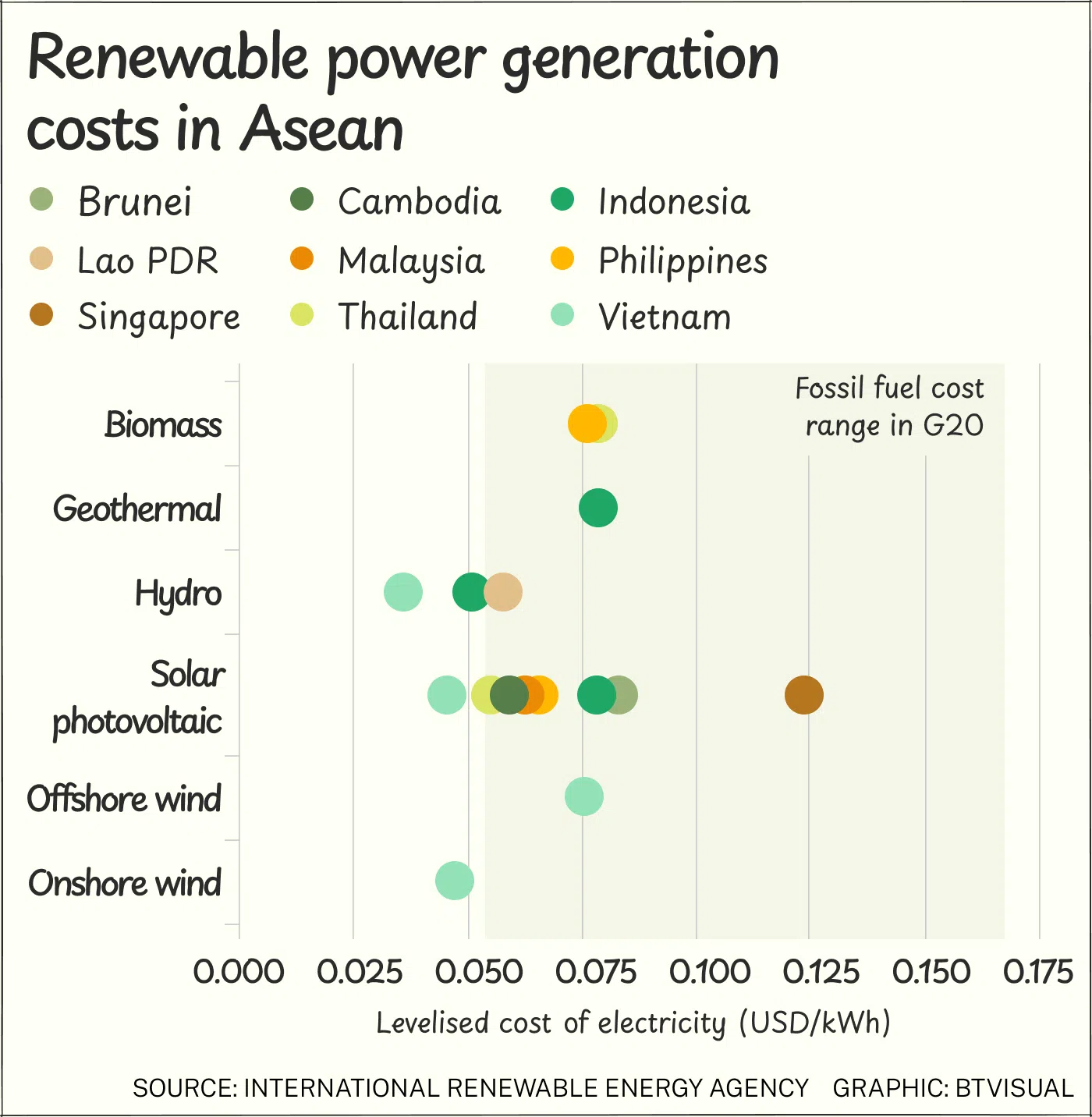
While the LCOE of solar PV in 2021 is between US$0.05 and US$0.075 per kilowatt-hour in most of South-east Asia, with the exception of Vietnam, the global weighted average LCOE for new solar PV projects is US$0.048/kWh, according to data from the International Renewable Energy Agency.
Vietnam, which is the recipient of the majority of renewable energy investment in the region, has an LCOE of US$0.046/kWh for solar PV.
A similar cost difference can be seen in onshore wind, with South-east Asia achieving an LCOE of US$0.048 per kWh, while the global weighted average is US$0.033/kWh.
High local content requirements for renewables in some countries, inflexible power purchase agreements, lack of an integrated policy approach towards scaling up renewables and incumbent interests in fossil fuels are some contributing factors to the elevated costs of renewables in South-east Asia.
The end result is that many renewable projects in the region are only marginally bankable, and are unable to attract sufficient private-sector investment.
According to the International Energy Agency, South-east Asia received an average of US$70 billion in energy investments annually between 2016 and 2020. About US$30 billion of that sum went to clean energy; and out of that, US$10 billion was for solar PV and wind projects – one of the lowest amounts globally and exceeding only Sub-Saharan Africa.
Almost half of the private capital for power in South-east Asia was invested in fossil fuel generation during this period.
Of course, efforts are underway to get around these impediments and bring down the costs of capital in renewable energy investments. Some new initiatives were announced during the recently concluded United Nations climate change conference in Dubai.
This includes a US$5 billion blended finance initiative by the Monetary Authority of Singapore and a new financial instrument called transition credits, which are carbon credits generated when coal-fired power plants are shut down and replaced by clean energy.
At the end of the day, though, what would really bring down the costs of renewables in South-east Asia is the removal of fossil fuel subsidies and the setting of a carbon price, whether through taxes or an emissions trading scheme.
Unfortunately, that is a political problem that financial markets cannot solve.
Other Singapore reads
Seatrium bags S$400 million in refinancing with sustainability-linked option
Singapore’s built environment sector on track to hit green targets: BCA chief
ESG funds
Sharp decline in capital flows into ESG funds despite stronger performance
Sustainable funds recorded US$68 billion of net inflow deposits for the first 11 months of 2023, down sharply from US$158 billion for the whole of 2022 and from US$558 billion in the previous year, according to data from LSEG Lipper.
The slowdown this year was attributed to political controversy in the US and concerns about “greenwashing,” even though many outperformed the broader market after technology stocks – which are usually constituent stocks of ESG funds – recovered.
The same trend can be seen among ESG funds domiciled in South-east Asia.
According to data from Morningstar, ESG funds in Singapore, Malaysia, Thailand and Indonesia received net inflows of US$198.2 million over the first three quarters of 2023, down from US$204.2 million over the same period last year.
Conversely, non-ESG funds have seen a reversal in capital flows, from net outflows of US$8.5 billion over the first three quarters of 2022 to US$25.2 billion of net inflows in the same period this year.
The increase in oil prices is probably a major reason behind investors reallocating some of their capital to non-ESG funds to increase their exposure to energy-related stocks.
While this may be attractive to some investors who have shorter-term investment horizons, those focused on long-term structural changes to their portfolios will still invest in ESG funds.
Other ESG reads
Swiss climate activists target the rich with new tax proposal
Brace for supply chain risks from conflict and climate change in 2024
Other good reads
Government sustainability reports need to demonstrate greater clarity, better leadership
Electric cars with recycled batteries are the next green holy grail
TRENDING NOW
Easy to rent out, hard to sell: Are buyers losing interest in Singapore’s one-bedroom condos?

GovTech retrenches another 38 staff in second round of layoffs

Stocks to watch: Seatrium, CapitaLand Investment, Keppel DC Reit, Suntec Reit, CLCT, TSH Resources

World’s largest offshore wind platform by Seatrium consortium on track to be completed by 2028

