

Asia’s financiers must look beyond headlines on environmental risks
Banks and investors should make companies’ environmental performance consequential for financing decisions
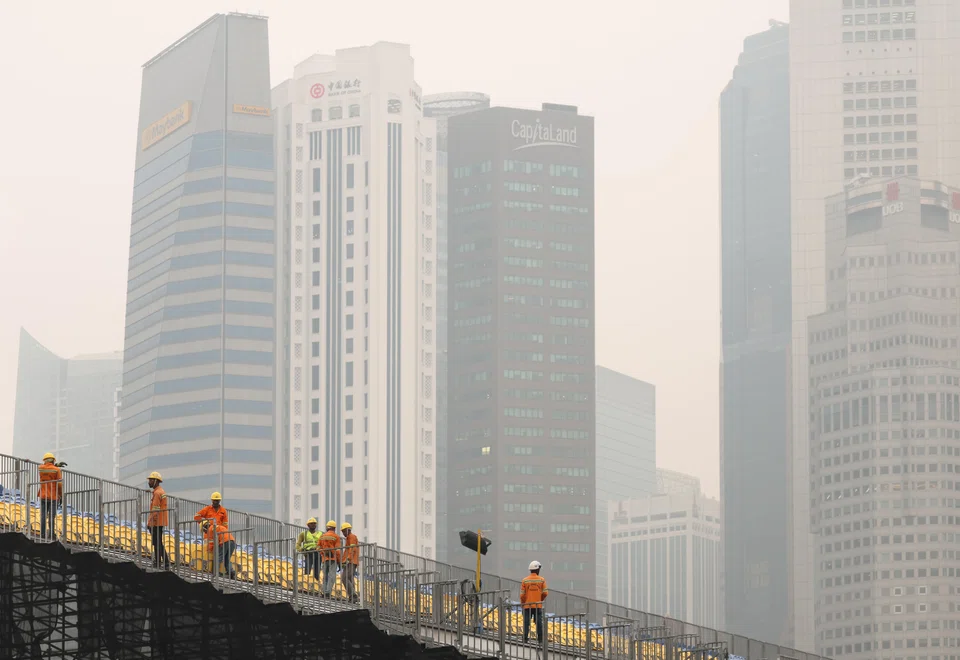
WHEN smoke from forest and land fires in Indonesia reaches Singapore, the consequences are immediately apparent. People check pollution readings, outdoor activities are disrupted and the search for those responsible intensifies.
But scrutiny often fades with the haze. Financial institutions supporting land-intensive businesses should not let their attention wane with it.
This is a question of financial discipline, not just environmental goodwill. In Asia, banks, asset managers and institutional investors provide capital to businesses that depend on forests, land and water.
Poor management of these resources can expose companies to operating disruptions, regulatory action, higher costs and reputational damage. Evaluating such risks requires more than collecting sustainability reports.
Credible information needed
Consider forests. In recent research conducted with fellow National University of Singapore researchers and published in the Proceedings of the National Academy of Sciences, we found that widely used ESG ratings do not consistently reflect measured corporate deforestation exposure.
Instead, the ESG scores responded more strongly to deforestation-related media coverage than actual forest loss.
Ratings may be useful, but financial institutions should not mistake a reassuring score for evidence of limited forest loss in a company’s assets or supply chains.
Geospatial data, such as satellite-derived forest loss maps, should be incorporated into ESG analyses, but a satellite hot spot map should not be treated as proof that a particular company started a fire.
Satellite evidence must be paired with land-tenure information, operating practices and verified supplier relationships.


Banks and investors should demand such evidence when environmental exposure is material, rather than wait for an incident to become a public controversy.
Now consider a less-visible environmental pressure: cooling Asia’s expanding computing infrastructure. The high resource demands led Singapore to restrict new data-centre capacity for several years from 2019, before restarting growth under tighter criteria.
Meanwhile, neighbouring Johor in Malaysia and Batam in Indonesia have attracted substantial investment, with water-supply concerns prompting closer scrutiny of water-cooled developments.
The economic promise of artificial intelligence and cloud services is substantial. So is the need to establish whether local infrastructure can support this growth.
A headline water-efficiency ratio tells only part of the story.
Financial institutions need to understand where water comes from, how much is withdrawn and consumed, what is discharged and whether local supplies can accommodate additional demand.
Corporate-wide water totals are no substitute for site-level analysis, particularly where water scarcity and competing users create material risks.
“Asia needs financial institutions willing to support viable growth while refusing to treat forests and water supplies as invisible inputs.”
A useful way to organise environmental accountability is to distinguish three stakeholder groups and their relationships to natural resources.
- Operators with direct impacts through land management or cooling systems;
- Customers who create purchased exposure when they buy agricultural commodities or computing services;
- Financial institutions with financed exposure through their loans and investments.
These categories identify economic relationships that warrant monitoring, rather than imply that every party caused the same environmental damage.
The third relationship deserves greater attention. Banks routinely scrutinise borrowers’ financial accounts, while institutional investors devote considerable resources to assessing companies’ earnings, strategies and growth prospects.
Why should they accept much weaker evidence about material environmental exposures that could undermine those same investments?
Independently verifiable progress crucial
For agribusiness companies, financiers should seek credible information about land-use changes, fire-prevention practices and high-risk suppliers.
Data-centre operators should examine cooling technologies, water-source reliability, withdrawal and consumption estimates, and contingency plans for shortages.
Independent verification is particularly valuable when financial projections depend on uncertain environmental assumptions.
Crucially, environmental monitoring must continue after capital has been committed.
Banks can incorporate material environmental indicators, reporting requirements and improvement milestones into financing agreements and periodic credit reviews.
Institutional investors can use active shareholder engagement, portfolio reviews and subsequent investment decisions to demand measurable progress.
These mechanisms differ, but the principle is the same: Environmental information must have consequences.
Repeated failures to provide credible information or address material risks should influence lending terms, investment decisions and continued financial support.
This does not mean that capital should be withdrawn indiscriminately from environmentally sensitive industries.
Financing may be essential for companies investing in better land management, water-efficient technologies and environmental resilience.
But engagement should be accompanied by independently verifiable progress, rather than an endless sequence of revised commitments.
Singapore has already taken steps in this direction.
The Monetary Authority of Singapore (MAS) issued environmental risk-management guidelines for financial institutions, and the Association of Banks in Singapore introduced a standardised Environmental Risk Questionnaire in 2022 to facilitate engagement with corporate clients.
The MAS’ recent transition-planning guidance places considerable emphasis on climate change and decarbonisation.
Yet collecting information is not the same as verifying environmental performance; managing climate risks is not sufficient to address deforestation, water use and biodiversity loss.
The critical question is whether these initiatives lead financial institutions to demand independently verifiable evidence, monitor actual environmental outcomes, and make them consequential for financing and investment decisions, including those involving activities outside Singapore.
Asia must step up to the plate
The challenge is particularly important for a region where economic development depends heavily on natural resources, and financial capital frequently crosses national boundaries.
Banks and investors operating from Singapore, Hong Kong and other financial centres can help establish more consistent expectations across regional businesses and supply chains.
Economic development can be advanced alongside environmental scrutiny. Asia needs financial institutions willing to support viable growth while refusing to treat forests and water supplies as invisible inputs.
The real test of sustainable finance is not how banks and investors respond when environmental damage makes headlines, but whether they consistently demand credible evidence of environmental performance – and act on it, even when nobody is watching.
The writer is professor of finance at the National University of Singapore Business School, and director of the university’s Sustainable and Green Finance Institute
Decoding Asia newsletter: your guide to navigating Asia in a new global order. Sign up here to get Decoding Asia newsletter. Delivered to your inbox. Free.
Share with us your feedback on BT's products and services
TRENDING NOW

Far East Organization’s The Serra Residences sells less than a quarter of units released at average S$3,460 psf

Once staunchly pro-China, Malaysian Chinese businesses are now distancing themselves from Beijing

Ageing in Asia: Huge potential for the consumer economy

DBS, OCBC, UOB face rate hike reality check

