Looking south of Singapore: A new vision for partnership with Indonesia
Working with the Riau Islands and mainland in Sumatra could be a vital test bed for cooperation
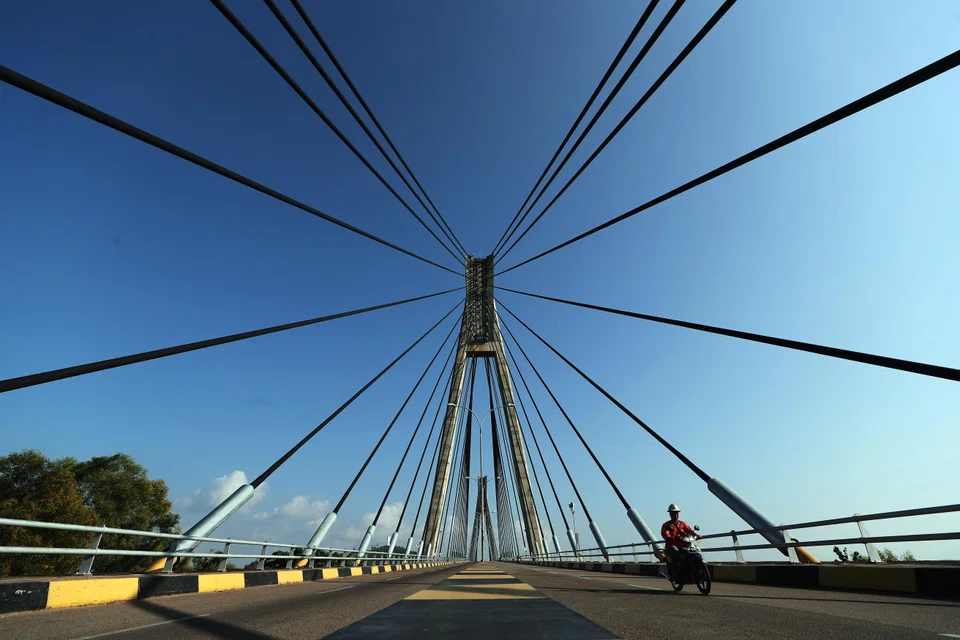
LINKS with the islands south of Singapore are longstanding and ongoing. From the early 1990s, efforts were made to connect Singapore, Johor and Riau in what was dubbed the Sijori growth triangle. But after an initial lift, progress largely plateaued.
In contrast, the first Vietnam-Singapore Industrial Park began only in 1996, and there are now 26, with more planned. Consider, too, the progress in the Johor-Singapore Special Economic Zone. While not without concerns, as my last column discussed, this should be boosted by a comprehensive masterplan and investment blueprint expected in the last quarter of 2026.
Is it therefore timely to reconsider Singapore’s engagements to the south? Might cooperation deepen with Batam, Bintan and Karimun in the Riau Islands and expand beyond to include provinces in mainland Riau and Sumatra? Can new sectors emerge? Yes, but this will require political vision and sustained commitment in the capitals, and a clearer understanding of how the two Indonesian provinces can play different but complementary roles with Singapore.
A changing context
Geopolitics urges a rethink. American tariffs are pushing countries to diversify markets and supply chains. Conflict in the Middle East and blockades in the Strait of Hormuz have highlighted Asia’s vulnerability to energy shocks.
While Indonesia and Singapore are very different, their responses run in parallel. Both continue to emphasise ties with the US and China while reaching out to other partners and seeking greater economic resilience.
Singapore seeks to enhance competitiveness by leaning into the digital and artificial intelligence economy, while also transforming to address climate change and reduce reliance on carbon. For Indonesia, President Prabowo Subianto has set ambitious targets to accelerate growth, increase downstream processing and capture more value from the country’s resources.
'%3e%3cpath%20d='M12.1475%2025.5262C13.7713%2025.4295%2014.94%2023.913%2014.94%2021.8832C14.94%2019.5359%2013.474%2018.093%2011.5917%2018.093C11.3745%2018.093%2010.9582%2018.093%2010.8393%2018.1413V25.2086L11.8891%2025.5745C11.8891%2025.5745%2012.207%2025.5262%2012.1475%2025.5262ZM11.4934%2017.6281C13.2567%2017.6281%2014.3843%2016.4292%2014.3843%2014.4501C14.3843%2012.372%2013.275%2011.2973%2011.4339%2011.2973H10.8393V17.6305H11.4934V17.6281ZM6.66078%2025.6482L7.39265%2025.5492C8.02617%2025.4502%208.26403%2025.3053%208.26403%2025.1097V11.6149C8.26403%2011.4193%208.1451%2011.3709%207.23484%2011.249L6.68137%2011.173L6.6219%2010.7588H11.9508C15.7153%2010.7588%2017.0624%2012.0797%2017.0624%2014.1578C17.0624%2015.9666%2015.7748%2017.1909%2013.4969%2017.6305V17.7041C16.111%2017.948%2017.6571%2019.5382%2017.6571%2021.7636C17.6571%2024.3318%2015.8937%2026.0417%2012.1109%2026.0417H6.60132L6.66078%2025.6482Z'%20fill='%232B2B2B'/%3e%3cpath%20d='M20.6287%2025.6505L21.5596%2025.5515C22.1725%2025.4779%2022.4104%2025.3076%2022.4104%2025.112V11.249H21.9346C20.073%2011.3479%2018.982%2013.0095%2018.408%2014.6227L18.1907%2015.5018H17.6555L18.1701%2010.7588H29.3837L29.6421%2015.4787H29.1664L28.9491%2014.6227C28.3728%2012.8645%2027.3047%2011.2743%2025.5002%2011.249H24.9856V25.1856C24.9856%2025.3812%2025.1251%2025.4548%2025.9965%2025.5515L26.7695%2025.6505L26.829%2026.0417H20.5693L20.6287%2025.6505Z'%20fill='%232B2B2B'/%3e%3c/g%3e%3cdefs%3e%3cclipPath%20id='clip0_5242_21648'%3e%3crect%20width='24'%20height='16.8'%20fill='white'%20transform='translate(6%2010)'/%3e%3c/clipPath%3e%3c/defs%3e%3c/svg%3e)
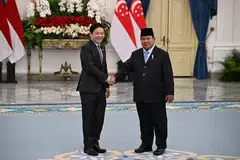
At the recent Leaders’ Retreat between Prabowo and Singapore Prime Minister Lawrence Wong, 26 cooperation outcomes were announced: 18 government-to-government arrangements and eight business-to-business agreements. These ranged from project frameworks to renewed memorandums of understanding, joint statements and progress reports. Two clusters stand out.
Sectors for collaboration
The first, and probably most strategically important, concerns cross-border electricity and renewable energy. The retreat produced a road map to catalyse electricity trade, together with commercial arrangements involving Indonesia’s Danantara and Singapore companies Keppel and Sembcorp to advance discussions on electricity offtake and transmission infrastructure.
Solar power is the most evident opportunity. Projects in Indonesia – especially with the Riau Islands – could potentially connect to Singapore through relatively short subsea cables, compared with proposed imports from Sarawak or Australia. This could reduce cost and complexity, although commercial viability, permitting, grid stability and Indonesia’s own domestic energy needs will remain decisive.
SEE ALSO

Another possibility is to convert biogas, including that captured from agricultural waste and palm-oil mill effluent into biomethanol. Unlike untreated biogas, methanol is a liquid that can be more readily stored and transported. It can be used as a marine fuel or as a chemical feedstock.
A second cluster arises around the memorandum on carbon-credit cooperation under Article 6 of the Paris Agreement. There was also a broader environmental cooperation agreement covering climate mitigation, the circular economy and environmental management. These sectors fit Prabowo’s agenda of downstreaming, economic resilience and investment in higher-value activities.
A wider southern partnership
The Leaders’ Retreat was wide-ranging and did not designate Riau or the Riau Islands as the main locations for these initiatives. But the new frameworks create an opening that these provinces close to Singapore are especially well-placed to seize.
The Riau Islands – especially Batam, Bintan and Karimun – offer proximity and connectivity. They are suited to electricity transmission and digital infrastructure. Shorter cable distances could help renewable-power projects.
Proximity can also reduce data latency and allow data-centre operations in Batam to complement Singapore’s digital hub. But this will require reliable low-carbon electricity, resilient fibre connections, cooling solutions and trusted data-governance arrangements.
While the Riau Islands can provide the connective platform for infrastructure, industry and exports, mainland Riau can complement and support this with a different scale and resource base – even more so if extended to the contiguous provinces of Jambi and Southern Sumatra. With extensive oil-palm and pulpwood plantations, this area produces large volumes of agricultural residues and also encompasses significant peatland and forest landscapes. This makes it relevant to biomethanol, biomass and nature-based carbon projects.
For biomethanol, Singapore could assist not only as a market but also as a bunkering hub, financier, certification centre and home to advanced chemical industries. The fuel is currently more expensive than conventional methanol, so reliable demand and price premiums will be critical if production is to reach scale.
Another possibility is for carbon credits. Although these can be produced and certified in many parts of Indonesia, there is good reason to consider Riau, especially for nature-based projects. Forests in parts of the province have been degraded and even plagued by fires during dry periods. These release carbon and create transboundary haze.
Better landscape management and peatland restoration can reduce both risks. Provincial leaders plan – with World Bank and United Nations backing – for sustainable growth, such as the Green for Riau initiative.
A recent visit to mainland Riau’s Kampar peninsula and April Group’s Restorasi Ekosistem Riau (RER) – a 150,000 hectare peatland restoration project – underscored the potential.
Scientific research is under way and the findings could support new projects that prevent fires and conserve peat carbon. Where carbon offset criteria – such as additionality and permanence that can be independently verified – are met, these projects could potentially produce high-quality carbon credits.
Aligning expectations
Concerns about regulation, policy predictability and Indonesia’s economic outlook have been expressed by business groups, including the China Chamber of Commerce in Indonesia. Moody’s and Fitch have shifted their sovereign-rating outlooks to negative.
Even so, Singaporean capital has consistently been attracted to Indonesia. Geographic proximity and a long-term view of Singapore’s largest Asean neighbour continue to sustain interest. What must be understood is that Indonesia is undergoing accelerated change.
The Prabowo administration has set high ambitions and favours rapid implementation, which will need to be evaluated carefully.
But business should recognise that the president’s ambitious agenda creates new commercial openings, as well as greater implementation risk. Investors must learn to distinguish between the two.
It is precisely during such a period of ambitious change that Singapore should look again at the territories closest to it and find ways to move forward, add value and spur new initiatives.
For Indonesia, deeper cooperation can support downstreaming, energy security and industrial capability. For Singapore, it can help address constraints in land, energy and carbon.
Both sides should develop a new vision of southern partnership aligning Singapore with the Riau Islands and provinces in mainland Sumatra, suited to a different era: one shaped by energy security, transition from carbon, digital infrastructure and fragmented supply chains.
Working on a win-win basis, these neighbouring provinces can become a laboratory for the next phase of Indonesia-Singapore cooperation.
The writer is chairman of the Singapore Institute of International Affairs. His visit to the RER project was hosted by April Group
Decoding Asia newsletter: your guide to navigating Asia in a new global order. Sign up here to get Decoding Asia newsletter. Delivered to your inbox. Free.
Share with us your feedback on BT's products and services