

Nvidia crisis: ‘Emperor’ Huang’s downfall may blow US-China AI race wide open
Turmoil at Nvidia could erode the West’s AI lead over China, but its weakening might also spur competition and innovation
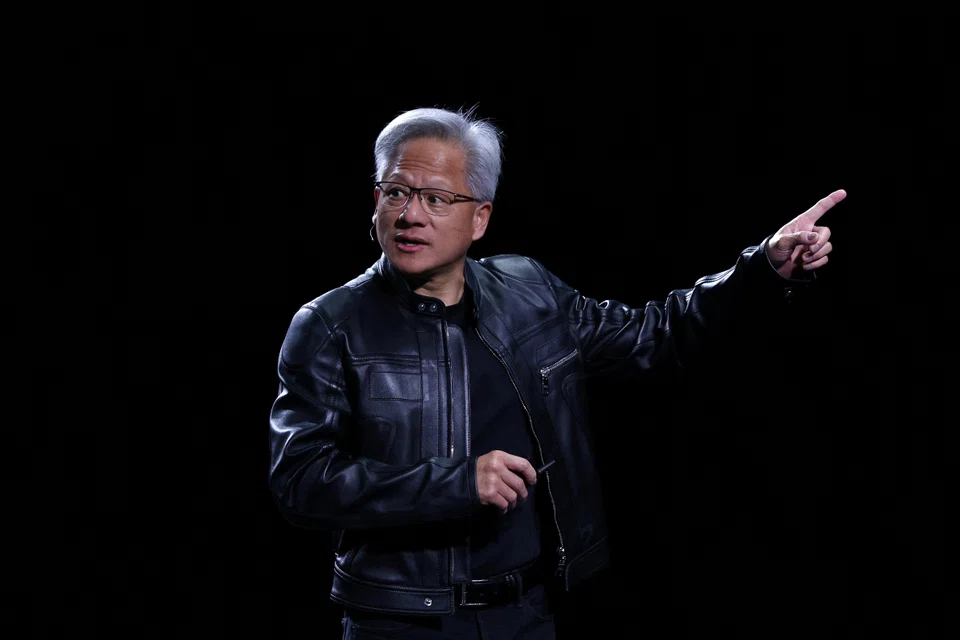
THE memes, influencer gags and Reddit rabbit holes surrounding Jensen Huang’s infidelity have made for irresistible entertainment.
But surely, the most consequential question arising from this saga is what it means for the frontier artificial intelligence race between the US and China.
The memes, influencer gags and Reddit rabbit holes surrounding Jensen Huang’s infidelity have made for irresistible entertainment.
But surely, the most consequential question arising from this saga is what it means for the frontier artificial intelligence race between the US and China.
Huang is no ordinary tech CEO. He is, in the words of his biographer Stephen Witt, the “emperor of AI”. The entire AI ecosystem, whether in the US or China, depends heavily on Nvidia, which dominates the market for graphics processing units that power AI development.
The multitrillion-dollar chipmaker is also effectively the central bank of AI, helping to finance the infrastructure expansion of companies that, in turn, buy its chips.

It is increasingly venturing into AI model development itself. Through all of that, Nvidia has fused its public identity, success and reputation with those of its founder.
In a reality where “Nvidia is Jensen, and Jensen is Nvidia”, what happens to the West’s lead over China now that he has resigned? Right now, that lead is about a year, going by US President Donald Trump’s estimate in his Nov 8 interview with 60 Minutes.
There are several strands to this story, each worth weighing.

The cost of Nvidia chaos
The first aligns with most people’s instincts: Nvidia is certain to be destabilised by Huang’s departure and the transition to new leadership.
That would send shockwaves across the US AI industry and, by extension, the entire Western tech stack, which is essentially American.
The logic is straightforward. A change of the guard, on top of a grilling by US lawmakers in upcoming committee hearings and ongoing Federal Bureau of Investigation probes, will consume immense bandwidth within the company.
A successor will also have to contend with a company built around one man. Huang has wielded concentrated power, with every major decision running through him.
The seating arrangement at Nvidia’s California headquarters reportedly reflected this: His top lieutenants sat in a stadium-style arc facing his enormous oval desk.
This risk of institutional paralysis has been flagged by experts such as Emily Kilcrease, a senior fellow and director of the energy, economics and security programme at the Center for a New American Security in Washington.
Speaking to news portal The Verge, she raised the possibility that internal distractions could hurt Nvidia’s ability to execute.
Slower decisions, delayed product roll-outs or hiccups in the allocation of scarce chips could hit major US players such as OpenAI and Anthropic. Both are trying to wean themselves off Nvidia hardware, but those efforts are still in the early stages.
In the race to build ever more powerful AI, time is precious. Even modest delays for American companies could help Chinese rivals catch up.
They do have ground to make up. China’s mass buying of Nvidia chips, including older generations that Huang lobbied the White House to allow, shows how far Beijing lags in advanced semiconductor manufacturing.
That is partly because the West’s technological moat lies in chipmaking equipment subject to US-led export controls.
Nvidia-designed processors are made using highly specialised extreme ultraviolet (EUV) lithography machines produced solely by Dutch firm ASML.
China is said to be within two to five years of high-volume manufacturing of less capable deep ultraviolet machines, while EUV technology remains a distant prospect.
All of that is the extreme scenario: Nvidia falls into chaos and China capitalises, using the opening to make further inroads into frontier AI development.
The case for resilience
Yet some pundits, including those who spoke to this columnist, take a diametrically opposed view. They argue that even with the outsized Huang factor, Nvidia and its wider ecosystem have enough built-in resilience to weather the storm, leaving the Western AI lead intact.
Paul Mah, a Singapore-based senior adviser specialising in South-east Asian data centres at consultancy Flint Global, said the company’s fundamentals remained unshaken. He pointed to its “global and diversified ecosystem, its existing technological moat, its technical prowess and its end-to-end partnerships”.
Tech commentator Mehran Gul agreed that Nvidia remained resilient as an institution in the near term. “Turmoil at the top” would not affect already-designed chips shipping over the next two years or pre-booked manufacturing capacity at Taiwanese foundry TSMC.
Nor would it affect Nvidia’s software moat, notably CUDA, the proprietary platform that allows developers to program its graphics chips for the heavy computing that underpins AI applications.
Gul, author of the book The New Geography Of Innovation, added that any longer-term impact from Huang’s departure would be financial and political rather than technological, tied to Nvidia’s balance sheet, its share price and Huang’s role as chief dealmaker and diplomat.
In his telling, this would not move the needle much for China. The West’s AI lead, he noted, rests on a layered, globally distributed system: Dutch lithography from ASML, Taiwanese fabrication, South Korean high-bandwidth memory chips and American design and capital.
A third scenario is that some pain for Nvidia might actually help secure the West’s AI lead in the long run.
If the crisis blunts the company’s near-monopoly, competitors could get more than a foot in the door, turning a single-company bottleneck into a healthier oligopoly of AI processor makers.
Mah cited Google’s roll-out of a broad array of AI chips, including the latest versions of its tensor processing units – custom-made semiconductors used to develop and run AI software.
Once reserved for the tech giant’s own use, these are now available to outside customers, with Apple, Meta, Oracle, Anthropic and OpenAI either already buying or planning to sign on.
Smaller rivals such as Nevada-based startup Positron could also gain ground.
It drew attention in 2026 after raising US$875 million (S$1.1 billion) at a valuation of US$5 billion, buoyed by investor appetite for its Asimov AI processor. Still, the circular nature of AI financing, with Nvidia bankrolling a sizeable part of the infrastructure expansion that drives demand for its chips, remains a wild card.
Another critical variable is what happens next with export controls.
Once the Democrats take control of both chambers of Congress, they are widely expected to come out guns blazing, accusing the Trump administration of paying lip service to restrictions and pushing for far tighter enforcement. Chuck Schumer, the putative Senate majority leader, has already intimated as much.
From there, things could go two ways.
On the one hand, China could be seriously squeezed. Beijing has gone out of its way to amass lower-end Nvidia chips and, if the espionage allegations linked to the Huang affair are to be believed, has left no stone unturned to acquire them.
A fierce US clampdown could even choke off Chinese firms’ remote access to computing power through South-east Asian data centres.
Taiwan-born Huang has long been the most prominent advocate of continued engagement with China rather than ever tighter restrictions. Self-serving, perhaps, but his publicly stated case was that keeping Chinese developers dependent on American technology served US interests better than shutting them out.
On the other hand, given how assiduously Beijing has pursued technological self-reliance, a harder line from Washington may simply accelerate that push. As Gul put it: “If the controversy hardens Washington’s stance on chip exports, it reinforces Beijing’s push for self-sufficiency, which was already well under way.”
Turning point for AI
There is little doubt that this is a turning point for the AI era, perhaps the most consequential jolt since ChatGPT’s debut in late 2022.
Beyond the gyrations in Nvidia’s share price and the tabloid neck-craning over Huang’s human frailties and hubris, these competing scenarios demand scrutiny by governments in Asia and beyond as they chart their own digital futures.
Should the episode derail AI momentum, it could upend well-laid national plans across the region, where governments have rolled out the welcome mat for multibillion-dollar data centres.
More broadly, the crisis is a timely stress test of technological dependencies. For the Western AI stack, a supply chain stretching from California to Tainan, the question is whether it is truly resilient enough to be trusted as global infrastructure.
If it can come undone over one man – who, despite his immense achievements, largely brought about his own downfall – then countries that have rushed to tether themselves to American AI without considering the Chinese alternative have some hard thinking to do.
For China, meanwhile, the question is whether the rival it has been stalking in AI is going through a mere blip or has genuine vulnerabilities.
If turmoil at Nvidia cascades into a wider crisis across the West’s AI world, disrupting investment, innovation and roll-out, Beijing could gain an opening that did not exist even a month ago. Whether it has the wherewithal and the will to pounce is another matter. THE STRAITS TIMES
Decoding Asia newsletter: your guide to navigating Asia in a new global order. Sign up here to get Decoding Asia newsletter. Delivered to your inbox. Free.
Copyright SPH Media. All rights reserved.
TRENDING NOW

Higher rates, weaker spending: Is the Philippines entering stagflation?
Ex-Nvidia CEO misled top lawyer on affair with Chinese businesswoman, sources say

‘I’ll be buying more’: Singapore investors pour into Nvidia shares on Jensen Huang’s exit
Nvidia approaches Arm CEO Haas as employees seek Huang's return, reports say

