
HOCK LOCK SIEW

‘Show me’ market: UltraGreen.ai should ditch its share buybacks for proactive engagement

Investors are more excited about earnings momentum and growth prospects than defensive capital management

Summarise
Ben Paul
Published Wed, Sep 9, 2026 · 08:12 AM
    • In August alone, UltraGreen.ai scooped up nearly 2.2 million shares from the market for US$1.6 million, or US$0.748 apiece.
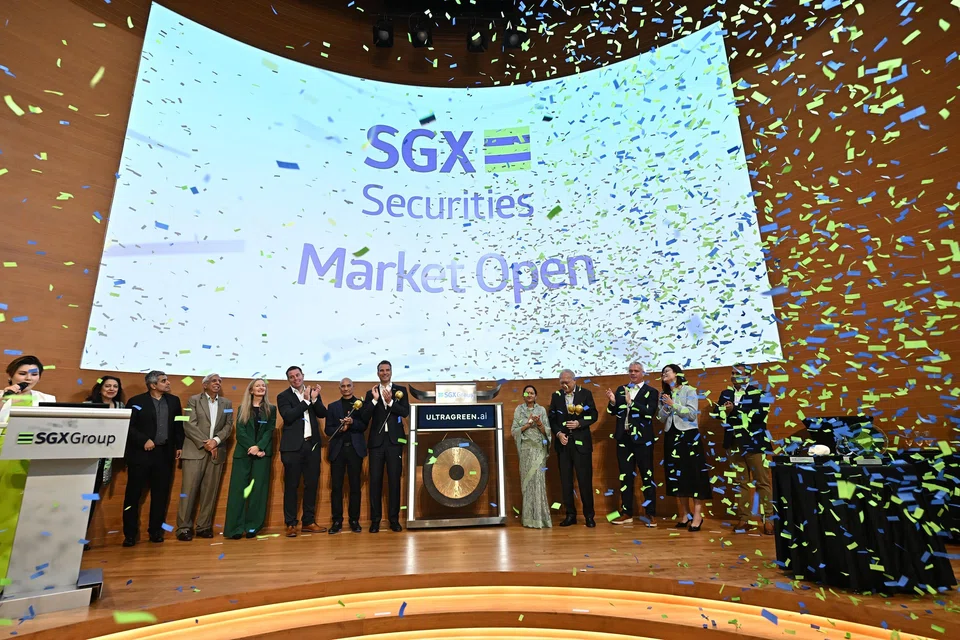
    • In August alone, UltraGreen.ai scooped up nearly 2.2 million shares from the market for US$1.6 million, or US$0.748 apiece. PHOTO: ULTRAGREEN.AI

    [SINGAPORE] As shares of UltraGreen.ai tumbled last month amid concerns of looming competition in its key market, the company has sharply increased the pace of its share buybacks.

    During the month of August alone, UltraGreen.ai scooped up nearly 2.2 million shares from the market for US$1.6 million, or US$0.748 apiece. This was more than twice the number of shares repurchased by the company during the preceding months of the year.

    In fact, it was the 11th-largest share buyback by an issuer with a primary listing in Singapore during the month, according to data compiled by the Singapore Exchange (SGX).

    UltraGreen.ai has continued buying back its shares this month. On Sep 2, the fluorescence-guided surgery specialist repurchased a further 640,000 shares for US$460,697.81, or US$0.72 per share.

    The acceleration in the company’s share buybacks came as it sought to calm investors in the wake of a report by The Business Times about Zydus Lifesciences and Provepharm possibly competing with it in the supply of indocyanine green (ICG) dye in the US.

    The nervousness doesn’t appear to have been assuaged, though. At the close of trading on Tuesday (Sep 8), UltraGreen.ai had slipped back down to US$0.635 – the 52-week closing low it hit on Aug 21. The counter closed 1.6 per cent higher at US$0.645 on Wednesday.

    This was more than 14 per cent below the average price the company paid for the shares it had repurchased since August.

    Should UltraGreen.ai continue buying back its shares? What else can it do to shore up its sagging share price?

    No boost from buybacks

    Companies repurchase their shares for a variety of reasons – including to signal that their shares are attractively priced, to support their share-based employee compensation plans, and to return excess capital to investors.

    Whatever the case, share buybacks by the largest companies in the Singapore market have done little to drive their share price performance this year, according to Citi Research.

    In a recent report, the research house noted that 25 of the 30 constituents of the Straits Times Index (STI) currently have share buyback programmes, but only five of these stocks managed to beat the benchmark index’s price return of 22 per cent during the period up to Aug 24.

    Even among the nine STI constituents with “active capital return” policies, only two outperformed the index, according to the Citi report. Ironically, those two constituents – DBS and OCBC – have not repurchased any shares recently.

    DBS last repurchased its shares from the market in July 2025, when it bought 350,000 shares at prices ranging from S$45.79 to S$46.33 apiece, or as much as 41 per cent below their current market price.

    OCBC’s last share buyback was in May this year, when it bought 447,300 shares at S$22.86 each, nearly 28 per cent below its current price.

    To be sure, with more than 80 per cent of the STI’s 30 constituents pursuing share buyback programmes, some of them are bound to underperform the index from time to time. But share buybacks haven’t even delivered decent absolute share price performance this year.

    Only 13 of the 25 STI stocks with capital management programmes managed to post price gains of 5 per cent or more, while 10 of those 25 stocks saw negative absolute share price returns during the period.

    So, if share buybacks haven’t driven outperformance or protected investors from share price downside, what has?

    Citi said stocks under its coverage that generated the greatest “alpha” this year – including AEM , DBS, First Resources , OCBC, SGX and Yangzijiang Shipbuilding – showed strong earnings momentum in the first half of 2026, with earnings beats in the second quarter of 2026. They are expected to report high-single-digit to double-digit growth into 2027.

    “We see that, currently, the market values growth more than defensive qualities offered by buybacks,” Citi said in its report.

    Opportunistic traders, patient investors

    Given the “show me” attitude of investors right now, perhaps UltraGreen.ai should shelve its share buybacks and focus squarely on realising the growth expectations that supported the US$1.45 per share valuation at which it came to market.

    On Aug 20, as its shares went into a tailspin, UltraGreen.ai maintained its guidance that its H2 2026 revenue would exceed that of H1 2026, and that its full-year revenue would come in between US$175 million and US$185 million.

    In a subsequent statement on Aug 24, UltraGreen.ai CEO Ravinder Sajwan went further by declaring his confidence in the company’s prospects, and backing it up with a pledge to continue increasing his personal investment in the company.

    However, Sajwan also said the company’s commercial response to any increased competition in the ICG market in the US would be calibrated to the new entrants’ pricing strategies, distribution approach and customer proposition.

    “Until those commercial plans become clearer, we believe it would be premature to speculate on their potential market impact or the specific actions (that UltraGreen.ai) may take in response,” Sajwan said on Aug 24.

    The problem is that investors are already speculating about how the ICG market in the US will be affected by the potential new entrants.

    Instead of pursuing share buybacks, the company should engage investors more aggressively and try to take control of the narrative about the evolving competitive landscape in which it operates.

    Such proactive dialogue may not be required under the listing rules, and it may do little in the short term to boost the company’s share price.

    But it could demystify the industry in which UltraGreen.ai operates, and build confidence in the operational and financial outlook for the company that gradually turns opportunistic traders into patient investors.

    The writer owns shares in UltraGreen.ai



