

Trump returns to Manila: Will Asean get more than a show?
His visit is a win for the bloc, but the US must show deeper engagement with South-east Asia
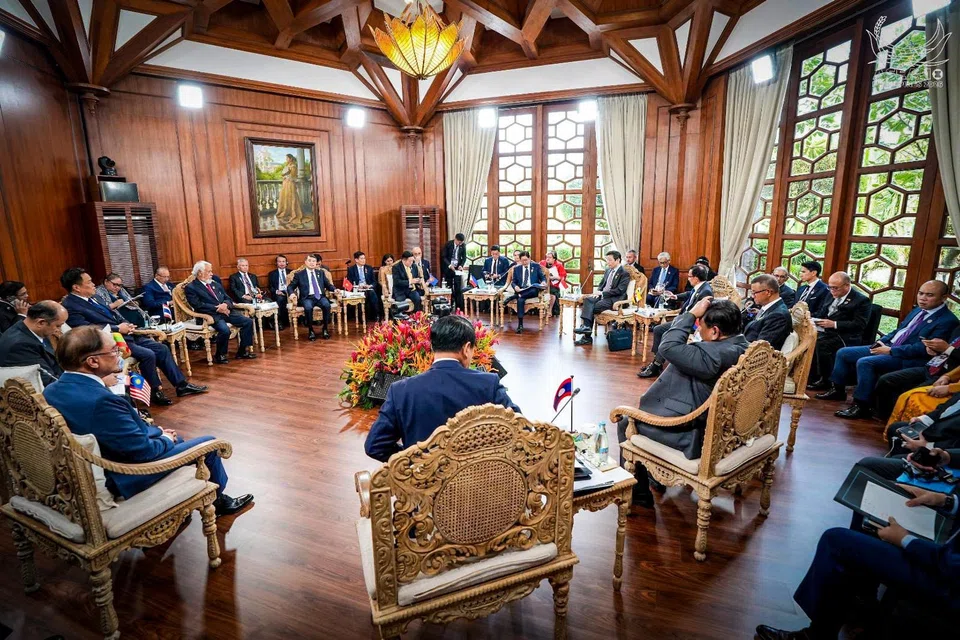
US PRESIDENT Donald Trump’s return to Manila for the 49th Asean Summit and related summits from Monday (Nov 16) to Wednesday is significant for several reasons.
It will mark his second consecutive attendance at an Asean Summit, following Kuala Lumpur in 2025, and his return to the Philippines after nearly a decade (he last attended the 31st Asean Summit in Manila in 2017).
Coming just ahead of the Apec Summit in China, the visit offers Trump an opportunity to demonstrate US engagement with South-east Asia, at a time when Washington’s currency in the region has weakened.
The US’ regional standing will continue to be affected if Washington prioritises bilateral interests over Asean-led multilateralism.
For Asean, Trump’s presence is welcome, especially given longstanding concerns about the consistency of US engagement.
The more important question, however, is whether the visit will lead to substantive cooperation or become another occasion for bilateral deal-making and diplomatic showmanship, potentially overshadowed by Trump’s subsequent meeting with Chinese President Xi Jinping at Apec in China.

At the 2025 Kuala Lumpur summit, Trump witnessed the Thailand-Cambodia peace agreement and announced several trade deals. However, renewed border clashes between the two countries in December exposed the fragility of the peace agreement.
The Democrats’ victories in both houses of Congress in the midterm elections mark a major setback for Trump, particularly on economic and foreign policy issues.
Unlike the previous Congress, the Democrat-controlled Congress could exercise scrutiny through hearings, funding restrictions and tighter controls on artificial intelligence chip exports to China.


Trump, however, still retains considerable executive authority over foreign policy. This means his approach to South-east Asia is unlikely to change fundamentally. He may also be more inclined to showcase diplomatic successes abroad.
Trump’s counterpart and host in Manila is hardly any stronger politically. Philippine President Ferdinand Marcos Jr’s approval rating is at its lowest since 2022.
The Asean chairmanship year has coincided with a flood-control corruption scandal, the impeachment trial of Marcos Jr’s ally-turned-political nemesis Vice-President Sara Duterte, and an ailing economy suffering from severe inflation.
Historically, a US presidential visit tends to give a political boost to a sitting Filipino president, given Filipinos’ consistently positive public opinion of the US.
However, the visit’s significance lies less in its pageantry than in whether the visit can contribute to the legacies both presidents seek to leave behind after their terms end in 2028.
The Philippines welcomes the visit as a longstanding US treaty ally in South-east Asia and as a country that has recently diversified its strategic relations with middle powers such as Australia, Japan and India (middle powers in the Quadrilateral Security Dialogue other than the US).
It also comes at a time when Philippine-China relations are at a low point given lingering tensions in the South China Sea and diplomatic skirmishes between Filipino security officials and the Chinese embassy in Manila.
Beijing has accused Manila of “abusing” its chairmanship in its recent hosting of the Asean Defence Ministers’ Meeting Plus (ADMM-Plus).
Marcos Jr has a difficult balancing role to manage: he has to fulfil his country’s responsibilities as Asean chair and also seek Trump’s strong commitment to the US-Philippine alliance (which would affect his country and Asean’s relations with China).
The South-east Asia that Trump will be revisiting remains beset by lingering security and diplomatic challenges, including China’s assertiveness in the South China Sea, dealing with Myanmar’s ruling military junta and the Thai-Cambodian border dispute.
Beyond US-Philippines relations, trade and economic security will likely dominate Trump’s agenda. Washington is seeking greater market access, critical minerals, technology cooperation, AI and more resilient supply chains.
Last year, Trump secured critical minerals arrangements with Cambodia, Malaysia and Thailand, alongside reciprocal trade agreements or negotiation frameworks with these countries and Vietnam.
Further trade announcements are possible, including a joint statement marking progress in US-Thailand reciprocal trade negotiations.
However, the tariff experience of the past year has also reinforced Asean’s concerns about economic coercion and the unpredictability of US trade policy.
The region’s unease is reflected in the Iseas-Yusof Ishak Institute’s State of South-east Asia 2026 Survey, where US leadership under Trump was the top geopolitical concern for 51.9 per cent of respondents, surpassing tensions in the South China Sea.
This does not mean South-east Asia is turning away from Washington, but rather, confidence in America’s reliability has weakened.
Trump’s visit therefore presents an opportunity to rebuild some of that confidence, though symbolic gestures alone will not be enough.
One potentially significant development is US Defence Secretary Pete Hegseth’s proposal at the October ADMM-Plus for an Asean-US Framework for Defence Cooperation.
The proposal identifies maritime domain awareness, naval cooperation and interoperability as potential areas for collaboration.
While Asean countries have yet to respond collectively, a clear reiteration of this plan by Trump would signal Washington’s commitment to regional defence cooperation and could attract bipartisan support in Congress.
While welcome, details about Hegseth’s proposal are scarce, and many of the suggested areas are already covered by existing Asean-US cooperation and ADMM-Plus (an Asean-led mechanism).
The real test is whether the framework can deliver concrete activities, resources and capacity-building rather than the repackaging of existing initiatives.
Looking ahead
Asean’s upcoming 60th anniversary next year provides another opportunity to give Asean-US relations greater continuity beyond Trump’s visit.
A concrete commitment to the anniversary, stronger implementation of the Comprehensive Strategic Partnership and practical cooperation in areas of shared interest such as maritime security, cybersecurity and combatting transnational crime would be more meaningful than another set of broad declarations.
Ultimately, Trump’s participation in two consecutive Asean Summits sends a positive signal, especially compared to his single appearance in 2017 during his first term.
However, showing up is only the beginning. The real test is whether Washington sees Asean as a regional partner worth investing in, rather than merely a platform for bilateral deals.
Equally important is whether Trump’s subsequent meeting with Xi in Shenzhen will help stabilise US-China relations without compromising South-east Asia’s interests.
In short, Asean would welcome a further stabilisation in Sino-US relations, but not by too much. Put differently, the bloc would not want to find itself on the menu when the two major powers sit at the table.
Joanne Lin is a senior fellow and coordinator of the Asean Studies Centre at Iseas-Yusof Ishak Institute. Aries A Arugay is a visiting senior fellow and coordinator of the Philippine Studies Programme at Iseas-Yusof Ishak Institute. He is also professor at the department of political science, University of the Philippines-Diliman. This is an edited version of an article that first appeared on Fulcrum, Iseas-Yusof Ishak Institute’s blog site.
Decoding Asia newsletter: your guide to navigating Asia in a new global order. Sign up here to get Decoding Asia newsletter. Delivered to your inbox. Free.
Share with us your feedback on BT's products and services
TRENDING NOW
Ex-Nvidia CEO Jensen Huang carried a secret for more than a year. It led to his downfall
South-east Asia has lost Nvidia’s best salesman

Demand, tech capabilities position Apac and AI as Skyscanner’s next growth frontiers: CEO Bryan Batista
Jensen Huang discusses comeback as Nvidia CEO with allies: report

