

Trump-Xi-Putin summit marks the start of the post-Western order
The US president went to China to escape a midterm defeat. He came home with a picture that belongs to Xi
AMERICAN presidents who lose a midterm election have a habit of boarding Air Force One soon afterwards.
In November 2014, a week after the Democrats lost the Senate, Barack Obama flew to Beijing for the Asia-Pacific Economic Cooperation (Apec) summit. Obama returned with a landmark climate agreement with Chinese President Xi Jinping, longer visas for students and business travellers, a deal to scrap tariffs on high-tech products and new military confidence-building measures.
Twenty years earlier, after the Republican landslide of 1994, Bill Clinton went to Bogor, Indonesia, where Apec leaders committed to free and open trade across the Pacific.
Neither trip rescued their fortunes at home. But Americans got something out of them.
Donald Trump, whose party lost both chambers of Congress on Nov 3, followed the script and flew to Shenzhen. If he brought anything for Americans, it is much harder to find.
Symbolism over substance
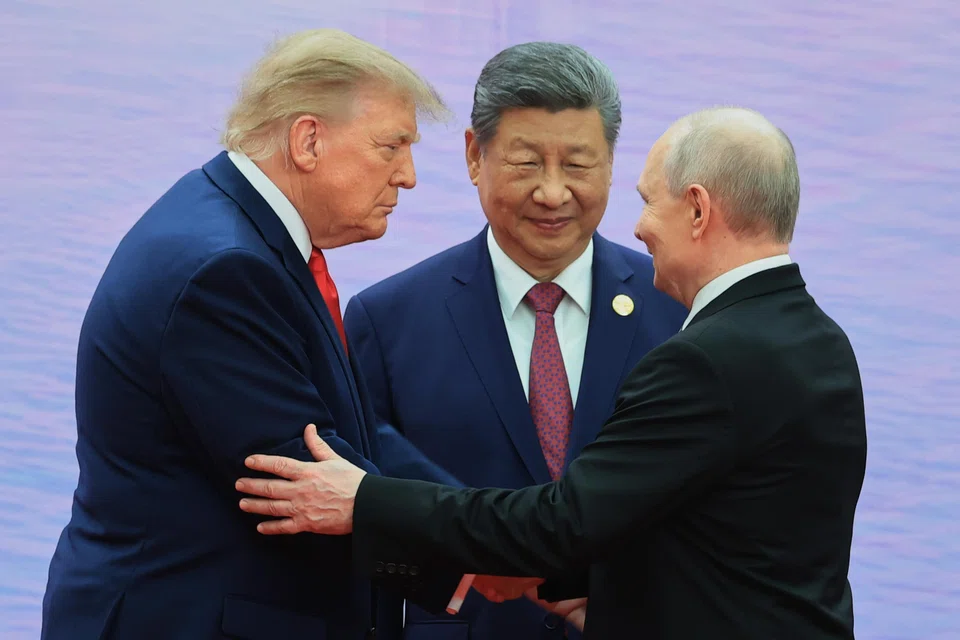
What the world will remember from the Nov 19 trilateral summit is a photograph.
At Kylin Villa, Xi sat at the centre of the table, with the presidents of the United States and Russia on either side.
Chinese diplomacy has always understood that power is also a matter of staging, and this was a masterpiece of the genre: China as the Middle Kingdom, convening and steadying the world.
The country that built the post-1945 order sat on one flank, at the same level as Russia, an economy of roughly US$2.9 trillion – against America’s US$32.6 trillion – with a declining population and a war in Ukraine approaching its fifth year with no end in sight.
If historians need one image to mark the start of the post-Western order, Shenzhen has supplied it.
Trump rated the summit “12 out of 10”. Analysts around the world are less generous.
Their near-unanimous verdict is that the meeting was heavy on symbolism and light on substance. I can only agree.
An ironic peace declaration
Trump, Xi and Vladmir Putin talked for about 90 minutes. No breakthroughs on Ukraine or Iran. No mention of Taiwan. There was no movement on the rare earth metals Beijing continues to ration, and no arms control was discussed.
The meeting produced a “Declaration toward Peace” that looks as if the surrealist painter Salvador Dali had composed it on an off day: United Nations reform, oil barrels, immunity of heads of state, and nuclear risks.
Tommy Koh, diplomat and Singapore’s former permanent representative to the UN, has called the declaration “absurd”.
It is curious that UN reform has suddenly become a shared priority for three veto powers that have spent decades blocking any change to the Security Council.
Are the three powers signalling an agreement on who should succeed Antonio Guterres, whose term ends in December, as next UN secretary-general?
The second point, a pledge to increase the production and supply of refined petroleum products “for the benefit of all nations”, is presented as energy security.
In practice it is a gift to the Kremlin, whose war economy depends on hydrocarbon revenues that have fallen sharply in 2026.
The most troubling is the third point.
The three leaders declared that state consent and respect for the immunities of state officials are “of paramount importance” and that the International Criminal Court and similar bodies “must not abuse their jurisdiction”.
The language serves Putin perfectly: the court issued a warrant for his arrest in 2023 over the unlawful deportation of Ukrainian children. A declaration about peace has turned into a declaration about impunity.
Only the fourth point deserves its place under the title.
The three presidents reaffirmed that a nuclear war cannot be won and must never be fought, the formula Reagan and Gorbachev adopted in 1985, and promised a dialogue on reducing nuclear risks and preventing proliferation.
The wording is careful. It speaks of “risks” rather than arms control, which China rejects while it expands its arsenal. It focuses on proliferation, the one issue on which those who already have the bomb always agree.
The message for Asia and Asean
Some experts suspect Moscow and Beijing are thinking less about Iran than about Japan and South Korea deciding one day that the American umbrella can no longer be trusted.
That is the real message for Asia. Tokyo and Seoul watched their protector sit in a lakeside villa with their two main strategic adversaries, in a meeting that ran twice as long as Trump’s session with the Quadrilateral Security Dialogue.
Prime Minister Sanae Takaichi insisted Japan’s interests would not be compromised, while her officials privately questioned Washington’s commitment.
In Seoul, scholars talk openly of the pillars of national security policy being shaken.
After 70 years of loyalty, America’s closest Asian allies may conclude that they have been thrown under the bus, and that the bus is Chinese.
For South-east Asia, and for Singapore in particular, Shenzhen is a warning more than a shock. This region has prospered in a world where rules, however imperfect, constrained the strong.
A concert of three powers that dismisses international courts and treats the UN as a matter to settle among themselves is the opposite of what middle powers and small states need.
At the Apec table, Singapore’s Prime Minister Lawrence Wong urged the region to keep cooperating even when it cannot agree on everything, and to resist splitting into rival blocs. That is the right instinct.
With Singapore chairing Asean next year, the task is to give real substance to coalitions of middle powers and to keep Asean at the centre of regional diplomacy, so that South-east Asia stays in the room rather than on the menu.
Obama came home from Beijing with a climate deal. Clinton came home from Bogor with a trade vision. Trump came home from Shenzhen with a photograph, and the photograph belongs to Xi.
The writer is vice-dean (executive education) and associate professor in practice at the Lee Kuan Yew School of Public Policy, National University of Singapore
TRENDING NOW
Wall Street asks what can save AI trade after Anthropic wipeout
What shattered Crystal Jade? How the culinary empire shrank from 120 to just 9 outlets
As Indonesia picks new vice-president to succeed Gibran, investors see risks and opportunities
Could Jensen Huang work for Elon Musk? It would be ‘a titanic ego death match’, says biographer

