Trump-Xi-Putin talks: US-China relations, AI chips, Iran war among 5 things to watch
Leaders gather in Shenzhen for Apec Summit to discuss trade tensions and technology restrictions
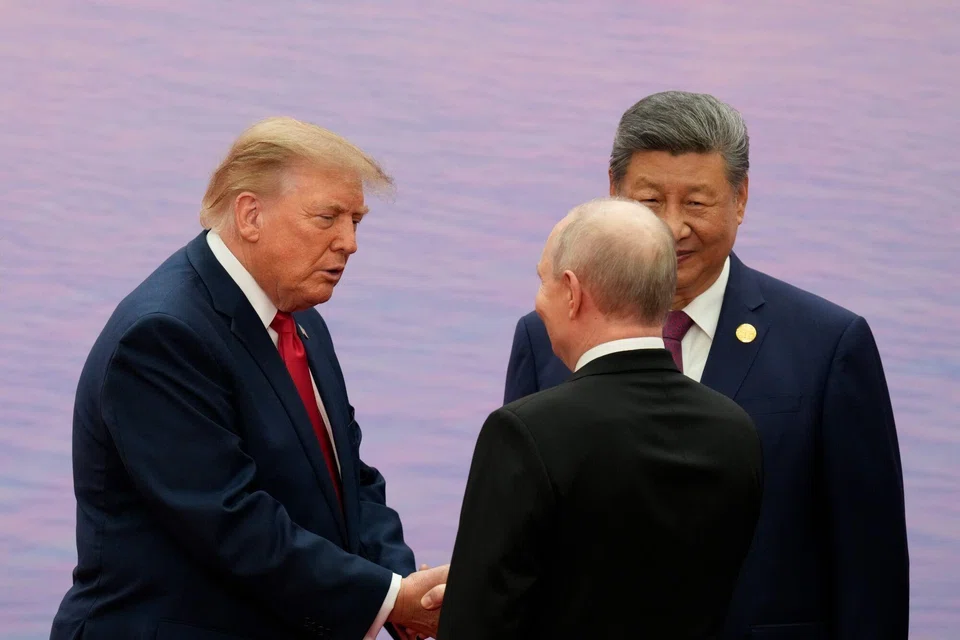
[SINGAPORE] US President Donald Trump, Chinese President Xi Jinping and Russia’s Vladimir Putin are meeting on Thursday (Nov 19) in Shenzhen China for historic three-way talks.
The world’s three most powerful men and leaders from 21 Asia-Pacific economies arrived earlier for the Asia-Pacific Economic Cooperation (Apec) summit, with high-stakes diplomacy and economic tensions threatening to overshadow the annual meeting.
The two-day gathering, which began on Wednesday, comes as the US States and China navigate a fragile trade truce, Washington tightens restrictions on advanced semiconductor exports, and geopolitical disputes continue to test regional stability.
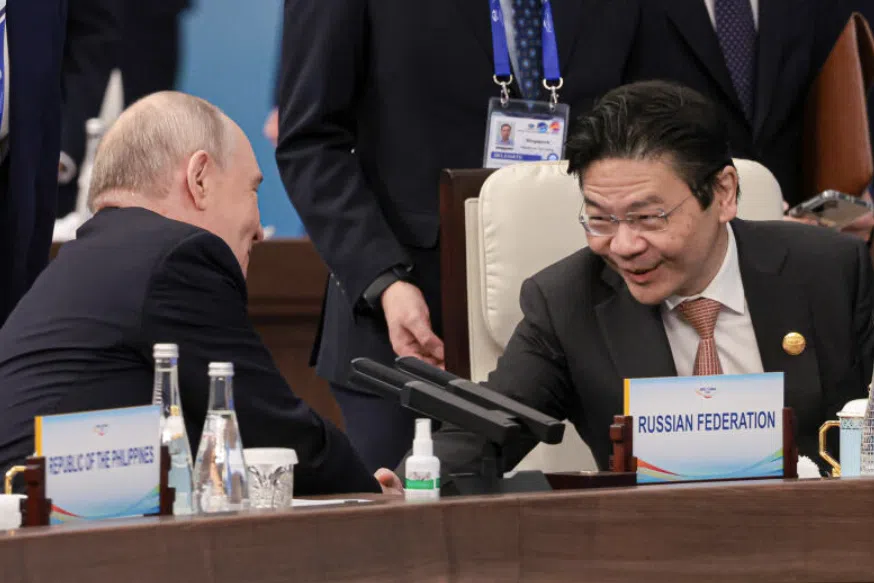
Singapore Prime Minister Lawrence Wong will also be holding a series of bilateral meetings on the sidelines.
Here are five things to watch at this year’s summit.
1. US-China relations
All eyes are on Trump and Xi as they meet in Shenzhen, with the trade truce between the world’s two largest economies due to expire in January 2027.

The two leaders last met in September in Washington, where they maintained a relatively conciliatory tone despite persistent disagreements over tariffs, technology restrictions and geopolitical issues.
Their latest meeting comes as both sides face pressure to prevent another escalation in trade tensions that could disrupt global markets and supply chains.
Xi has sought to portray China as a champion of economic openness. Speaking at the Apec CEO Summit on Wednesday, he pledged to cut tariffs, expand market access and improve conditions for foreign investors.
His remarks contrasted with Trump’s protectionist trade policies, which have raised concerns among economies dependent on international commerce.
Xi also called for closer technology partnerships and efforts to keep global supply chains and stable open.
The key question is whether the two leaders can extend their trade truce and prevent fresh disputes from undermining their relationship.
2. PM Wong’s agenda
For Singapore, the summit provides an opportunity to strengthen ties with regional partners as the Republic prepares to chair Asean in 2027.
PM Wong began his visit on Wednesday with bilateral meetings involving Vietnamese President To Lam, Chilean President Jose Antonio Kast and Peruvian President Keiko Fujimori.
The discussions covered trade, the digital economy, carbon credits and regional cooperation.
During his meeting with Lam, PM Wong highlighted opportunities for Singapore and Vietnam to support each other’s priorities next year, when Singapore chairs Asean and Vietnam chairs Apec.
He also discussed strengthening economic cooperation with Chile and Peru, including through existing trade agreements and new opportunities in the digital economy.
He said Singapore hoped to deepen collaboration with its partners amid growing global uncertainty.
PM Wong is scheduled to address the Apec leaders’ meeting on Thursday and meet Xi on Friday, before travelling to Beijing for talks with Chinese Premier Li Qiang on Saturday.
His engagements with China’s top leaders will be closely watched for indications of how Singapore intends to strengthen bilateral economic ties while navigating growing rivalry between major powers.
3. US-China chip, AI race
The US-China technology rivalry has intensified just days before the summit, following Washington’s announcement of tighter restrictions on advanced artificial intelligence chips.
The new measures, announced on Monday, require export licences for certain advanced semiconductors shipped to Singapore, Malaysia, Indonesia, Thailand and Brazil.
They also target overseas data centres that provide significant computing capacity to Chinese companies, as Washington seeks to prevent Beijing from circumventing existing export controls.
China has criticised the restrictions as economic coercion and warned that it would take necessary measures to protect its interests.
The move threatens to complicate Trump-Xi talks, particularly as access to advanced chips remains central to both countries’ ambitions in AI.
The restrictions also have implications for Singapore, a major semiconductor trading hub and growing data centre market.
PM Wong said on Tuesday that Singapore could manage the impact on chips transhipped through the Republic, but was more concerned about those used by local companies and data centres.
Still, Singapore is pressing ahead with three national AI missions for financial services.
Whether Washington and Beijing can prevent their technology rivalry from escalating further will be a key development to watch.
Rare earths – crucial for the clean energy transition and electric vehicles – may also be discussed. The global supply is currently dominated by China and the US is struggling to catch up. On Tuesday, Trump gave a 10-month time frame, which analysts said is unlikely to happen.
4. Putin’s presence and geopolitics
Putin’s attendance marks his first in-person appearance at an Apec leaders’ meeting since 2017.
He is expected to join Trump and Xi for a three-way meeting on Thursday, bringing together the leaders of three major nuclear powers.
Trump has previously floated denuclearisation as a possible discussion topic, although China has historically resisted negotiations over nuclear stockpile limits with Russia and the US, which possess much larger arsenals.
The meeting also takes place against the backdrop of the war in Ukraine and the conflict involving Iran.
A senior US administration official said Trump intended to discuss Iran with the two leaders but was not expected to raise Ukraine.
Putin used his address to the Apec CEO Summit on Wednesday to criticise Western sanctions and export restrictions, while highlighting Russia’s growing economic ties with the Asia-Pacific.
He said trade with the region now accounts for more than half of Russia’s total trade.
His presence gives Moscow an opportunity to deepen engagement with Asian economies despite Western efforts to isolate Russia following its invasion of Ukraine.
5. Regional disputes
Although Apec is primarily an economic forum, the gathering comes amid persistent security tensions in the Asia-Pacific.
Among the most contentious issues are competing territorial claims in the South China Sea, where China and several South-east Asian countries, including the Philippines and Vietnam, have overlapping claims.
The disputes have complicated efforts by Asean and China to conclude a Code of Conduct governing behaviour in the contested waters.
The Philippines ended its Asean chairmanship this week without securing a final agreement on the code, leaving the issue unresolved as Singapore prepares to take over the grouping’s leadership. The unfinished maritime negotiations remain among the key challenges facing the region.
Security concerns also extend to the Korean Peninsula, where North Korea’s nuclear weapons and missile programmes continue to unsettle neighbouring countries.
While such issues are not expected to dominate Apec’s formal economic discussions, they could feature in bilateral meetings and informal exchanges among leaders.
For Singapore, regional stability is closely linked to economic confidence and trade, making developments in the South China Sea and wider Asia-Pacific particularly significant.
Decoding Asia newsletter: your guide to navigating Asia in a new global order. Sign up here to get Decoding Asia newsletter. Delivered to your inbox. Free.
Copyright SPH Media. All rights reserved.