Trump’s America remains a less welcoming place for talent and foreign students
Stephen Miller’s appointment as chief of staff is a sign that battle lines are being drawn on the issue

FOR THOUSANDS of students across Asia, Singapore included, the US is the top choice for tertiary education – if they have the means or the funding.
Britain and Australia follow. Those who look to eventually immigrate will likely add Canada as a fourth prospect, for both quality education and a possible future home.
Those still eyeing the US as the land of learning and lucre will probably need to wait until US President Donald Trump finishes his term in early 2029.
Even as critics savour the Republican Party’s setbacks in the US midterms, there is little sign Washington will soften its stance on immigration.
Trump recognises that immigration was an important issue for voters.
But even as he acknowledged that the excesses of his immigration policy had hurt him, and made cursory mention of working with Democrats on this, his interview with CBS’ 60 Minutes showed no indication that he intends to abandon his administration’s overall hostility towards immigration.

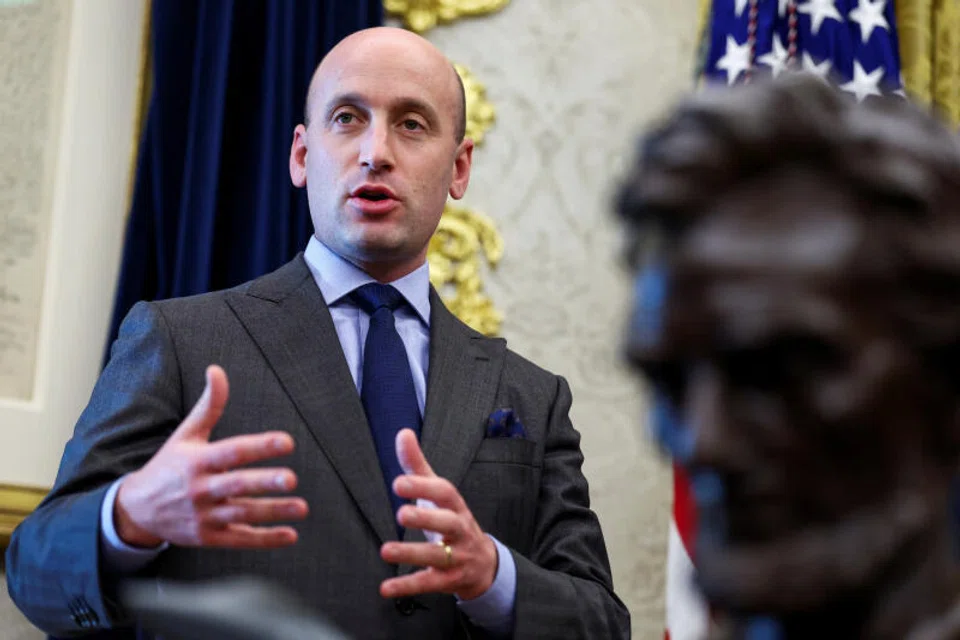
And, shortly after the interview, he walked off to announce that immigration hardliner Stephen Miller would replace Susie Wiles as his chief of staff, the most influential unelected position in the White House.
“An accelerant of executive power”
Miller, the grand vizier of Trump’s Maga (Make America Great Again) politics, will get his way. Through the Trump presidency, he has focused on immigration and hardline domestic issues. Migrants, in his view, are “invaders”.
Friends and foes alike think Miller is an “accelerant of executive power” – shorthand for an operator who will unbridledly leverage the weight and power of the presidency to not only fulfil his superior’s agenda, but also his own.

Unlike Trump’s Cabinet members, who can be impeached by Congress, only one man can unseat him: the President himself. Proximity is power.
Hence, few buy into Trump’s talk of working with Democrats on the issue.
Trump himself had previously spoken of working with the opposition on immigration, and nothing came of it.
Cooperation across the aisle is even less likely now, as Democrats, who won every congressional district on the US-Mexico border during the midterms, see the battle lines being drawn with Miller’s appointment.
Senate Minority Leader Chuck Schumer described the Miller appointment as “not a course correction, (but) a promotion”. For Hakeem Jeffries, House Democratic leader, Miller is a “stone-cold racist”.
Will Trump chicken out – as he frequently does?
Unlikely when it concerns domestic political issues. The exception is when the financial markets come into play, as seen in his unsuccessful attempt to pressure former US Federal Reserve chairman Jerome Powell to quit, after threats to fire him.
To Trump, a setback to his agenda is usually just another opportunity to effect a workaround.
Look at what he did after the Supreme Court, in a 6-3 decision this June, struck down an executive order limiting birthright citizenship. Just over a month later, he issued two narrower orders targeting the same issue.
The brazenness has worked for him for the most part. How many men do you know got re-elected to the world’s most powerful office six months after being convicted of 34 felony counts, and while awaiting formal sentencing?
Limits of congressional checks
Those awaiting a softer American line on immigration would be prudent to expect disappointment.
The Republican Party is unlikely to pressure Trump on the matter, despite its recent electoral setbacks that saw control of Congress pass into Democratic hands.
See what they just did for Pete Hegseth, Trump’s secretary of war.
The Republican House majority – which will vanish when the new members are sworn in come January – rallied to save him from impeachment, at a time when the war on Iran is even more unpopular with Americans than immigration.
Ordinarily, with Congress passing into Democratic hands, the legislature could be expected to exercise more oversight of presidential policy by controlling the budgetary purse strings. But on immigration policy, Trump is insulated from those handcuffs.
The Secure America Act that he signed in June funds immigration enforcement through September 2029.
The bulk of the money is allocated to Immigration and Customs Enforcement, or ICE, to fund its operations and mass deportations. Even border enforcement – for which Trump claimed voters gave him much credit – is lower in the budgetary provisions.
Democrats looking to bring about changes to immigration policy had declined to back further funding for ICE and Border Patrol.
But the House voted 214-212, with the measure passing in June solely on Republican strength, and Trump quickly signed it into law.
The overwhelming prioritisation of enforcement funding is happening without additional funding to Citizenship and Immigration Services to process visas and other services. In many Asian countries, the wait for a US visa interview can take weeks or even months.
A changed mood
The harder reality to stomach is that Trump’s tougher stance on immigration may not be too far out of step with a changed national mood.
In the US Midwest particularly, such creeping hostility to foreign-born migrants is causing a steady exodus towards coastal metropolises like New York and San Francisco.
An Asia-born senior legal counsel told me a few months ago that he and his wife, a doctor, moved from Milwaukee to the West Coast after they learnt that even their friendly neighbours had taken to referring to them as the “Huxtables” – after a fictional upwardly mobile black American family that moves into a predominantly white neighbourhood.
That story was the premise of the 1980s sitcom The Cosby Show.
In my two trips to the US in the past 14 months – entering through New York and San Francisco, two of its most global cities – I experienced a longer than usual chat with an immigration officer.
Never before had I felt uneasy entering this country admired by many. I need to be there again next June for a family event, and have found myself already scouting for credible excuses not to go.
That palpable sense of apprehension among foreign visitors may be one reason why inbound tourism numbers remain below pre-pandemic levels.
Furthermore, international tourist arrivals fell 5.5 per cent in 2025 compared with the 72.3 million visitors the US received in 2024, according to the US Travel Association. In 2026, that number is expected to decline further.
And so it is for foreign students, too. US education data suggests that in the first full year of Trump’s second stint as president, new international student enrolments fell by 17 per cent.
Nearly 16,000 fewer foreign students vied for spots at US colleges in 2026 than in 2025, CommonApp, the most widely used college application platform, reported in August, following tighter visa rules and heightened restrictions on overseas arrivals.
Miller’s significant influence on immigration policy
At 41 – roughly half his boss’ age – Miller has plenty of runway left.
Born and raised though he was in liberal California, and himself a descendant of Eastern European Jewish immigrants, he has enjoyed a meteoric rise since leaving Duke University to work for Tea Party firebrand Michele Bachmann.
He is unlikely to relent in advancing the agenda of a US president who recently awarded himself an “A-plus” for closing the border. And he can be trusted to do his utmost to delay the projected trend of non-Hispanic white Americans becoming a minority between 2041 and 2045.
But it would be a mistake to think this shift in political direction is cost-free. Already, talent is turning away from the US, thanks to Trumpian policies – led by Chinese and Indians heading home to tech hubs such as Shenzhen and Bengaluru, as well as emerging hubs such as Dubai.
Whether Miller succeeds in reshaping America’s long-term trajectory is another question. For all its political turbulence, America does have a habit of self-correcting.
Bachmann, herself the big star of conservative politics in 2009, had flamed out by 2013, a period that included a failed presidential bid.
In 2015, she left Congress and has since been on the faculty of Regent University – a niche Christian institution far removed from the mainstream destinations that draw top foreign students.
Now, how many famous political or business leaders can you recall came from Regent? THE STRAITS TIMES
Decoding Asia newsletter: your guide to navigating Asia in a new global order. Sign up here to get Decoding Asia newsletter. Delivered to your inbox. Free.
Copyright SPH Media. All rights reserved.