

Australia tackles property tax breaks, disappoints on deficit
The Budget’s housing package is a highlight, with a crackdown on tax concession for investors to help address intergenerational inequality
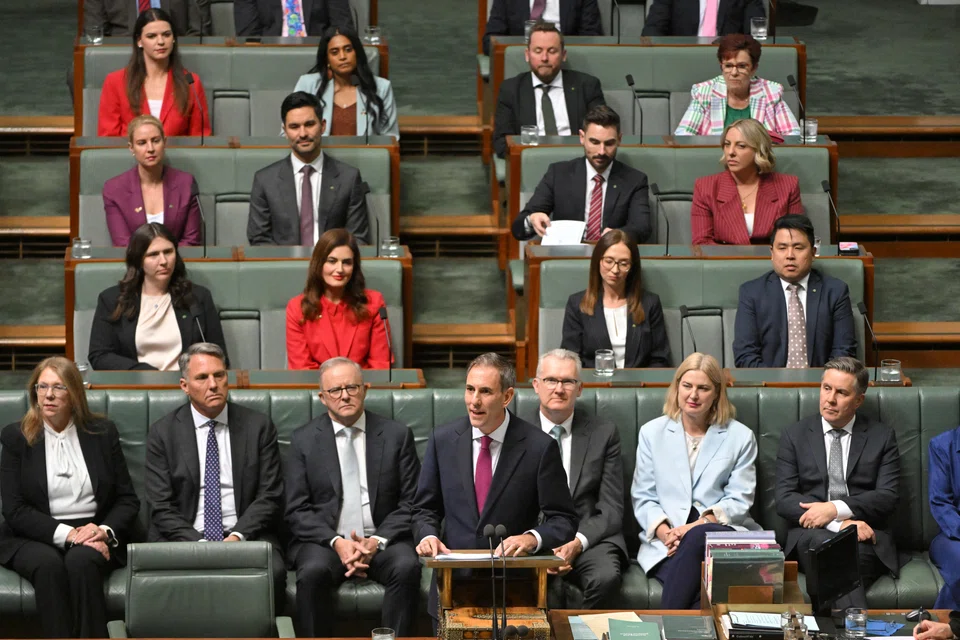
[CANBERRA] Australia will overhaul tax settings that have long favoured property investors and assist households and firms grappling with soaring fuel costs in a Budget that outlined deficits across the forecast horizon.
Treasurer Jim Chalmers’ first Budget since the centre-left government won a landslide election victory 12 months ago showed this year’s deficit at A$28.3 billion (S$25.3 billion), or 1 per cent of gross domestic product. It is then expected to widen to A$31.5 billion in fiscal 2027 and remain in the low 30s to June 2029.
That was above economists’ median estimate of a A$26.7 billion shortfall in the current year, and A$25 billion in 2026-27. Still, compared with the average 2.5 per cent Budget deficit in major developed economies, Australia’s finances are in better shape.
The Labor government is trying to shield the economy from an Iran-war driven energy shock while turning around moribund productivity and addressing intergenerational inequality that has frustrated young Australians. The economy is reasonably placed at present with low unemployment and key exports like iron ore, coal and liquefied natural gas boosted by the conflict in the Middle East, which is swelling government revenue.
Yet Australia was grappling with resurgent inflation even before the US-Israeli attack on Iran at the end of February. That pushed the Reserve Bank of Australia (RBA) to raise interest rates three times this year, even before the full impact of soaring fuel prices was felt.
The latest rate hike came with a warning that headline inflation will peak near 5 per cent this quarter, well above the RBA’s 2-to-3 per cent target. As a result, economists were hopeful Chalmers would use the Budget to take as tougher fiscal stance to cool price pressures. He maintains the document addresses pressing needs.
“It’s a responsible Budget, and a reforming Budget, which builds resilience and bolsters our economy,” Chalmers said in a speech to lawmakers on Tuesday (May 12) evening. “There is more cost-of-living relief, more Medicare and more aged care, and more housing.”
The treasurer added in his address to parliament that the macroeconomic outlook is “much more uncertain” with oil prices expected to remain elevated for some time yet and a slowdown in global growth.
Chalmers reiterated that the government is banking some of the windfall from commodity prices to help restrain inflation pressures, calling his document “the most important and ambitious” Budget in decades.
SEE ALSO





Yet outside well-telegraphed cuts to Labor’s flagship National Disability Welfare Scheme, there were limited savings. Australia’s public finances are under pressure from rising costs tied to an ageing population and soaring defence spending in an increasingly unstable world. These limit the government’s political scope for sweeping economic reforms despite a significant parliamentary majority.
The Budget’s housing package was a centrepiece of the document, with a well-flagged crackdown on tax concession for property investors to help address intergenerational inequality whereby younger Australians have struggled to get a foothold on the property ladder.
From July 2027, it will limit negative gearing – which allows people to claim expenses on rental properties including interest paid on mortgage as deductions – to new builds. The capital gains tax discount of 50 per cent will be replaced with cost base indexation and a 30 per cent minimum tax rate. A minimum 30 per cent tax rate will also be applied to discretionary trusts from mid-2028.
There is also a new A$2 billion programme to help local government and state utilities build essential infrastructure around new housing. The government will also extend a ban on foreign purchases of already-built homes until mid-2029.
Other key expenditure items include a A$14.8 billion fuel package to boost supply and support households and businesses with surging costs; lifting the effective tax-free threshold for workers; and outlays towards public hospitals, dental services and cheaper medicines.
The government’s coffers have been bolstered by revenue from high commodity prices and unemployment at a historically low 4.3 per cent.
The Budget shows the latter unwinding a bit, with the jobless rate seen climbing to 4.5 per cent by June 2027 and staying there through mid-2029. The terms of trade – the ratio of export prices to import prices – will swing to 4.5 per cent this year, from a 4.1 per cent decline in 2024-25.
Another factor that aided Budget revenue was strong migration, which is now forecast to ease from 295,000 this year to 245,000 in fiscal 2027 – and down from 305,000 in 2024-25.
Australia has been grappling with weak productivity for at least a decade and the Budget aims to tackle this structural issue with a series of steps. These include making standards consistent across states and territories to build a single national market.
Chalmers said that the productivity package will cut compliance costs by A$10.2 billion a year and unlock a further A$400 million in research and development investment by young firms each year.
Australia’s deficits in the years ahead of around 1 per cent of GDP still leave the Budget in better shape than the US, which is running shortfalls of more than 3 per cent. Australia is among just a handful of economies to hold a triple-A credit rating from all three agencies.
With deficits here to stay, borrowing expectations remain elevated too with net debt forecast at A$616.6 billion, or 19.9 per cent of GDP, in June 2027, broadly in line with estimates. Australia places well internationally here, too, with a developed-world average near 90 per cent. BLOOMBERG
Decoding Asia newsletter: your guide to navigating Asia in a new global order. Sign up here to get Decoding Asia newsletter. Delivered to your inbox. Free.
Share with us your feedback on BT's products and services
TRENDING NOW

Once staunchly pro-China, Malaysian Chinese businesses are now distancing themselves from Beijing

Looking beyond looming CEO succession, should UOB potentially pursue a transformative merger?

Could stablecoins be the future of money?

Grab CEO’s wife Chloe Tong on life with Anthony Tan and finding her purpose

