

Singapore commercial property deals on track to hit record in 2026
US$10.3 billion of transactions closed in H1, with another US$6 billion in the pipeline: MSCI

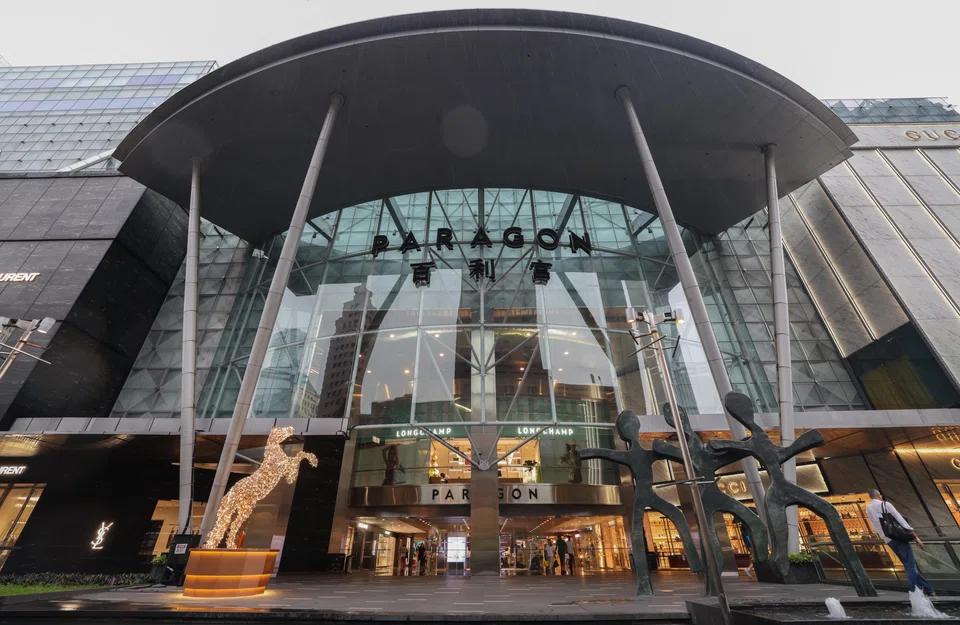
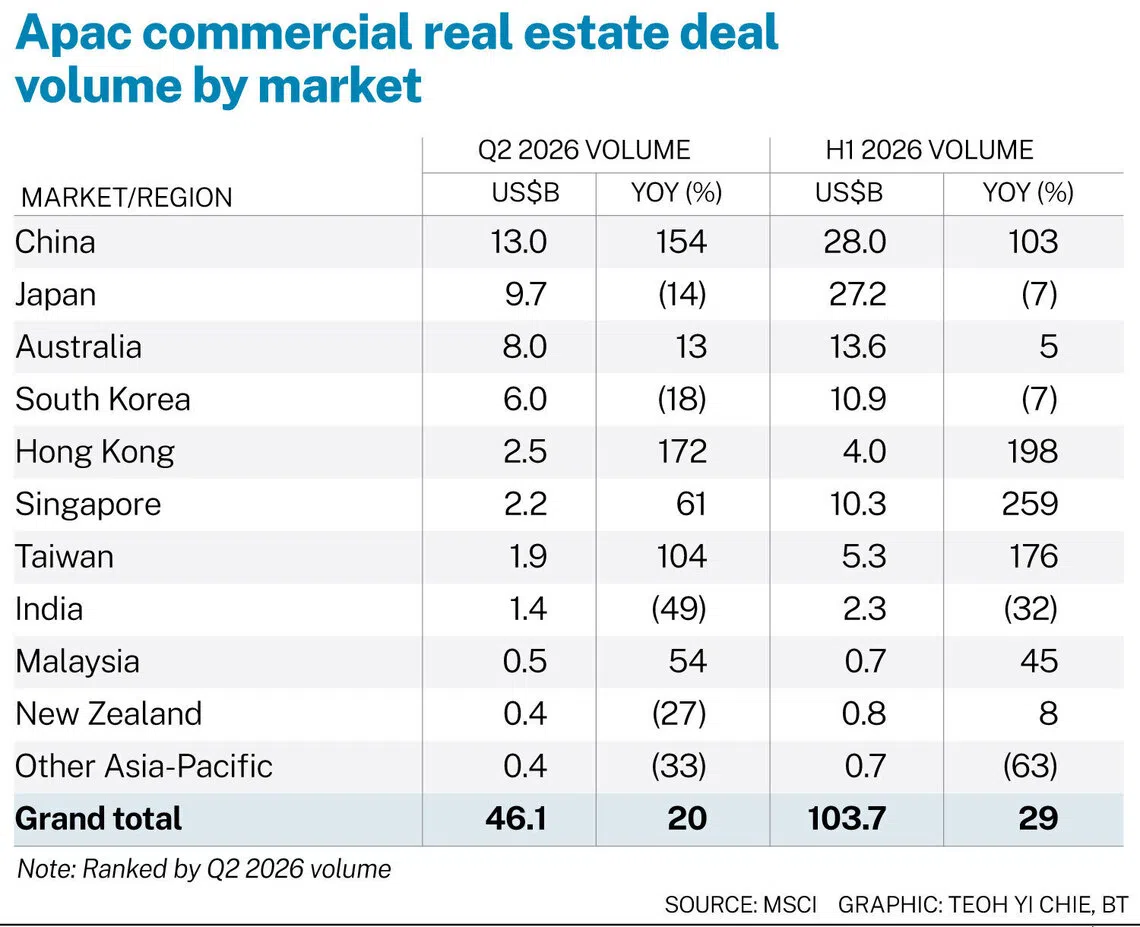
[SINGAPORE] Singapore’s commercial real estate market is on track for a record year, with US$10.3 billion of deals completed in the first half of 2026, said global index provider MSCI.
Another US$6 billion of transactions is in the pipeline, MSCI’s latest Asia Pacific Capital Trends quarterly report showed. If completed, the deals would push full-year volume past the previous record of US$13.1 billion set in 2019.
“Singapore’s recovery has been driven in large part by overseas capital, with global investors accounting for a significant share of activity in the city-state this year,” said Benjamin Chow, head of private assets research for Asia at MSCI.
The recovery in Singapore is part of a broader rebound across the Asia-Pacific.
According to JLL, regional transaction volume in H1 2026 – at US$92.5 billion – was the strongest first-half showing on record.
“Rental growth prospects across nearly all major markets and sectors are very compelling, driven by a lack of supply and rising replacement costs,” said Stuart Crow, CEO of Asia-Pacific capital markets at JLL.
The scale of dealmaking in the quarter showed that “capital remains abundant”, he added.
Retail leads regional recovery
Retail transaction volume more than doubled year on year to US$11.9 billion in the second quarter, making it the strongest-performing sector across the Asia-Pacific, MSCI said.
The sector saw major deals in Singapore and China. These included CapitaLand Integrated Commercial Trust’s (CICT) purchase of Paragon and China Resources’ US$2 billion sale of Chengdu MixC, a major shopping mall in Chengdu.


Retail yields tightened further in Australia, Japan and Singapore, with Hong Kong joining the trend in early 2026.
Office and industrial activity also gained ground, supported by improving leasing fundamentals and transaction yields that held largely stable.
Based on MSCI data, office transaction volume rose 13 per cent year on year to US$15.7 billion in Q2, taking the H1 volume to US$39.4 billion, up 28 per cent. Industrial deals climbed 28 per cent to US$9.7 billion.
Office transaction volumes also picked up in Singapore, Hong Kong and Shanghai, while Seoul, Sydney and Tokyo experienced modest office yield compression.
Knight Frank highlighted hotels as another bright spot, with investment rising 55.2 per cent year on year to US$5.4 billion in Q2, its latest Asia-Pacific Capital Markets Insights report showed.
The property consultancy attributed the growth to tourism recovery, improving operating performance and limited supply of quality assets.
Data-centre investment was a notable exception, with acquisition volume falling 37 per cent year on year to US$2.1 billion in Q2, MSCI said.
The decline largely reflected the absence of platform deals closing during the quarter, while asset-level activity remained plentiful.
Cross-border capital gains traction
Cross-border deal volume jumped 38 per cent in Q2, MSCI said, with global and regional investors making roughly equal contributions.
The report noted that the US$70.3 billion deployed over the past year was just shy of the pre-2025 peak of US$71 billion set in 2019. Such deals made up 32 per cent of all activity at the end of June 2026, against the historical average of 28 per cent.
Investors continued to plough money into Asia-Pacific assets, with MSCI attributing this to allocations towards Japan and growing investor appetite for the region more broadly.
Among the major deals signed in Singapore was the sale of Asia Square Tower 2 in Marina Bay by CICT to Malaysia-listed IOI Properties Group for S$2.48 billion.
CICT will use the proceeds to fund part of its S$3.9 billion purchase of Paragon, the freehold Orchard Road development comprising retail, office and medical suites, from Cuscaden Peak. The remaining amount will come from debt and a private placement.
However, not all foreign money in the region is buying. MSCI said overseas investors sold more than US$11 billion of assets in China in H1, accounting for about 40 per cent of activity in the country and marking the highest level since late 2021.
Separately, fund managers are increasingly turning to recapitalisations rather than outright asset sales, MSCI said, as they balance investors seeking a return of capital with those looking to extend their holding periods.
The recovery comes even as borrowing costs trend upwards.
Japan and Australia raised policy rates in Q2, and South Korea followed with a 25-basis-point increase in July.
Still, investors remain attracted by rental growth prospects across many major markets and sectors. Where that capital is going has shifted, however.
“Investors are pivoting towards sectors with strong structural demand, such as data centres in Japan and logistics in Australia, or targeting assets that offer immediate yield stabilisation, like Hong Kong’s recovering offices,” said Pamela Ambler, JLL’s head of investor intelligence for the Asia-Pacific.
Knight Frank also expects the next leg to be selective. “Liquidity is concentrating around quality assets, clearer pricing and large-scale execution opportunities,” said Christine Li, its Asia-Pacific head of research.
“Prime office, selected retail, logistics and tourism-linked hotel assets should stay in focus.”
Decoding Asia newsletter: your guide to navigating Asia in a new global order. Sign up here to get Decoding Asia newsletter. Delivered to your inbox. Free.
Copyright SPH Media. All rights reserved.
TRENDING NOW

Malaysian king buys stake in Singapore-listed mining firm expanding into rare earths

Grab CEO’s wife Chloe Tong on life with Anthony Tan and finding her purpose

Once staunchly pro-China, Malaysian Chinese businesses are now distancing themselves from Beijing
Longer wait times expected as S’pore healthcare institutions report system disruptions

